
X12 transaction guide · Finance
EDI 828 Debit Authorization
The X12 document a paying entity uses to tell its bank which debits it has authorized against its account.
- Sent by
- Paying company (account holder)
- Received by
- Its financial institution
- Standard
- ANSI ASC X12
What is an EDI 828?
The EDI 828 Debit Authorization is the ANSI X12 transaction set used to provide information from the paying entity to its financial institution about debits it has authorized against its account. The financial institution holds this information to check incoming debits against it.
Companies protect their accounts from unauthorized direct debits with debit filters or blocks. The 828 lets them maintain the list of authorized debit originators and limits electronically, so legitimate debits from tax authorities or suppliers pass while others are rejected.
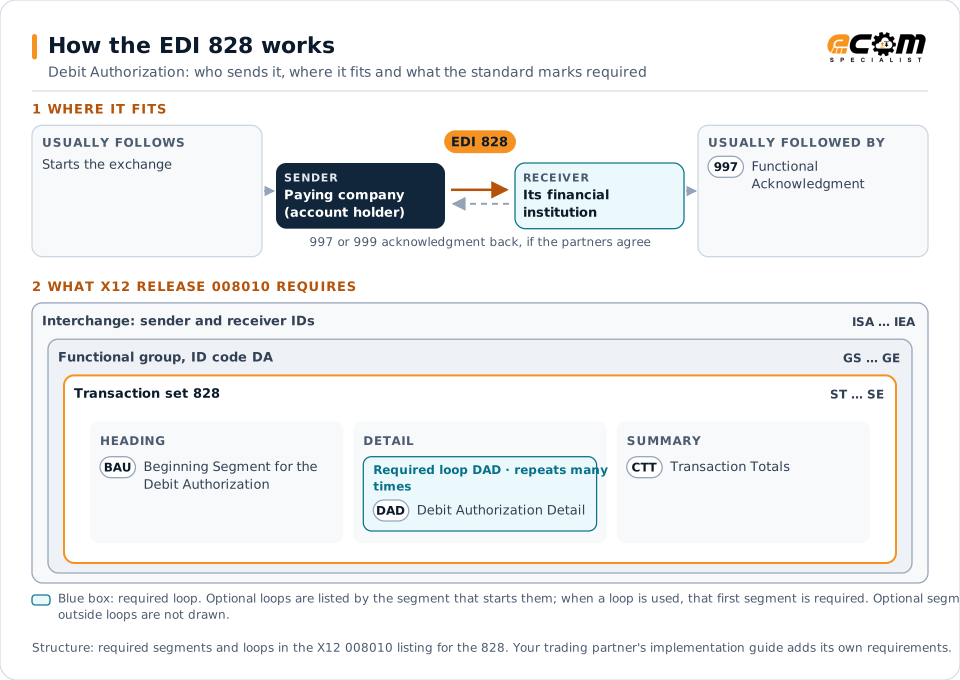
How to read this diagram: the top row shows who sends the 828, to whom, and which documents usually come before and after it. The lower part shows what X12 release 008010 itself requires: the envelopes around the 828 and the segments and loops the standard marks as required, area by area. Optional loops are listed by the segment that starts them rather than drawn in full. This is the standard's minimum, not a trading partner's requirement: each partner's implementation guide usually makes some optional loops mandatory, restricts the codes and may use a different release.
When it is used
- Authorizing a new debit originator
- Setting maximum amounts for authorized debits
- Removing authorizations no longer needed
Where it fits in the document flow
Structure
Mandatory segments in the 828 (X12 release 008010)
The segments X12 release 008010 marks as mandatory at their level, in order. Segments inside optional loops are needed only when the loop is used. This is the standard's requirement, not your trading partner's: each partner's implementation guide names the release it uses, adds the optional segments it requires and restricts the values. The requirement status comes from one published X12 reference listing and has not been checked against a second source.
- ST
- BAU
- DAD
- CTT
- SE
Practical example
The 828 in practice
A company's account has a debit block, but its fuel card provider collects payment by direct debit. The company sends its bank an 828 authorizing debits from the provider's originator ID up to a monthly limit. The bank allows those debits and continues to reject others.
Implementation
Implementation considerations for the 828
- Keep the list of authorized originators current.
- Set amount limits that match expected debits.
- Review authorizations periodically and remove old ones.
- Coordinate with accounts payable before new direct debits start.
How ECOM helps
Automate the 828 with ECOM
Solution
Financial Document Automation
Automate invoices, remittances, payment files and bank statements from capture to posting.
Industry
Financial Services
Secure file transfer and B2B integration for banks and financial institutions.
Solution
Procure-to-Pay Automation
Automate purchasing, receiving and supplier invoicing across EDI, portals and documents.
More general questions about EDI are answered in the EDI FAQ.
Related transactions
Related finance documents
- 820Payment Order/Remittance Advice
- 135Student Aid Origination Record
- 139Student Loan Guarantee Result
- 144Student Loan Transfer and Status Verification
- 155Business Credit Report
- 191Student Loan Pre-Claims and Claims
- 197Real Estate Title Evidence
- 198Loan Verification Information
- 199Real Estate Settlement Information
- 200Mortgage Credit Report
- 201Residential Loan Application
- 202Secondary Mortgage Market Loan Delivery
Need help with the EDI 828?
ECOM maps, tests and monitors X12 documents for your trading partners and integrates them with your ERP.