
The short answer
EDI (electronic data interchange) is the computer-to-computer exchange of business documents, such as purchase orders, ship notices and invoices, in a standard format that both trading partners' systems can process automatically. It replaces paper, email and manual data entry with structured documents that flow directly into business systems like ERP.
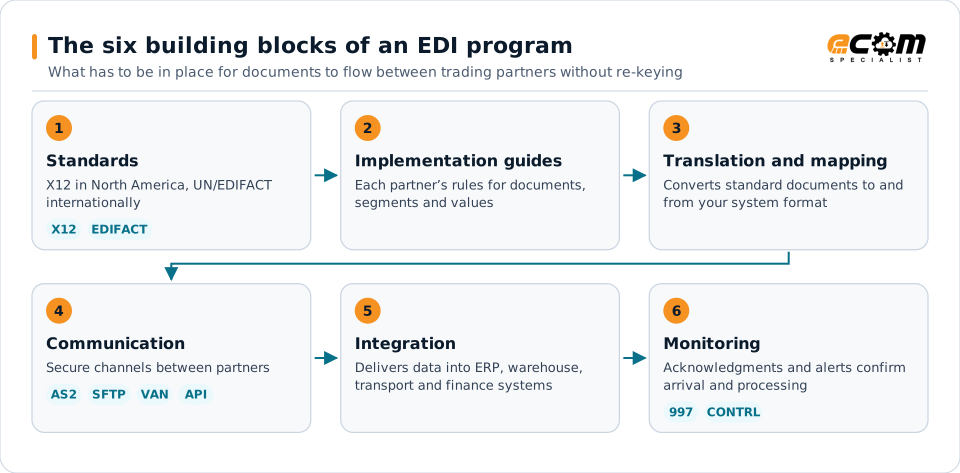
The six blocks match the list in this article. Standards and partner guides define what a document must contain; translation, communication and integration move it from one business system to another; monitoring proves that it arrived and was processed.
What EDI means in practice
Every business relationship generates documents. A buyer issues a purchase order, the supplier confirms it, ships the goods with a packing list, and sends an invoice. The buyer pays and explains the payment. When these documents travel as paper, PDFs or emails, someone on each side has to read them and type the information into a system.
Electronic data interchange removes that manual step. Instead of a document a person reads, each party sends a structured electronic file that the other party’s systems can interpret directly. A purchase order from a retailer becomes a sales order in the supplier’s ERP without anyone re-keying it. The supplier’s shipment confirmation becomes a ship notice the retailer’s warehouse system uses to plan receiving.
Why trading partners require EDI
Large organizations exchange thousands or millions of documents a year with thousands of trading partners. Processing them manually would be slow, expensive and error-prone. EDI gives them:
- Speed. Documents arrive and are processed in minutes rather than days.
- Accuracy. Data is not re-keyed, so typing errors disappear and validation catches problems early.
- Scale. The same processes work for ten partners or ten thousand.
- Visibility. Every document is tracked, so both sides know what was sent, received and acknowledged.
That is why many retailers, manufacturers and carriers make EDI a condition of doing business, and why suppliers often first encounter EDI as a customer requirement.
The building blocks of EDI
An EDI program has a few core components:
- Standards. Documents follow published standards so both sides agree on structure. In North America the dominant standard is ANSI ASC X12; internationally, UN/EDIFACT is widely used. See X12 vs EDIFACT.
- Implementation guides. Each trading partner publishes rules describing which documents, segments and values it requires.
- Translation and mapping. EDI software converts standard documents to and from the format your business systems use.
- Communication. Documents travel over secure channels such as AS2, SFTP, APIs or a value-added network. See EDI VAN vs AS2.
- Integration. Translated data is delivered into ERP, warehouse, transportation and finance systems.
- Monitoring. Acknowledgments and alerts confirm that documents arrived and were processed.
Common EDI documents
A handful of documents cover most supply chain relationships:
| Document | X12 code | Purpose |
|---|---|---|
| Purchase order | 850 | Buyer orders goods |
| Order acknowledgment | 855 | Supplier confirms the order |
| Advance ship notice | 856 | Supplier describes the shipment |
| Invoice | 810 | Supplier bills the buyer |
| Remittance advice | 820 | Buyer explains the payment |
| Functional acknowledgment | 997 | Receiver confirms receipt |
Logistics, warehousing, manufacturing and healthcare each add their own documents. The X12 reference lists the most common sets by business process.
EDI and APIs
APIs are increasingly common for real-time data exchange, such as tracking updates or marketplace orders. They complement EDI rather than replacing it: most large trading partners still require EDI for core order, shipment and invoice documents. Many organizations now run both through one integration platform. See EDI vs API.
Ways to get started
Organizations typically choose one of three approaches:
- Web EDI for a small number of partners and low volumes, using a browser instead of software.
- Integrated EDI that connects partners directly to the ERP, either on a platform the company runs or as a managed service.
- Outsourced or team-based models where specialists run the EDI operation, fully or alongside internal staff.
The right choice depends on volumes, the number of partners, internal skills and how tightly EDI needs to connect with business systems.
For short answers to the questions teams ask most often, such as why customers require EDI and which documents are most common, see the EDI FAQ.