
Learning Center
EDI frequently asked questions
Straight answers to the questions we hear most from business and IT teams starting or improving EDI programs.
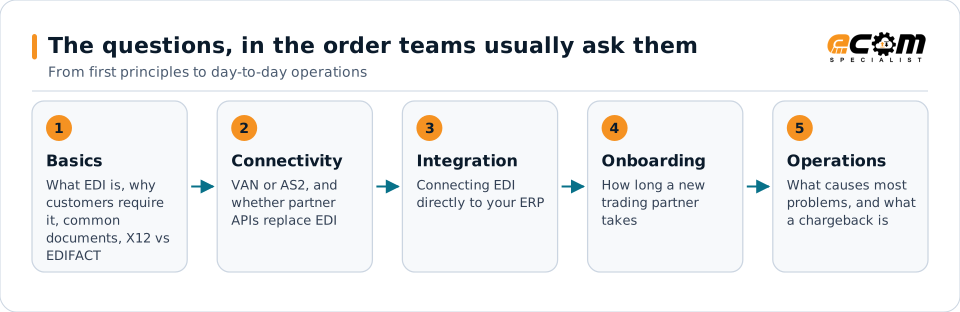
The questions on this page are grouped the same way. Jump to the stage you are at.
EDI basics
What is EDI?
EDI (electronic data interchange) is the computer-to-computer exchange of business documents, such as purchase orders and invoices, in a standard format that trading partners can process automatically.
Why do customers require EDI?
Large retailers, manufacturers and carriers exchange huge volumes of documents. EDI lets them process orders, shipments and invoices quickly and accurately across thousands of partners.
What are the most common EDI documents?
In X12, the most common are the 850 purchase order, 855 acknowledgment, 856 ship notice, 810 invoice, 820 remittance and 997 functional acknowledgment.
What is the difference between X12 and EDIFACT?
X12 is the dominant EDI standard in North America and numbers its documents, such as 850. EDIFACT is the international UN standard used widely in Europe and Asia and names its messages, such as ORDERS.
Connectivity and integration
What is the difference between a VAN and AS2?
A VAN is a third-party mailbox network that delivers documents between partners, usually charging by volume. AS2 sends documents directly and securely over the internet with signed receipts and no per-document network fees.
Can EDI connect directly to our ERP?
Yes. Integrated EDI translates partner documents into ERP transactions, such as sales orders, and generates outbound documents from ERP data, using APIs, IDocs, files or connectors.
Do we need EDI if our partners offer APIs?
Often both. Many partners still require EDI for core documents, while APIs are useful for real-time data such as tracking and inventory. A single platform can run both.
How long does it take to connect a new trading partner?
It depends on the partner's requirements, testing process and how much existing work can be reused. Simple setups can be quick, while complex programs with certification take longer.
Operations and support
What causes most EDI problems?
Common causes include missing item or location cross-references, maps that do not follow a partner's current guide, late documents, and failures nobody notices because acknowledgments are not monitored.
What is a chargeback?
A chargeback is a deduction a retailer applies when a supplier does not meet requirements, such as sending late or inaccurate ship notices or incorrect carton labels.
Should we run EDI in-house or outsource it?
It depends on your skills, volumes and need for control. Options range from running a platform yourself to EDI Team as a Service, where specialists work alongside you, to fully managed EDI.
Can EDI run in the cloud, on premises or both?
Yes. EDI can run as cloud iPaaS or SaaS, in a private cloud, on premises, or in a hybrid model that combines cloud connectivity with on-premises systems.
Talk to an integration expert
Tell us about your partners, systems and goals. We will show you how PRISM and our team can help.