
X12 transaction guide · Finance
EDI 820 Payment Order/Remittance Advice
The X12 document that explains a payment, listing the invoices paid, amounts and any deductions, and in some cases instructs a bank to pay.
- Sent by
- Payer (buyer) or its bank
- Received by
- Payee (supplier) or bank
- Standard
- ANSI ASC X12
- EDIFACT equivalent
- REMADV (remittance) / PAYORD (payment order)
What is an EDI 820?
The EDI 820 Payment Order/Remittance Advice is the ANSI X12 transaction set used to communicate payment information. As a remittance advice, a buyer sends it to a supplier to explain which invoices a payment covers, the amounts paid and any deductions or adjustments. As a payment order, a company can send it to its bank with instructions to make the payment.
For suppliers, the 820 is the key input to cash application. Payments often arrive separately from the remittance detail and frequently cover many invoices at once, so matching 820 data to open receivables automatically saves considerable manual effort.
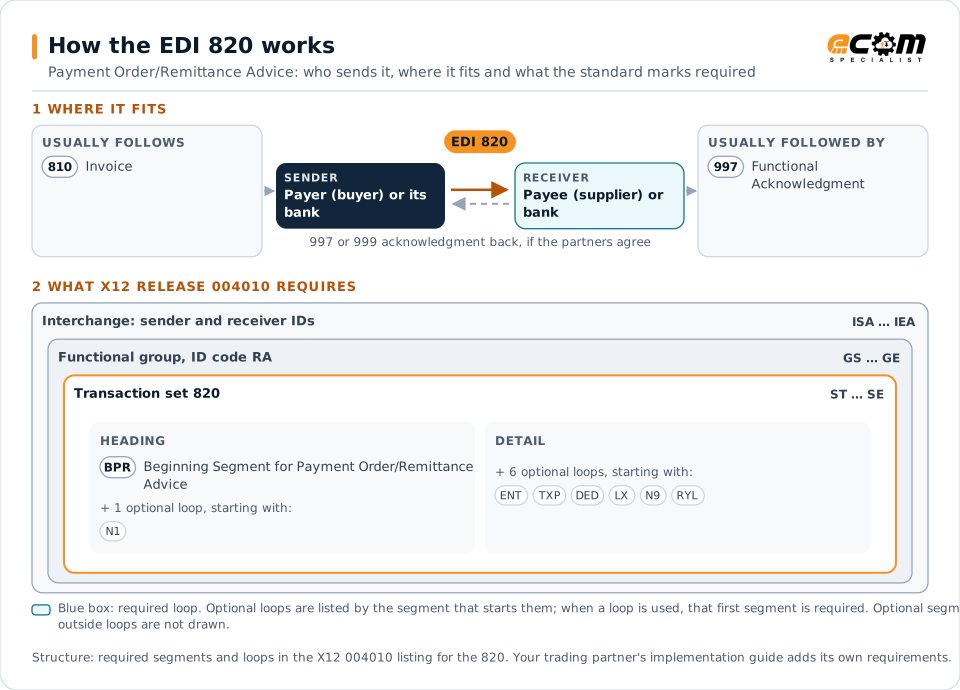
How to read this diagram: the top row shows who sends the 820, to whom, and which documents usually come before and after it. The lower part shows what X12 release 004010 itself requires: the envelopes around the 820 and the segments and loops the standard marks as required, area by area. Optional loops are listed by the segment that starts them rather than drawn in full. This is the standard's minimum, not a trading partner's requirement: each partner's implementation guide usually makes some optional loops mandatory, restricts the codes and may use a different release.
When it is used
- Retailers explaining payments and deductions to suppliers
- Companies sending payment instructions with remittance detail to their banks
- Carriers and 3PLs receiving payment details for freight invoices
- Automating cash application against open invoices
Where it fits in the document flow
Structure
Key segments in the 820
The segments most implementations use, described in plain language. The last column shows what X12 release 004010 itself requires: "Required" marks a segment the standard requires in every 820; "Optional, common" marks a segment the standard leaves optional, or that sits in an optional loop, but that implementations often use. This is the standard's requirement, not your trading partner's: each partner's implementation guide names the release it uses, makes some optional segments mandatory and restricts the values, and requirements can differ between releases. The requirement status comes from one published X12 reference listing and has not been checked against a second source.
| Segment | Name | What it carries | In X12 004010 |
|---|---|---|---|
| BPR | Beginning Segment for Payment Order/Remittance Advice | Payment amount, payment method, bank and account details, and payment date. | Required |
| TRN | Trace | Trace number that links the remittance to the payment. | Optional, common |
| N1 loop | Party Identification | Payer and payee names and identifiers. | Optional, common |
| ENT | Entity | Groups remittance detail by entity, such as a payee account. | Optional, common |
| RMR | Remittance Advice Accounts Receivable Open Item Reference | Each invoice paid with the amount paid and, where applicable, the original and discount amounts. | Optional, common |
| ADX | Adjustment | Deductions or adjustments with reason codes. | Optional, common |
Example
Sample EDI 820
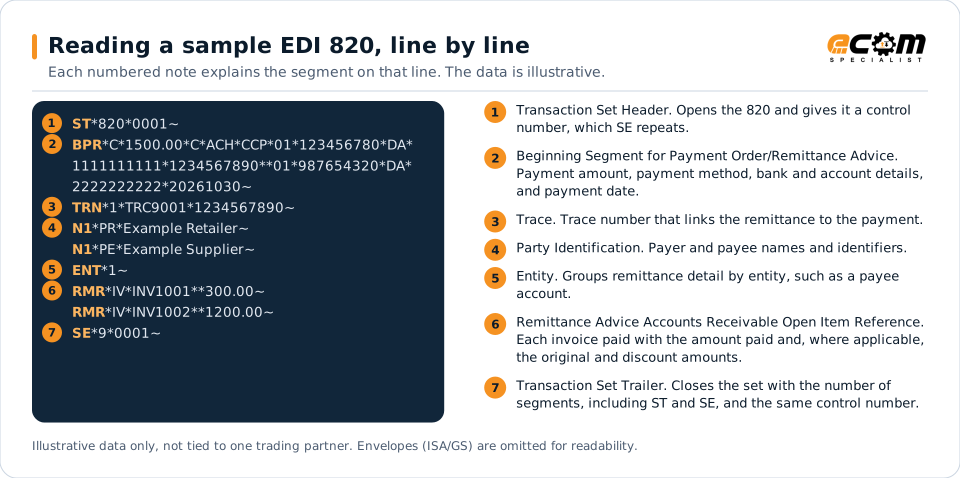
A 1,500.00 ACH payment with remittance detail covering two invoices. BPR carries the amount, method and fictional bank details, TRN the trace number, and each RMR an invoice paid.
Illustrative data only, not tied to one X12 release or trading partner. The interchange (ISA/IEA) and functional group (GS/GE) envelopes are omitted for readability.
ST*820*0001~
BPR*C*1500.00*C*ACH*CCP*01*123456780*DA*1111111111*1234567890**01*987654320*DA*2222222222*20261030~
TRN*1*TRC9001*1234567890~
N1*PR*Example Retailer~
N1*PE*Example Supplier~
ENT*1~
RMR*IV*INV1001**300.00~
RMR*IV*INV1002**1200.00~
SE*9*0001~The sample is the same one shown above, with a note beside each segment the first time it appears. Segment IDs are highlighted at the start of each line; the fields after them are separated by asterisks, and each segment ends with a tilde.
Avoid problems
Common 820 errors and how to prevent them
Remittance not linked to payment
Without the trace number, remittance detail cannot be matched to the bank deposit it explains.
Deductions ignored
Adjustments with reason codes should flow into deduction management, not be written off automatically.
Invoice numbers reformatted
Buyers sometimes truncate or reformat invoice numbers. Matching logic should handle common variations.
Trading partners
Integration guides that include the 820







How ECOM helps
Automate the 820 with ECOM
Solution
Procure-to-Pay Automation
Automate purchasing, receiving and supplier invoicing across EDI, portals and documents.
Solution
Financial Document Automation
Automate invoices, remittances, payment files and bank statements from capture to posting.
Industry
Financial Services
Secure file transfer and B2B integration for banks and financial institutions.
EDI 820 FAQs
What is an EDI 820 used for?
It explains a payment, listing the invoices paid, amounts and deductions, and can also serve as a payment instruction to a bank.
Does the 820 move money?
When used as a payment order sent to a bank, it can instruct payment. As a remittance advice between trading partners, it only describes a payment made separately.
How does an 820 help cash application?
It provides the invoice-level detail needed to apply a payment to open receivables automatically.
More general questions about EDI are answered in the EDI FAQ.
Related transactions
Related finance documents
- 829Payment Cancellation Request
- 827Financial Return Notice
- 810Invoice
- 880Grocery Products Invoice
- 110Air Freight Details and Invoice
- 223Consolidators Freight Bill and Invoice
- 224Motor Carrier Summary Freight Bill Manifest
- 412Trailer or Container Repair Billing
- 811Consolidated Service Invoice/Statement
- 812Credit/Debit Adjustment
- 819Joint Interest Billing and Operating Expense Statement
- 859Freight Invoice
Need help with the EDI 820?
ECOM maps, tests and monitors X12 documents for your trading partners and integrates them with your ERP.