
X12 transaction guide · Finance
EDI 812 Credit/Debit Adjustment
The X12 document trading partners use to notify each other of, or request, credits, debits and billbacks for goods or services.
- Sent by
- Either trading partner
- Received by
- Either trading partner
- Standard
- ANSI ASC X12
What is an EDI 812?
The EDI 812 Credit/Debit Adjustment is the ANSI X12 transaction set used to notify a trading partner of an adjustment or billback, or to request one. It identifies the exceptions, adjustments, credits or debits involved and the amounts, and it can travel in either direction between buyer and seller.
Retailers often use the 812 to explain deductions they take from payments, such as shortages, pricing differences or compliance charges. Suppliers use it to issue credits or to bill for differences. Linking 812 detail to the original invoices and orders is essential for resolving deductions.
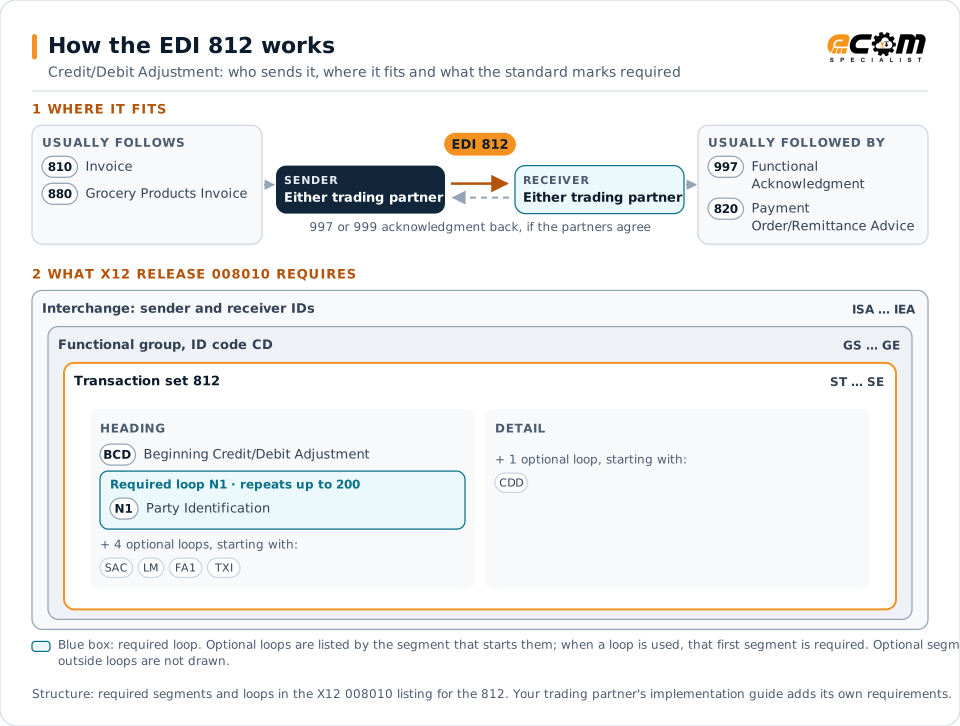
How to read this diagram: the top row shows who sends the 812, to whom, and which documents usually come before and after it. The lower part shows what X12 release 008010 itself requires: the envelopes around the 812 and the segments and loops the standard marks as required, area by area. Optional loops are listed by the segment that starts them rather than drawn in full. This is the standard's minimum, not a trading partner's requirement: each partner's implementation guide usually makes some optional loops mandatory, restricts the codes and may use a different release.
When it is used
- Explaining deductions for shortages or pricing errors
- Issuing credits for returns or allowances
- Billing back promotional or compliance charges
Where it fits in the document flow
Structure
Mandatory segments in the 812 (X12 release 008010)
The segments X12 release 008010 marks as mandatory at their level, in order. Segments inside optional loops are needed only when the loop is used. This is the standard's requirement, not your trading partner's: each partner's implementation guide names the release it uses, adds the optional segments it requires and restricts the values. The requirement status comes from one published X12 reference listing and has not been checked against a second source.
- ST
- BCD
- SAC
- N1
- LM
- LQ
- FA1
- FA2
- TXI
- CDD
- N11
- SE
Practical example
The 812 in practice
A retailer receives fewer units than it was invoiced for. Instead of paying the full invoice, it sends the supplier an 812 debit for the shortage, referencing the invoice and purchase order. The supplier's deduction team matches the 812 to the receiving advice, confirms the shortage and closes the item without a dispute.
Implementation
Implementation considerations for the 812
- Carry the original invoice and purchase order references on every adjustment.
- Use coded reasons so deductions can be sorted and resolved automatically.
- Agree which partner sends 812s and in which direction, because the same transaction set covers credits and debits.
Trading partners
Integration guides that include the 812

How ECOM helps
Automate the 812 with ECOM
Solution
Financial Document Automation
Automate invoices, remittances, payment files and bank statements from capture to posting.
Industry
Retail
Retail and eCommerce EDI for suppliers and retailers, from purchase order to payment, with compliance built in.
Solution
Order-to-Cash Automation
Automate the flow from purchase order to payment across every customer channel.
More general questions about EDI are answered in the EDI FAQ.
Related transactions
Related finance documents
- 810Invoice
- 820Payment Order/Remittance Advice
- 880Grocery Products Invoice
- 223Consolidators Freight Bill and Invoice
- 290Cooperative Advertising Agreements
- 818Commission Sales Report
- 822Account Analysis
- 881Manufacturer Coupon Redemption Detail
- 882Direct Store Delivery Summary Information
- 884Market Development Fund Settlement
- 891Deduction Research Report
- 155Business Credit Report
Need help with the EDI 812?
ECOM maps, tests and monitors X12 documents for your trading partners and integrates them with your ERP.