
X12 transaction guide · Finance
EDI 822 Account Analysis
The X12 document banks use to send corporate clients detailed balance, service charge and adjustment information, typically monthly.
- Sent by
- Bank
- Received by
- Corporate client
- Standard
- ANSI ASC X12
What is an EDI 822?
The EDI 822 Account Analysis is the ANSI X12 transaction set used to transmit detailed balance, service charge and adjustment information, primarily from a bank to its corporate clients. It can also be used between or within corporations.
Banks charge companies for services such as wire transfers, lockbox processing and account maintenance, often offset by an earnings credit on balances. The account analysis statement shows the volumes and price of each service and the resulting fees, so treasury teams can verify charges and compare banks.
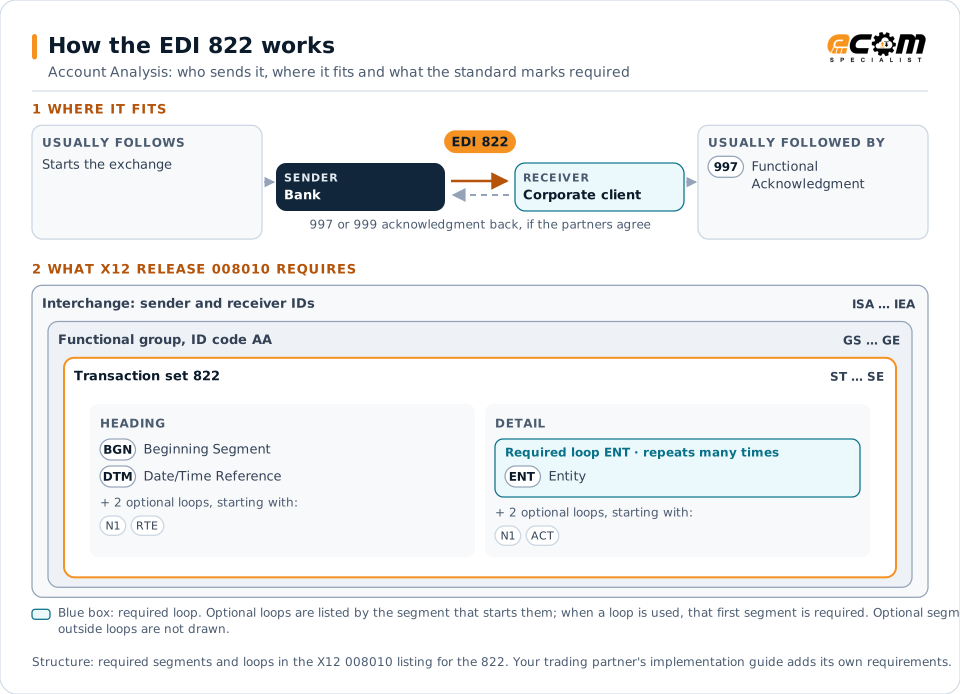
How to read this diagram: the top row shows who sends the 822, to whom, and which documents usually come before and after it. The lower part shows what X12 release 008010 itself requires: the envelopes around the 822 and the segments and loops the standard marks as required, area by area. Optional loops are listed by the segment that starts them rather than drawn in full. This is the standard's minimum, not a trading partner's requirement: each partner's implementation guide usually makes some optional loops mandatory, restricts the codes and may use a different release.
When it is used
- Receiving monthly bank fee statements
- Auditing service charges against pricing agreements
- Comparing bank costs across relationships
Where it fits in the document flow
Structure
Mandatory segments in the 822 (X12 release 008010)
The segments X12 release 008010 marks as mandatory at their level, in order. Segments inside optional loops are needed only when the loop is used. This is the standard's requirement, not your trading partner's: each partner's implementation guide names the release it uses, adds the optional segments it requires and restricts the values. The requirement status comes from one published X12 reference listing and has not been checked against a second source.
- ST
- BGN
- DTM
- N1
- RTE
- ENT
- ACT
- LX
- BLN
- SER
- SE
Practical example
The 822 in practice
A retailer uses three banks for collections and payments. Each month the banks send an 822 listing each service, the volume, unit price, total charge and the earnings credit on balances. The retailer's treasury team loads the statements into a fee analysis tool and finds a lockbox charge billed above the agreed price.
Implementation
Implementation considerations for the 822
- Use standard service codes so analyses can be compared across banks.
- Reconcile charges with negotiated pricing schedules.
- Track volumes to confirm they match actual activity.
- Agree the delivery schedule and format with each bank.
How ECOM helps
Automate the 822 with ECOM
Solution
Financial Document Automation
Automate invoices, remittances, payment files and bank statements from capture to posting.
Industry
Financial Services
Secure file transfer and B2B integration for banks and financial institutions.
Industry
Retail
Retail and eCommerce EDI for suppliers and retailers, from purchase order to payment, with compliance built in.
More general questions about EDI are answered in the EDI FAQ.
Related transactions
Related finance documents
- 248Account Assignment/Inquiry and Service/Status
- 820Payment Order/Remittance Advice
- 135Student Aid Origination Record
- 139Student Loan Guarantee Result
- 144Student Loan Transfer and Status Verification
- 155Business Credit Report
- 191Student Loan Pre-Claims and Claims
- 197Real Estate Title Evidence
- 198Loan Verification Information
- 199Real Estate Settlement Information
- 200Mortgage Credit Report
- 201Residential Loan Application
Need help with the EDI 822?
ECOM maps, tests and monitors X12 documents for your trading partners and integrates them with your ERP.