
X12 transaction guide · Finance
EDI 290 Cooperative Advertising Agreements
The X12 document used to initiate, review and conclude cooperative advertising agreements, used iteratively between partners.
- Sent by
- Retailer or manufacturer
- Received by
- Manufacturer or retailer
- Standard
- ANSI ASC X12
What is an EDI 290?
The EDI 290 Cooperative Advertising Agreements is the ANSI X12 transaction set used to initiate, review and conclude a cooperative advertising agreement. It is designed to be used iteratively, for example to request advertising support, provide guidelines and confirm agreements.
In co-op advertising, a manufacturer funds part of a retailer's advertising that features its products. The agreement sets the eligible products, media, funding percentages and proof requirements, and later claims are paid against it. Claims for funds earned under an agreement follow after the advertising has run.
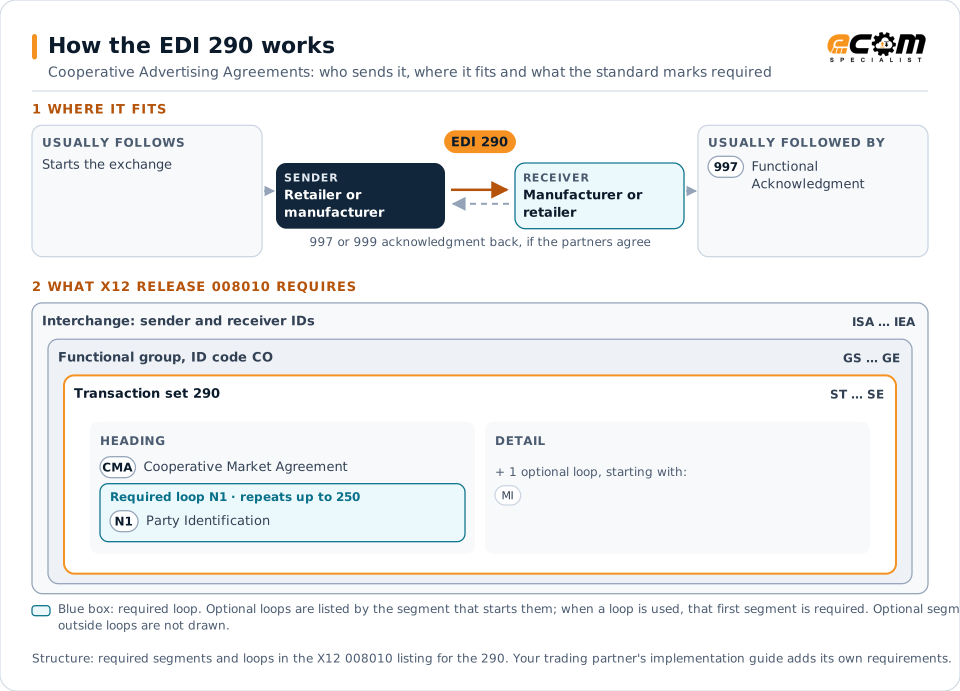
How to read this diagram: the top row shows who sends the 290, to whom, and which documents usually come before and after it. The lower part shows what X12 release 008010 itself requires: the envelopes around the 290 and the segments and loops the standard marks as required, area by area. Optional loops are listed by the segment that starts them rather than drawn in full. This is the standard's minimum, not a trading partner's requirement: each partner's implementation guide usually makes some optional loops mandatory, restricts the codes and may use a different release.
When it is used
- Requesting co-op advertising support
- Providing co-op program guidelines
- Confirming agreed co-op terms
Where it fits in the document flow
Structure
Mandatory segments in the 290 (X12 release 008010)
The segments X12 release 008010 marks as mandatory at their level, in order. Segments inside optional loops are needed only when the loop is used. This is the standard's requirement, not your trading partner's: each partner's implementation guide names the release it uses, adds the optional segments it requires and restricts the values. The requirement status comes from one published X12 reference listing and has not been checked against a second source.
- ST
- CMA
- N1
- MI
- SE
Practical example
The 290 in practice
A home appliance retailer plans a spring advertising campaign. It sends a manufacturer a 290 requesting co-op support for ads featuring the manufacturer's products. The manufacturer replies with its guidelines and the funding it offers, and the two confirm the agreement before the ads run.
Implementation
Implementation considerations for the 290
- Agree the proof of performance needed for claims.
- Track agreed funding against the claims made.
- Use program identifiers both parties reference.
- Respect the iterative flow of request, review and confirmation.
How ECOM helps
Automate the 290 with ECOM
Industry
Retail
Retail and eCommerce EDI for suppliers and retailers, from purchase order to payment, with compliance built in.
Industry
Consumer Goods
Retail, distributor, marketplace and direct-channel integration for consumer brands.
Solution
Financial Document Automation
Automate invoices, remittances, payment files and bank statements from capture to posting.
More general questions about EDI are answered in the EDI FAQ.
Related transactions
Related finance documents
Need help with the EDI 290?
ECOM maps, tests and monitors X12 documents for your trading partners and integrates them with your ERP.