
X12 transaction guide · Finance
EDI 819 Joint Interest Billing and Operating Expense Statement
The X12 document an asset operator uses to send periodic expense details to the co-owners of the asset, such as an oil and gas property.
- Sent by
- Operator of the jointly owned asset
- Received by
- Non-operating owners (working interest partners)
- Standard
- ANSI ASC X12
What is an EDI 819?
The EDI 819 Joint Interest Billing and Operating Expense Statement is the ANSI X12 transaction set used to transmit periodic expense details from the operator of an asset to the various owners of that asset, for example the operation of a petroleum lease or property with multiple owners.
In oil and gas, one company operates a well or lease on behalf of several working interest owners and bills each its share of the costs. The joint interest billing lists the expenses by category and property, and each partner's share, so partners can audit and record them without paper statements.
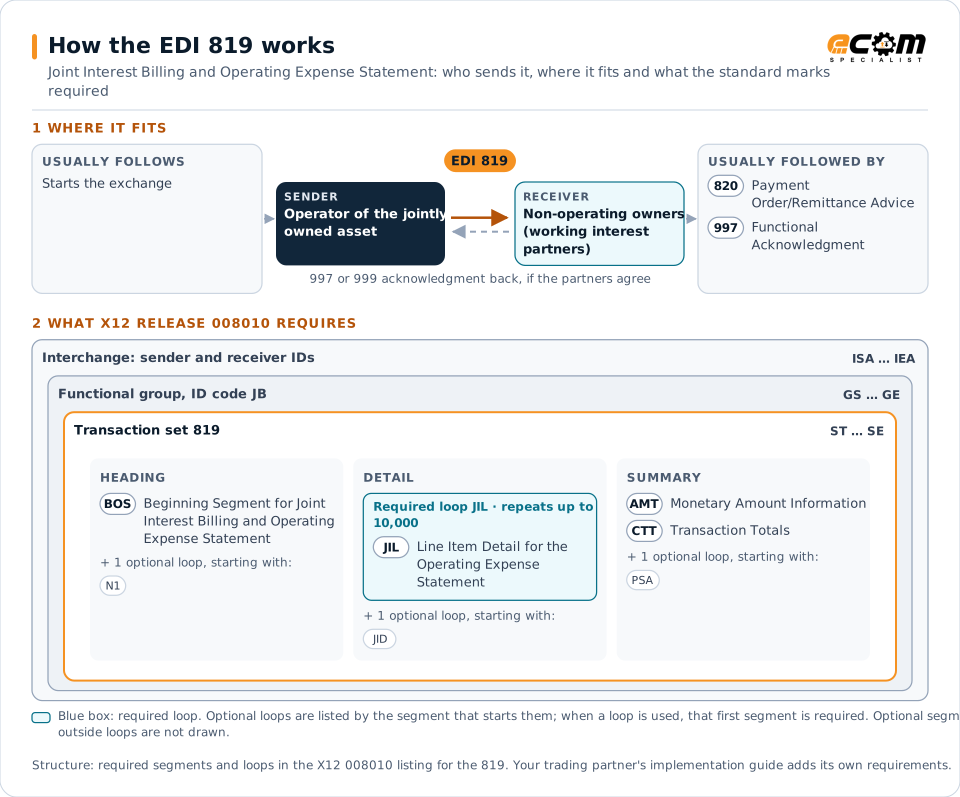
How to read this diagram: the top row shows who sends the 819, to whom, and which documents usually come before and after it. The lower part shows what X12 release 008010 itself requires: the envelopes around the 819 and the segments and loops the standard marks as required, area by area. Optional loops are listed by the segment that starts them rather than drawn in full. This is the standard's minimum, not a trading partner's requirement: each partner's implementation guide usually makes some optional loops mandatory, restricts the codes and may use a different release.
When it is used
- Billing partners for their share of operating costs
- Reporting capital and operating expenses by property
- Supporting joint venture audits
Where it fits in the document flow
Structure
Mandatory segments in the 819 (X12 release 008010)
The segments X12 release 008010 marks as mandatory at their level, in order. Segments inside optional loops are needed only when the loop is used. This is the standard's requirement, not your trading partner's: each partner's implementation guide names the release it uses, adds the optional segments it requires and restricts the values. The requirement status comes from one published X12 reference listing and has not been checked against a second source.
- ST
- BOS
- N1
- JIL
- JID
- AMT
- PSA
- CTT
- SE
Practical example
The 819 in practice
An operator runs a group of wells owned with three partners. Each month it sends each partner an 819 listing the drilling, lease operating and overhead costs by property, the partner's working interest percentage and the amount billed. The partners load the statements into their accounting systems and pay their shares.
Implementation
Implementation considerations for the 819
- Use expense categories consistent with the joint operating agreement.
- Show each partner's interest percentage and calculation.
- Reconcile statements with property and partner master data.
- Support audits with detail that partners can trace.
How ECOM helps
Automate the 819 with ECOM
Solution
Financial Document Automation
Automate invoices, remittances, payment files and bank statements from capture to posting.
Industry
Manufacturing
Customer schedules, supplier connectivity and shipping integrated with the ERP for manufacturers.
Solution
EDI Integration
Exchange X12 and EDIFACT documents with partners and integrate them directly with your ERP.
More general questions about EDI are answered in the EDI FAQ.
Need help with the EDI 819?
ECOM maps, tests and monitors X12 documents for your trading partners and integrates them with your ERP.