
The short answer
A value-added network (VAN) is a third-party mailbox service that receives and delivers EDI documents between partners, usually charging by volume. AS2 is a protocol for sending documents directly and securely over the internet, with encryption, signatures and receipts, and no per-document network fees. Many companies use both, choosing per partner.
VAN vs AS2 at a glance
| Criteria | VAN | AS2 |
|---|---|---|
| How it works | Documents go to a provider's mailbox, which delivers them to the partner's mailbox | Documents go directly from your system to the partner's system over HTTPS |
| Cost model | Typically mailbox fees plus charges by document or volume | Software and certificate management; no per-document network fees |
| Setup per partner | Exchange mailbox IDs; the VAN handles connectivity | Exchange AS2 IDs, URLs and certificates with each partner |
| Delivery proof | Provider tracking and reports | Signed message disposition notifications (MDNs) |
| Best fit | Partners that require a VAN, or many low-volume partners | High-volume partners that support direct connections |
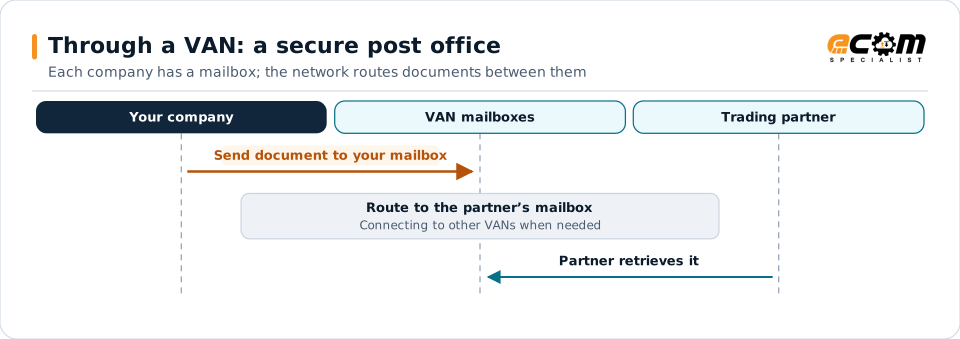
A VAN sits between the partners: one connection reaches many partners, and the provider handles routing. Pricing is often based on documents or characters sent.
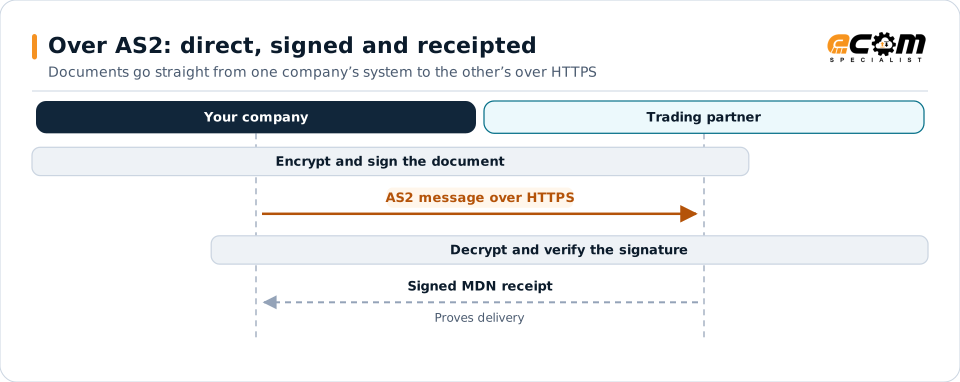
AS2 has no network in the middle and no per-document network fees. Each connection needs exchanged AS2 identifiers, endpoints and certificates, and certificates must be renewed before they expire.
The communication layer
Translating documents into EDI is only half the job. They also have to reach the trading partner reliably and securely. The main options are value-added networks, direct protocols such as AS2 and SFTP, and APIs.
How a VAN works
A value-added network acts like a secure post office. Each company has a mailbox with its VAN. You send documents to your mailbox, the VAN routes them to your partner’s mailbox (connecting to other VANs when needed), and your partner retrieves them.
Advantages:
- One connection reaches many partners.
- The provider handles connectivity, routing and often tracking.
- Some trading partners require a VAN.
Considerations:
- Pricing is often based on documents or characters sent, so costs grow with volume.
- Interconnection between VANs can add delay and troubleshooting steps.
How AS2 works
AS2 (Applicability Statement 2) sends documents directly between two companies’ systems over HTTPS. Each message is encrypted and digitally signed, and the receiver returns a signed receipt called a message disposition notification (MDN) that proves delivery.
Advantages:
- No per-document network fees.
- Near-real-time delivery.
- Strong security and proof of receipt.
Considerations:
- Each partner connection requires exchanging AS2 identifiers, endpoints and certificates.
- Certificates expire and must be renewed and coordinated with partners.
Other options: SFTP and APIs
- SFTP is widely supported and simple, but lacks AS2’s signed receipts. See AS2 vs SFTP.
- APIs suit real-time exchanges and partners with modern platforms, such as marketplaces and carriers.
Choosing per partner
Most organizations do not pick one method for everything. A typical approach:
- Use AS2 for high-volume partners that support it, to remove per-document costs.
- Keep a VAN for partners that require it or for many low-volume partners.
- Use SFTP or APIs where partners prefer them.
An integration platform that supports all of these lets you choose per partner without changing your internal processes, and monitors every channel in one place.