
EDIFACT message guide · Transport
MEQPOS Means of transport and equipment position
The UN/EDIFACT message that reports the position of a means of transport, such as a vessel or truck, or of related equipment.
- Sent by
- Carrier, vessel, truck or tracking provider
- Received by
- Shipper, forwarder, carrier or planner
- Standard
- UN/EDIFACT · Batch message
- X12 equivalent
- No direct equivalent
What is the EDIFACT MEQPOS message?
MEQPOS is the UN/EDIFACT means of transport and equipment position message. The directory defines it as a message containing the position of a means of transport, such as a vessel or truck, or of equipment related to a means of transport.
Position reports feed tracking and arrival estimates. Where status messages report business events such as departure or delivery, a position report gives the location of the vehicle or container at a moment, which can be used to calculate expected arrival or to monitor routes.
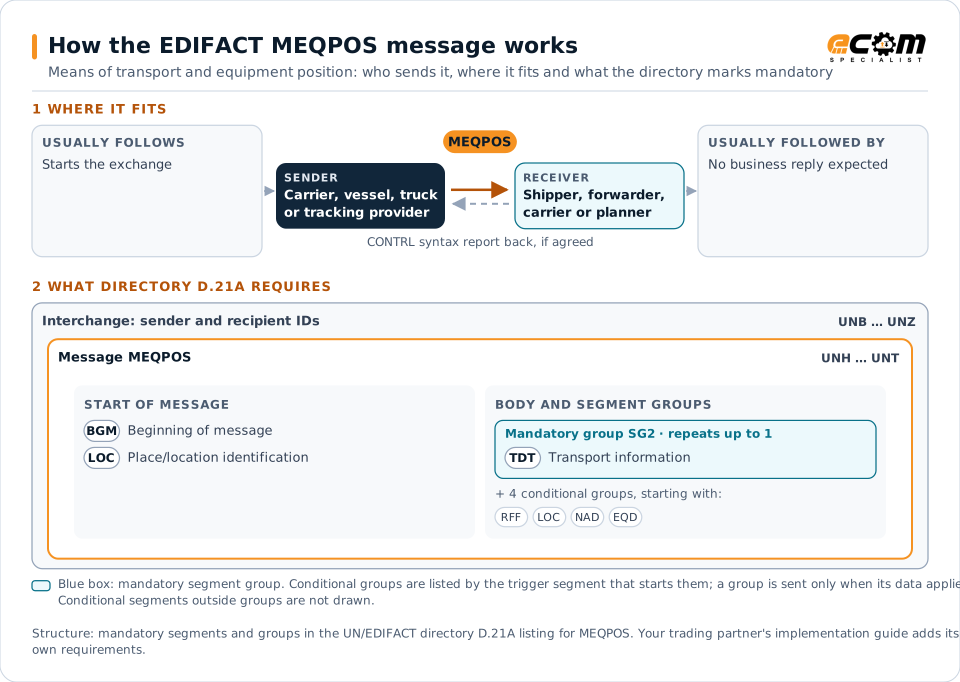
How to read this diagram: the top row shows who sends MEQPOS, to whom, and which messages usually come before and after it. The lower part shows what the directory D.21A itself requires: the envelopes around MEQPOS and the segments and segment groups it marks mandatory. Conditional groups are listed by their trigger segment rather than drawn in full. This is the directory's minimum, not a trading partner's requirement: a message implementation guide, such as an industry subset or a partner’s own guide, usually makes some conditional groups mandatory, restricts the codes and may use an older directory.
When it is used
- Reporting vessel or truck positions for tracking
- Reporting the location of containers or trailers
- Supporting arrival time estimates
Where it fits in the message flow
No other message routinely comes directly before or after MEQPOS; it is exchanged when the business event occurs. If the partners agree, the receiver confirms each interchange with a CONTRL syntax and service report.
Structure
Mandatory segments in MEQPOS (directory D.21A)
In UN/EDIFACT directory D.21A, the MEQPOS message has 18 segment positions arranged in 6 segment groups. These are the segments and segment groups marked mandatory at message level, in order; a mandatory group is shown with the segment that starts it. Segments inside conditional groups are needed only when the group is used. This is the directory’s requirement, not your trading partner’s: each partner’s message implementation guide names the directory it uses, often an older one such as D.96A or D.01B where the structure can differ, makes some conditional segments mandatory and restricts the codes.
- UNH
- BGM
- LOC
- SG2 (TDT)
- UNT
Practical example
MEQPOS in practice
A road carrier's telematics platform sends a shipper a MEQPOS every hour for each truck carrying its goods, with the coordinates, time and vehicle identity. The shipper's visibility tool updates estimated arrival times and alerts the customer when a truck falls behind schedule.
Implementation
Implementation considerations for MEQPOS
- Agree the reporting frequency and precision.
- Use consistent identifiers for vehicles and equipment.
- Combine positions with status events for a complete picture.
- Respect data protection rules for driver-related location data.
How ECOM helps
Automate MEQPOS with ECOM
Solution
Supply Chain Visibility
Track orders, shipments and invoices across partners and catch exceptions early.
Industry
Trucking and Transportation
Load tenders, responses, status and freight invoices for carriers, brokers and shippers, integrated with the TMS.
Solution
Logistics Automation
Automate tenders, status updates, freight invoices and warehouse orders with logistics partners.
Compare X12 and EDIFACT, or see answers to general questions in the EDI FAQ.
Related messages
Related transport messages
- COEDORTransport equipment stock and profile report
- DESTIMEquipment damage and repair estimate
- IFTCCAForwarding and transport shipment charge calculation
- IFTFCCInternational transport freight costs and other charges
- IFTRINForwarding and transport rate information
- IFTSAIForwarding and transport schedule and availability information
- BAPLIEBayplan/stowage plan occupied and empty locations
- BERMANBerth management
- BMISRMBulk marine inspection summary report
- CALINFVessel call information
- COARRIContainer discharge/loading report
- CODECOContainer gate
Need help with MEQPOS?
ECOM maps, tests and monitors EDIFACT messages for your trading partners and integrates them with your ERP.