
EDIFACT message guide · Transport
BAPLIE Bayplan/stowage plan occupied and empty locations
The UN/EDIFACT message that transmits the equipment and goods on a means of transport, typically a container vessel, with their locations.
- Sent by
- Vessel operator, carrier or terminal
- Received by
- Terminal at the next port, carrier or vessel planner
- Standard
- UN/EDIFACT · Batch message
- X12 equivalent
- 324 Vessel Stow Plan (Ocean)
What is the EDIFACT BAPLIE message?
BAPLIE is the UN/EDIFACT bayplan/stowage plan occupied and empty locations message. The directory defines it as a message to transmit information about equipment, mostly containers, and goods on a means of transport, typically a container vessel, including their location on board.
BAPLIE is the global standard for container vessel stowage data. After each port the stowage plan is sent to the next port's terminal and to planners, who use container positions, weights, ports of discharge and dangerous goods details to plan operations and check stability. SMDG publishes widely used implementation guides.
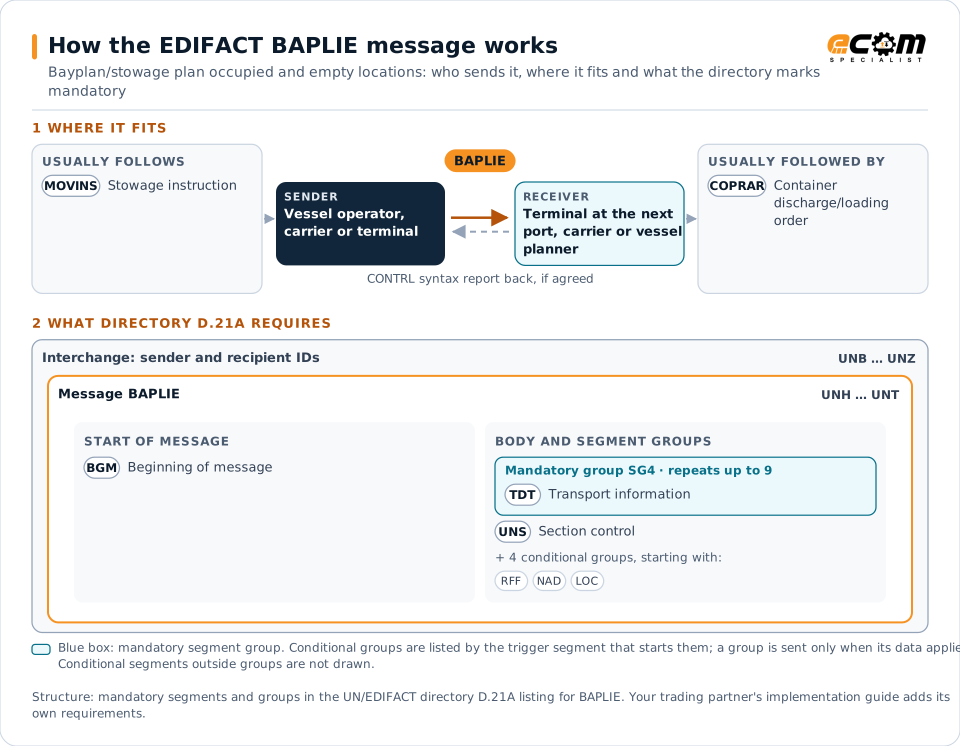
How to read this diagram: the top row shows who sends BAPLIE, to whom, and which messages usually come before and after it. The lower part shows what the directory D.21A itself requires: the envelopes around BAPLIE and the segments and segment groups it marks mandatory. Conditional groups are listed by their trigger segment rather than drawn in full. This is the directory's minimum, not a trading partner's requirement: a message implementation guide, such as an industry subset or a partner’s own guide, usually makes some conditional groups mandatory, restricts the codes and may use an older directory.
When it is used
- Sending the departure bayplan to the next port
- Sharing positions of reefer and dangerous goods containers
- Supporting vessel stability and lashing calculations
Where it fits in the message flow
Structure
Mandatory segments in BAPLIE (directory D.21A)
In UN/EDIFACT directory D.21A, the BAPLIE message has 43 segment positions arranged in 12 segment groups. These are the segments and segment groups marked mandatory at message level, in order; a mandatory group is shown with the segment that starts it. Segments inside conditional groups are needed only when the group is used. This is the directory’s requirement, not your trading partner’s: each partner’s message implementation guide names the directory it uses, often an older one such as D.96A or D.01B where the structure can differ, makes some conditional segments mandatory and restricts the codes.
- UNH
- BGM
- SG4 (TDT)
- UNS
- UNT
Practical example
BAPLIE in practice
A container vessel departs Singapore for Colombo. The terminal sends the carrier and the Colombo terminal a BAPLIE listing every container on board with its bay, row and tier, weight, port of discharge, reefer settings and dangerous goods details. Colombo's planners prepare the discharge and loading sequence before arrival.
Implementation
Implementation considerations for BAPLIE
- Follow the SMDG implementation guide version agreed with partners.
- Validate container numbers, weights and positions.
- Include complete dangerous goods data for segregation checks.
- Send the plan promptly after the vessel departs.
How ECOM helps
Automate BAPLIE with ECOM
Industry
Trucking and Transportation
Load tenders, responses, status and freight invoices for carriers, brokers and shippers, integrated with the TMS.
Solution
Logistics Automation
Automate tenders, status updates, freight invoices and warehouse orders with logistics partners.
Solution
EDI Integration
Exchange X12 and EDIFACT documents with partners and integrate them directly with your ERP.
Compare X12 and EDIFACT, or see answers to general questions in the EDI FAQ.
Related messages
Related transport messages
- MOVINSStowage instruction
- COPRARContainer discharge/loading order
- BERMANBerth management
- BMISRMBulk marine inspection summary report
- CALINFVessel call information
- COARRIContainer discharge/loading report
- CODECOContainer gate
- COEDORTransport equipment stock and profile report
- COHAORContainer special handling order
- COPARNContainer announcement
- COPINOContainer pre-notification
- COREORContainer release order
Need help with BAPLIE?
ECOM maps, tests and monitors EDIFACT messages for your trading partners and integrates them with your ERP.