
X12 transaction guide · Planning
EDI 830 Planning Schedule with Release Capability
The X12 document a manufacturer sends to share demand forecasts and authorize suppliers to produce or ship against them.
- Sent by
- Manufacturer or buyer
- Received by
- Supplier
- Standard
- ANSI ASC X12
- EDIFACT equivalent
- DELFOR
What is an EDI 830?
The EDI 830 Planning Schedule with Release Capability is the ANSI X12 transaction set manufacturers use to share forecasts with suppliers. It lists expected quantities for each part over a planning horizon, typically by week or month, and distinguishes firm quantities that suppliers are authorized to ship from planning quantities that are forecasts only. It can also carry fabrication and material authorizations and cumulative quantities.
The 830 is central to automotive and industrial supply chains, where suppliers plan production and buy materials weeks or months ahead. A shipping schedule, the 862, often supplements the 830 with firm, near-term delivery detail.
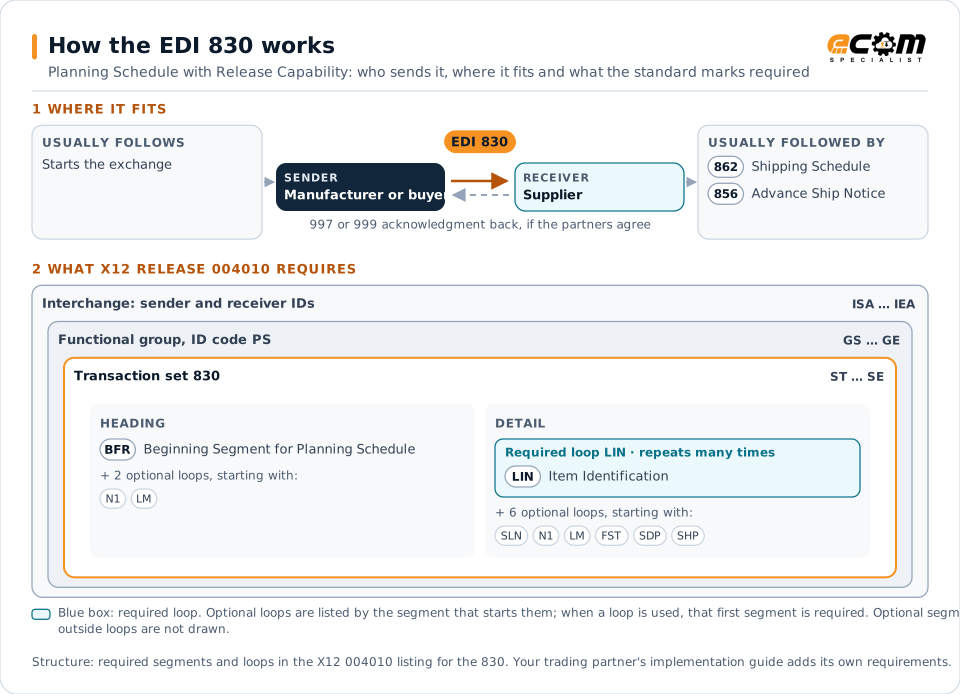
How to read this diagram: the top row shows who sends the 830, to whom, and which documents usually come before and after it. The lower part shows what X12 release 004010 itself requires: the envelopes around the 830 and the segments and loops the standard marks as required, area by area. Optional loops are listed by the segment that starts them rather than drawn in full. This is the standard's minimum, not a trading partner's requirement: each partner's implementation guide usually makes some optional loops mandatory, restricts the codes and may use a different release.
When it is used
- Automotive manufacturers sharing material releases with tier suppliers
- Industrial manufacturers forecasting component demand
- Authorizing suppliers to fabricate or buy raw material
Where it fits in the document flow
Structure
Key segments in the 830
The segments most implementations use, described in plain language. The last column shows what X12 release 004010 itself requires: "Required" marks a segment the standard requires in every 830; "Optional, common" marks a segment the standard leaves optional, or that sits in an optional loop, but that implementations often use. This is the standard's requirement, not your trading partner's: each partner's implementation guide names the release it uses, makes some optional segments mandatory and restricts the values, and requirements can differ between releases. The requirement status comes from one published X12 reference listing and has not been checked against a second source.
| Segment | Name | What it carries | In X12 004010 |
|---|---|---|---|
| BFR | Beginning Segment for Planning Schedule | Purpose code, release number, schedule type, quantity type and the horizon start and end dates. | Required |
| N1 loop | Party Identification | Ship-to plant, supplier and other parties. | Optional, common |
| LIN | Item Identification | Buyer part number and other part identifiers. | Required |
| UIT | Unit Detail | Unit of measure for the scheduled quantities. | Optional, common |
| FST | Forecast Schedule | Quantity, firm or planning qualifier, time bucket (daily, weekly, monthly) and date. | Optional, common |
| SHP | Shipped/Received Information | Last shipment and cumulative quantities used to reconcile the schedule. | Optional, common |
Example
Sample EDI 830
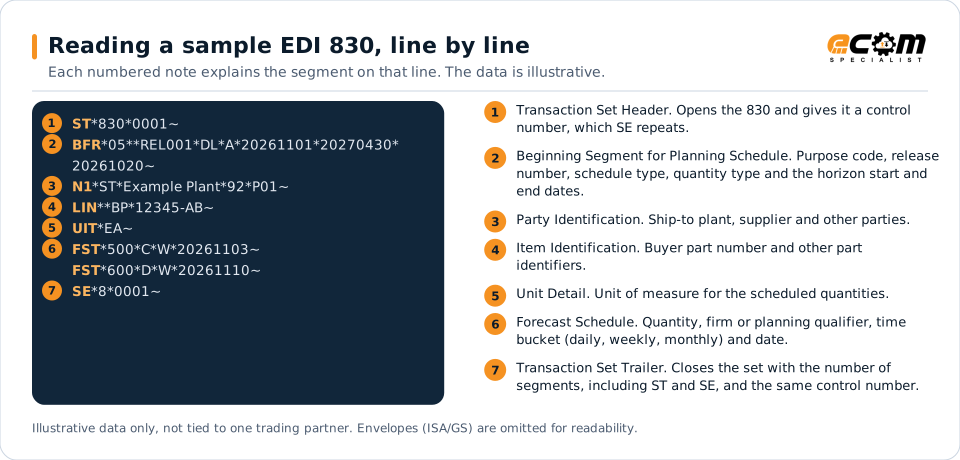
A replacement schedule (05) for part 12345-AB at plant P01. The first week's 500 units are firm (C) and the next week's 600 are planning only (D), in weekly buckets (W).
Illustrative data only, not tied to one X12 release or trading partner. The interchange (ISA/IEA) and functional group (GS/GE) envelopes are omitted for readability.
ST*830*0001~
BFR*05**REL001*DL*A*20261101*20270430*20261020~
N1*ST*Example Plant*92*P01~
LIN**BP*12345-AB~
UIT*EA~
FST*500*C*W*20261103~
FST*600*D*W*20261110~
SE*8*0001~The sample is the same one shown above, with a note beside each segment the first time it appears. Segment IDs are highlighted at the start of each line; the fields after them are separated by asterisks, and each segment ends with a tilde.
Avoid problems
Common 830 errors and how to prevent them
Treating forecasts as firm
Planning quantities are not authorizations to ship. Production plans must respect the firm and planning qualifiers.
Ignoring cumulative quantities
Automotive schedules often depend on cumulative quantities. Out-of-sync cumulatives cause over- or under-shipment.
Not replacing previous schedules
Most 830s replace the prior schedule. Adding them instead creates inflated demand.
Trading partners
Integration guides that include the 830






How ECOM helps
Automate the 830 with ECOM
Industry
Automotive
Schedules, ship notices, labels, self-billing and multi-plant routing for automotive suppliers.
Solution
ERP Integration
Connect your ERP to trading partners through EDI, APIs, IDocs, files and connectors.
Industry
Manufacturing
Customer schedules, supplier connectivity and shipping integrated with the ERP for manufacturers.
EDI 830 FAQs
What is the difference between an 830 and an 862?
The 830 shares longer-term forecasts and authorizations. The 862 gives firm, near-term shipping requirements that supplement the 830.
Who uses the 830?
Mostly automotive and industrial manufacturers and their suppliers, where production is planned against forecasts.
What is the EDIFACT equivalent of the 830?
The UN/EDIFACT equivalent is the DELFOR delivery forecast message.
More general questions about EDI are answered in the EDI FAQ.
Related transactions
Related planning documents
Need help with the EDI 830?
ECOM maps, tests and monitors X12 documents for your trading partners and integrates them with your ERP.