
X12 transaction guide · Transportation
EDI 216 Motor Carrier Shipment Pickup Notification
The X12 document shippers use to notify a motor carrier that a shipment is available for pickup.
- Sent by
- Shipper or interested party
- Received by
- Motor carrier
- Standard
- ANSI ASC X12
What is an EDI 216?
The EDI 216 Motor Carrier Shipment Pickup Notification is the ANSI X12 transaction set that lets shippers or other interested parties tell a motor carrier that a shipment is available for pickup. It identifies where and when the shipment can be collected and gives basic details such as pieces and weight.
The standard keeps the 216 separate from the legal bill of lading, rating and pricing, and appointment scheduling. It is a pickup request, so it suits shippers that call carriers for pickups as shipments become ready rather than on a fixed schedule.
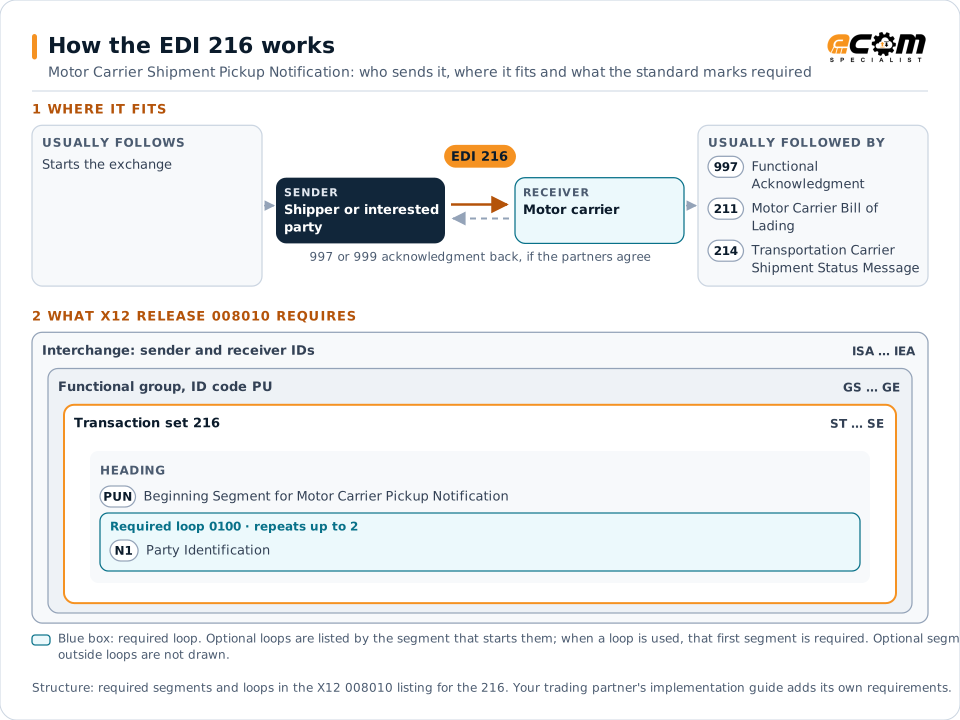
How to read this diagram: the top row shows who sends the 216, to whom, and which documents usually come before and after it. The lower part shows what X12 release 008010 itself requires: the envelopes around the 216 and the segments and loops the standard marks as required, area by area. Optional loops are listed by the segment that starts them rather than drawn in full. This is the standard's minimum, not a trading partner's requirement: each partner's implementation guide usually makes some optional loops mandatory, restricts the codes and may use a different release.
When it is used
- Requesting a pickup when a shipment is ready
- Notifying carriers of ad hoc or irregular shipments
- Giving pickup windows and location details
Where it fits in the document flow
Structure
Mandatory segments in the 216 (X12 release 008010)
The segments X12 release 008010 marks as mandatory at their level, in order. Segments inside optional loops are needed only when the loop is used. This is the standard's requirement, not your trading partner's: each partner's implementation guide names the release it uses, adds the optional segments it requires and restricts the values. The requirement status comes from one published X12 reference listing and has not been checked against a second source.
- ST
- PUN
- N1
- SE
Practical example
The 216 in practice
A small manufacturer ships a few pallets each week. When an order is packed, its system sends the LTL carrier a 216 with the pickup address, the ready time, the dock closing time, and the pieces and weight. The carrier dispatches a driver, and the shipment moves without a phone call.
Implementation
Implementation considerations for the 216
- Give accurate ready and closing times so carriers can route drivers efficiently.
- Send weights and piece counts that match the bill of lading.
- Confirm whether each carrier acknowledges pickup requests and how.
How ECOM helps
Automate the 216 with ECOM
Industry
Trucking and Transportation
Load tenders, responses, status and freight invoices for carriers, brokers and shippers, integrated with the TMS.
Industry
Manufacturing
Customer schedules, supplier connectivity and shipping integrated with the ERP for manufacturers.
Solution
EDI Integration
Exchange X12 and EDIFACT documents with partners and integrate them directly with your ERP.
More general questions about EDI are answered in the EDI FAQ.
Related transactions
Related transportation documents
- 211Motor Carrier Bill of Lading
- 106Motor Carrier Rate Proposal
- 108Response to a Motor Carrier Rate Proposal
- 213Motor Carrier Shipment Status Inquiry
- 215Motor Carrier Pickup Manifest
- 404Rail Carrier Shipment Information
- 107Request for Motor Carrier Rate Proposal
- 212Motor Carrier Delivery Trailer Manifest
- 227Trailer Usage Report
- 240Motor Carrier Package Status
- 422Equipment Order
- 104Air Shipment Information
Need help with the EDI 216?
ECOM maps, tests and monitors X12 documents for your trading partners and integrates them with your ERP.