
X12 transaction guide · Transportation
EDI 106 Motor Carrier Rate Proposal
The X12 document a motor carrier uses to propose rates and services to a shipper, receiver or other party.
- Sent by
- Motor carrier
- Received by
- Shipper, receiver or logistics provider
- Standard
- ANSI ASC X12
What is an EDI 106?
The EDI 106 Motor Carrier Rate Proposal is the ANSI X12 transaction set a motor carrier uses to propose rates and services to a shipper, receiver or other party. It describes the lanes or points covered, the rate basis, charges, accessorials, service terms and effective dates.
The 106 is part of a three-document rate negotiation: a shipper can ask for a proposal with the 107, the carrier proposes with the 106, and the shipper accepts, rejects or counters with the 108. Agreed rates then feed the shipper's transportation management and freight audit systems.
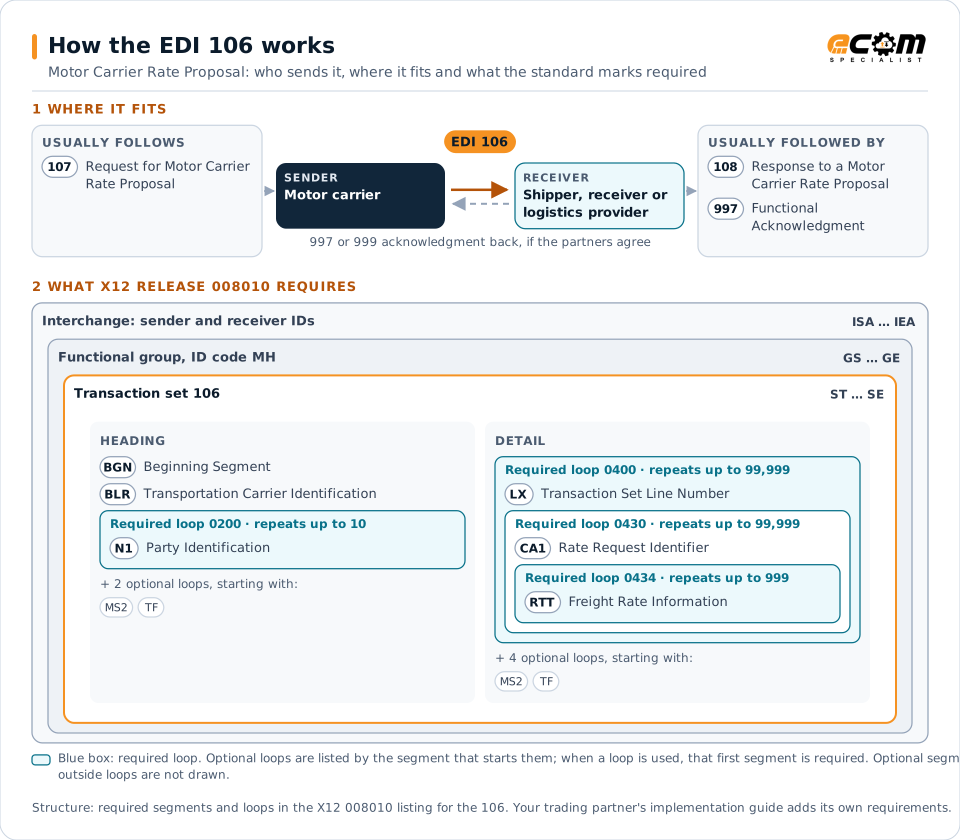
How to read this diagram: the top row shows who sends the 106, to whom, and which documents usually come before and after it. The lower part shows what X12 release 008010 itself requires: the envelopes around the 106 and the segments and loops the standard marks as required, area by area. Optional loops are listed by the segment that starts them rather than drawn in full. This is the standard's minimum, not a trading partner's requirement: each partner's implementation guide usually makes some optional loops mandatory, restricts the codes and may use a different release.
When it is used
- Proposing rates in response to a shipper's request or bid
- Offering rates on new lanes or services
- Proposing changes to existing rates
Where it fits in the document flow
Structure
Mandatory segments in the 106 (X12 release 008010)
The segments X12 release 008010 marks as mandatory at their level, in order. Segments inside optional loops are needed only when the loop is used. This is the standard's requirement, not your trading partner's: each partner's implementation guide names the release it uses, adds the optional segments it requires and restricts the values. The requirement status comes from one published X12 reference listing and has not been checked against a second source.
- ST
- BGN
- BLR
- MS2
- TF
- N1
- LX
- CA1
- RTT
- SE
Practical example
The 106 in practice
A manufacturer runs its annual truckload bid and sends carriers a 107 listing 40 lanes with expected volumes. A regional carrier replies with a 106 proposing a rate per mile for 15 of the lanes, its fuel surcharge table, accessorial charges and a one-year validity period. The manufacturer evaluates the proposal and responds with a 108.
Implementation
Implementation considerations for the 106
- Match each proposed rate to the lane identifiers in the request.
- State the rate basis and units clearly, such as per mile, per hundredweight or flat.
- Include effective and expiry dates so rates can be loaded correctly.
- Keep proposals consistent with the tariff and rate data used for invoicing.
How ECOM helps
Automate the 106 with ECOM
Industry
Trucking and Transportation
Load tenders, responses, status and freight invoices for carriers, brokers and shippers, integrated with the TMS.
Solution
Logistics Automation
Automate tenders, status updates, freight invoices and warehouse orders with logistics partners.
Industry
Manufacturing
Customer schedules, supplier connectivity and shipping integrated with the ERP for manufacturers.
More general questions about EDI are answered in the EDI FAQ.
Related transactions
Related transportation documents
- 108Response to a Motor Carrier Rate Proposal
- 107Request for Motor Carrier Rate Proposal
- 211Motor Carrier Bill of Lading
- 216Motor Carrier Shipment Pickup Notification
- 212Motor Carrier Delivery Trailer Manifest
- 213Motor Carrier Shipment Status Inquiry
- 215Motor Carrier Pickup Manifest
- 227Trailer Usage Report
- 404Rail Carrier Shipment Information
- 240Motor Carrier Package Status
- 422Equipment Order
- 352Customs Carrier General Order Status
Need help with the EDI 106?
ECOM maps, tests and monitors X12 documents for your trading partners and integrates them with your ERP.