
EDIFACT message guide · Travel and tourism
TSDUPD Timetable static data update
The UN/EDIFACT interactive message that provides static data, such as locations and parties, that complements schedule information.
- Sent by
- Travel service provider
- Received by
- Other providers, authorities or timetable publishers
- Standard
- UN/EDIFACT · Interactive (I-EDI) message
- X12 equivalent
- No direct equivalent
What is the EDIFACT TSDUPD message?
TSDUPD is the UN/EDIFACT timetable static data update. The directory defines it as a message providing static data complementary to the travel schedule information conveyed by the schedule update message (SKDUPD), such as information about locations and parties. A travel service provider sends it to other service providers or agencies.
Schedules refer to stations, stops and operators by code. The static data defines those codes, with names, coordinates and other attributes, so receivers can interpret and display schedules correctly. Static data changes less often than schedules.
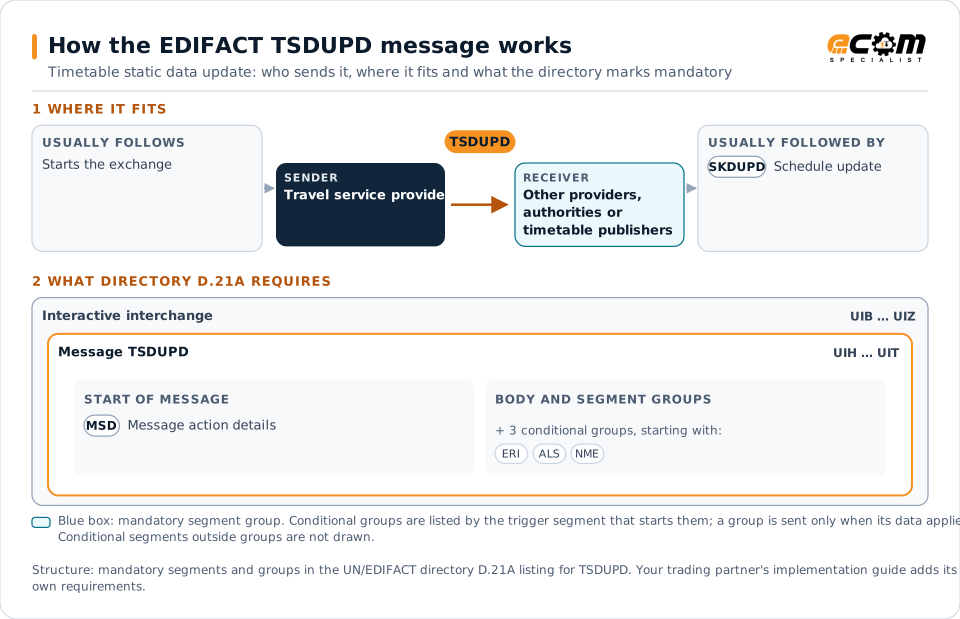
How to read this diagram: the top row shows who sends TSDUPD, to whom, and which messages usually come before and after it. The lower part shows what the directory D.21A itself requires: the envelopes around TSDUPD and the segments and segment groups it marks mandatory. Conditional groups are listed by their trigger segment rather than drawn in full. This is the directory's minimum, not a trading partner's requirement: a message implementation guide usually makes some conditional groups mandatory, restricts the codes and may use an older directory.
When it is used
- Publishing station and stop data
- Updating operator and party details
- Adding new locations before schedules use them
Where it fits in the message flow
Structure
Mandatory segments in TSDUPD (directory D.21A)
In UN/EDIFACT directory D.21A, the TSDUPD message has 41 segment positions arranged in 8 segment groups. These are the segments and segment groups marked mandatory at message level, in order; a mandatory group is shown with the segment that starts it. Segments inside conditional groups are needed only when the group is used. This is the directory’s requirement, not your trading partner’s: each partner’s message implementation guide names the directory it uses, often an older one such as D.96A or D.01B where the structure can differ, makes some conditional segments mandatory and restricts the codes. This structure comes from one published copy of the directory and has not been independently verified: confirm it before you build a map.
- UIH
- MSD
- UIT
Practical example
TSDUPD in practice
A bus operator opens a new route with five new stops. Before sending the new schedules, it sends partners a TSDUPD defining each stop's code, name and location. When the SKDUPD schedules arrive, the journey planners can place the new stops on their maps.
Implementation
Implementation considerations for TSDUPD
- Send static data before schedules that reference it.
- Keep location codes stable over time where possible.
- Include coordinates where journey planners need them.
- Retire codes carefully, since old schedules may still refer to them.
How ECOM helps
Automate TSDUPD with ECOM
Industry
Trucking and Transportation
Load tenders, responses, status and freight invoices for carriers, brokers and shippers, integrated with the TMS.
Industry
Hospitality
Procurement, invoicing and supplier integration for hotels, restaurant groups and foodservice suppliers.
Solution
EDI Integration
Exchange X12 and EDIFACT documents with partners and integrate them directly with your ERP.
Compare X12 and EDIFACT, or see answers to general questions in the EDI FAQ.
Related messages
Related travel and tourism messages
- SKDUPDSchedule update
- SKDREQSchedule request
- TUPREQTravel, tourism and leisure data update request
- TUPRSPTravel, tourism and leisure data update response
- AVLREQAvailability request
- AVLRSPAvailability response
- RESREQReservation request
- RESRSPReservation response
- TIQREQTravel, tourism and leisure information inquiry request
- TIQRSPTravel, tourism and leisure information inquiry response
- PASREQTravel, tourism and leisure product application status request
- PASRSPTravel, tourism and leisure product application status response
Need help with TSDUPD?
ECOM maps, tests and monitors EDIFACT messages for your trading partners and integrates them with your ERP.