
X12 transaction guide · Master data
EDI 885 Retail Account Characteristics
The X12 document a retailer, wholesaler or broker uses to share detailed attributes of retail stores with a trading partner.
- Sent by
- Retailer, wholesaler or broker
- Received by
- Manufacturer or broker
- Standard
- ANSI ASC X12
What is an EDI 885?
The EDI 885 Retail Account Characteristics is the ANSI X12 transaction set a retailer, wholesaler or broker uses to provide detailed attributes of retail stores to a trading partner. Attributes include the store number, store size, class of trade, product category information, customer demographics and marketing information.
Manufacturers and brokers use the data to plan assortments, target promotions and allocate field sales effort by store. Keeping it current matters, because store attributes drive which programs and products each location receives.
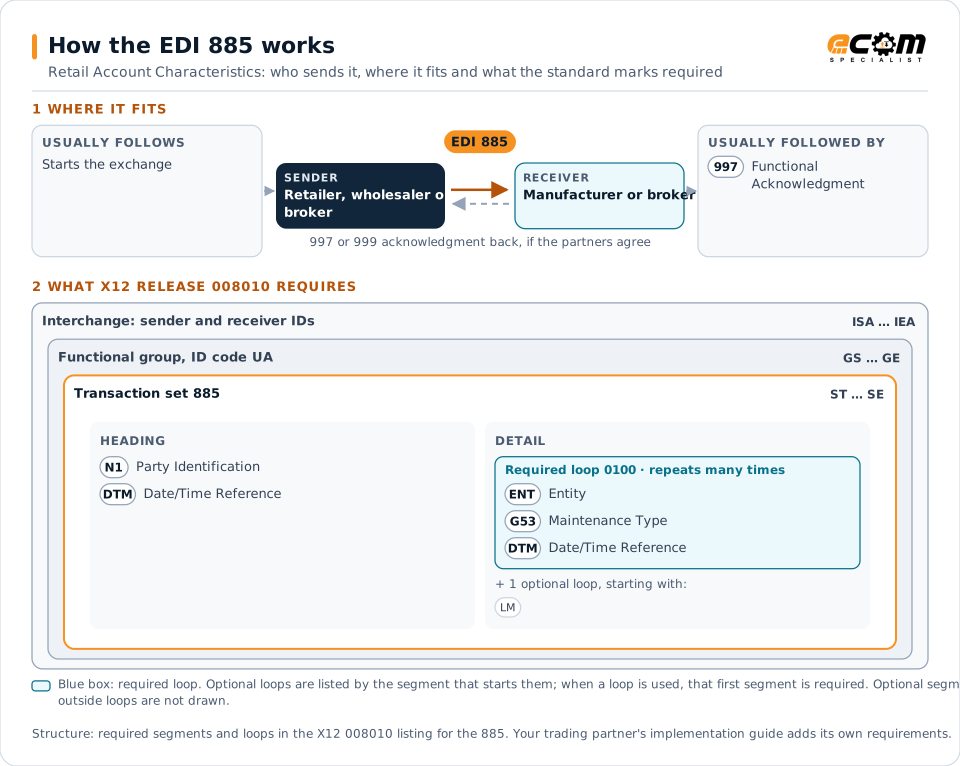
How to read this diagram: the top row shows who sends the 885, to whom, and which documents usually come before and after it. The lower part shows what X12 release 008010 itself requires: the envelopes around the 885 and the segments and loops the standard marks as required, area by area. Optional loops are listed by the segment that starts them rather than drawn in full. This is the standard's minimum, not a trading partner's requirement: each partner's implementation guide usually makes some optional loops mandatory, restricts the codes and may use a different release.
When it is used
- Sharing store attributes with manufacturers and brokers
- Updating store data after openings, closures or remodels
- Supporting assortment and promotion planning by store cluster
Where it fits in the document flow
Structure
Mandatory segments in the 885 (X12 release 008010)
The segments X12 release 008010 marks as mandatory at their level, in order. Segments inside optional loops are needed only when the loop is used. This is the standard's requirement, not your trading partner's: each partner's implementation guide names the release it uses, adds the optional segments it requires and restricts the values. The requirement status comes from one published X12 reference listing and has not been checked against a second source.
- ST
- N1
- DTM
- ENT
- G53
- LM
- LQ
- SE
Practical example
The 885 in practice
A convenience store chain opens 12 new locations and remodels 20 others. It sends its key manufacturers an 885 for each store with the store number, address, size, class of trade, fuel and food service attributes and opening dates. A snack manufacturer uses the data to assign the new stores to its planogram clusters and its broker's call schedule.
Implementation
Implementation considerations for the 885
- Keep store identifiers consistent with those used in orders and authorizations (878).
- Update the data whenever stores open, close or change format.
- Agree on which demographic and marketing attributes may be shared.
- Load the data into the systems that plan assortments and field visits.
How ECOM helps
Automate the 885 with ECOM
Industry
Retail
Retail and eCommerce EDI for suppliers and retailers, from purchase order to payment, with compliance built in.
Industry
Consumer Goods
Retail, distributor, marketplace and direct-channel integration for consumer brands.
Solution
B2B Integration
Connect every customer, supplier, carrier and bank across EDI, API, file and portal channels.
More general questions about EDI are answered in the EDI FAQ.
Related transactions
Related master data documents
Need help with the EDI 885?
ECOM maps, tests and monitors X12 documents for your trading partners and integrates them with your ERP.