
X12 transaction guide · Transportation
EDI 421 Estimated Time of Arrival and Car Scheduling
The X12 document railroads use to exchange car scheduling and estimated time of arrival data with each other.
- Sent by
- Rail carrier
- Received by
- Connecting rail carrier
- Standard
- ANSI ASC X12
What is an EDI 421?
The EDI 421 Estimated Time of Arrival and Car Scheduling is the ANSI X12 transaction set that lets railroads exchange car scheduling and estimated time of arrival data between carriers.
Car scheduling plans each car's trip as a series of train connections, with an estimated arrival at the destination or the next interchange. Sharing these plans between railroads gives an end-to-end estimate for interline shipments, which shippers rely on for planning. Trip plans are recalculated when trains are delayed or cars miss connections. Shared estimates let each carrier see how the others' delays affect a car's arrival at destination.
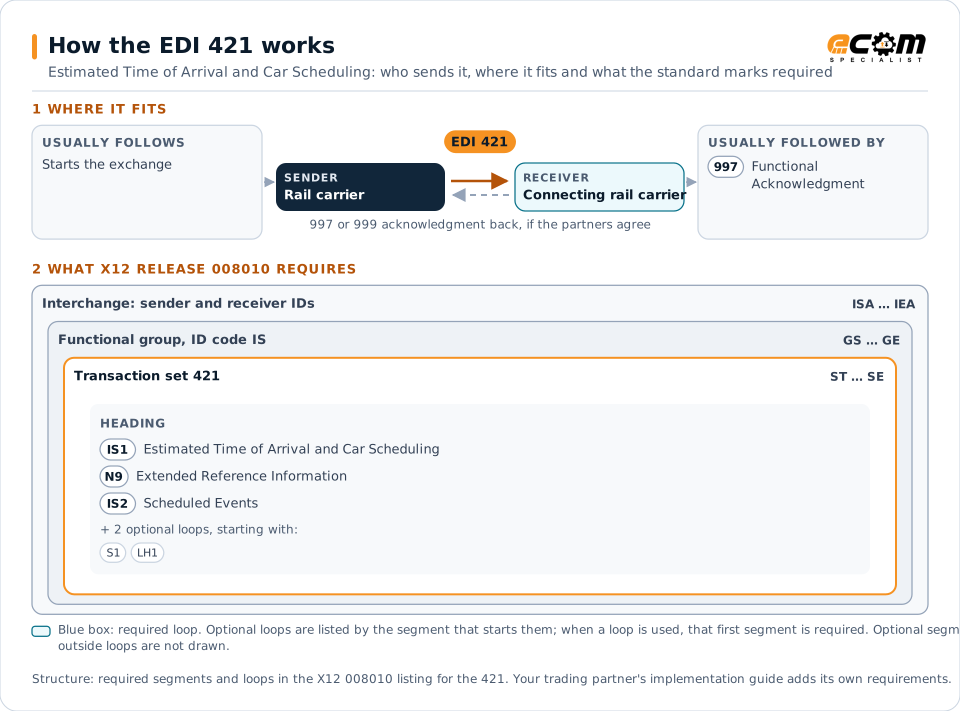
How to read this diagram: the top row shows who sends the 421, to whom, and which documents usually come before and after it. The lower part shows what X12 release 008010 itself requires: the envelopes around the 421 and the segments and loops the standard marks as required, area by area. Optional loops are listed by the segment that starts them rather than drawn in full. This is the standard's minimum, not a trading partner's requirement: each partner's implementation guide usually makes some optional loops mandatory, restricts the codes and may use a different release.
When it is used
- Sharing trip plans for interline cars
- Exchanging estimated arrival times at interchange
- Updating estimates after delays
Where it fits in the document flow
Structure
Mandatory segments in the 421 (X12 release 008010)
The segments X12 release 008010 marks as mandatory at their level, in order. Segments inside optional loops are needed only when the loop is used. This is the standard's requirement, not your trading partner's: each partner's implementation guide names the release it uses, adds the optional segments it requires and restricts the values. The requirement status comes from one published X12 reference listing and has not been checked against a second source.
- ST
- IS1
- N9
- IS2
- S1
- LH1
- N1
- SE
Practical example
The 421 in practice
A car of auto parts moves over two railroads to an assembly plant. The origin railroad sends the destination railroad a 421 with the car's trip plan and estimated arrival at interchange. The destination railroad adds its own schedule, giving the plant a reliable delivery estimate.
Implementation
Implementation considerations for the 421
- Update estimates when trains are delayed.
- Use car identification consistent with waybills and consists.
- Combine estimates from each carrier for end-to-end visibility.
- Measure actual arrivals against estimates.
How ECOM helps
Automate the 421 with ECOM
Industry
Trucking and Transportation
Load tenders, responses, status and freight invoices for carriers, brokers and shippers, integrated with the TMS.
Solution
Supply Chain Visibility
Track orders, shipments and invoices across partners and catch exceptions early.
Industry
Automotive
Schedules, ship notices, labels, self-billing and multi-plant routing for automotive suppliers.
More general questions about EDI are answered in the EDI FAQ.
Related transactions
Related transportation documents
- 120Vehicle Shipping Order
- 121Vehicle Service
- 125Multilevel Railcar Load Details
- 127Vehicle Baying Order
- 453Railroad Service Commitment Advice
- 924Loss or Damage Claim - Motor Vehicle
- 928Automotive Inspection Detail
- 161Train Sheet
- 312Arrival Notice (Ocean)
- 404Rail Carrier Shipment Information
- 410Rail Carrier Freight Details and Invoice
- 417Rail Carrier Waybill Interchange
Need help with the EDI 421?
ECOM maps, tests and monitors X12 documents for your trading partners and integrates them with your ERP.