
X12 transaction guide · Transportation
EDI 312 Arrival Notice (Ocean)
The X12 document an ocean carrier sends to give the consignee what it needs to receive a shipment, including charges due and the estimated arrival.
- Sent by
- Ocean carrier or its agent
- Received by
- Consignee, notify party or customs broker
- Standard
- ANSI ASC X12
- EDIFACT equivalent
- IFTMAN
What is an EDI 312?
The EDI 312 Arrival Notice (Ocean) is the ANSI X12 transaction set that provides all the information a consignee needs to receive a shipment, including customs information, payments due and the estimated date and time of arrival.
The arrival notice starts the import side of an ocean shipment. Customs brokers use it to prepare entries, consignees use it to arrange pickup and pay outstanding charges, and the dates in it drive free time and demurrage calculations. It is usually sent several days before the vessel arrives.
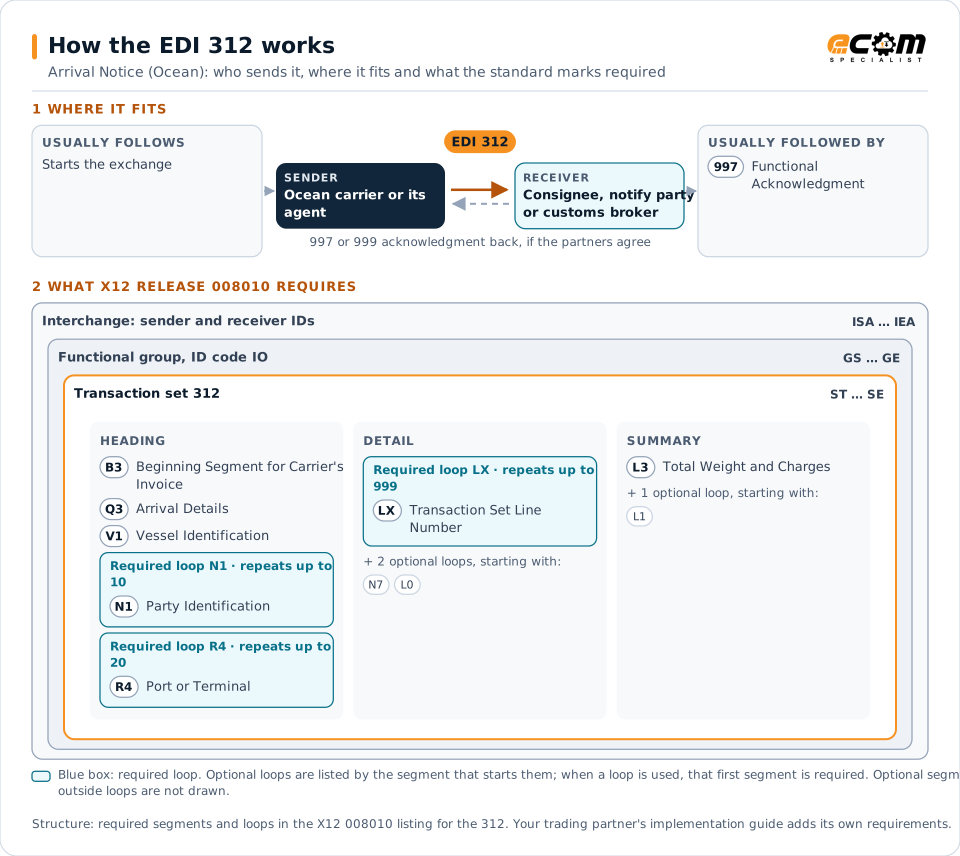
How to read this diagram: the top row shows who sends the 312, to whom, and which documents usually come before and after it. The lower part shows what X12 release 008010 itself requires: the envelopes around the 312 and the segments and loops the standard marks as required, area by area. Optional loops are listed by the segment that starts them rather than drawn in full. This is the standard's minimum, not a trading partner's requirement: each partner's implementation guide usually makes some optional loops mandatory, restricts the codes and may use a different release.
When it is used
- Notifying a consignee of an arriving ocean shipment
- Advising charges that must be paid before release
- Giving customs brokers data for entry preparation
Where it fits in the document flow
Structure
Mandatory segments in the 312 (X12 release 008010)
The segments X12 release 008010 marks as mandatory at their level, in order. Segments inside optional loops are needed only when the loop is used. This is the standard's requirement, not your trading partner's: each partner's implementation guide names the release it uses, adds the optional segments it requires and restricts the values. The requirement status comes from one published X12 reference listing and has not been checked against a second source.
- ST
- B3
- Q3
- V1
- N1
- R4
- LX
- N7
- H1
- LH1
- L0
- L1
- L3
- SE
Practical example
The 312 in practice
A furniture importer's containers are five days from the Port of Los Angeles. The carrier sends a 312 to the importer and its customs broker with the bill of lading, the containers, the vessel and estimated arrival, the discharge terminal and the freight charges collect. The broker files the customs entry and the importer pays the charges so the containers can be released on arrival.
Implementation
Implementation considerations for the 312
- Route arrival notices to customs brokers as well as the consignee.
- Track estimated arrival changes, since free time starts at discharge.
- Pay charges due before arrival to avoid release delays.
- Match the notice to the purchase orders on the bill of lading.
How ECOM helps
Automate the 312 with ECOM
Industry
Trucking and Transportation
Load tenders, responses, status and freight invoices for carriers, brokers and shippers, integrated with the TMS.
Industry
Retail
Retail and eCommerce EDI for suppliers and retailers, from purchase order to payment, with compliance built in.
Solution
Supply Chain Visibility
Track orders, shipments and invoices across partners and catch exceptions early.
More general questions about EDI are answered in the EDI FAQ.
Related transactions
Related transportation documents
- 315Status Details (Ocean)
- 163Transportation Appointment Schedule Information
- 213Motor Carrier Shipment Status Inquiry
- 326Consignment Summary List
- 300Reservation (Booking Request) (Ocean)
- 301Confirmation (Ocean)
- 303Booking Cancellation (Ocean)
- 310Freight Receipt and Invoice (Ocean)
- 313Shipment Status Inquiry (Ocean)
- 323Vessel Schedule and Itinerary (Ocean)
- 324Vessel Stow Plan (Ocean)
- 361Carrier Interchange Agreement (Ocean)
Need help with the EDI 312?
ECOM maps, tests and monitors X12 documents for your trading partners and integrates them with your ERP.