
EDIFACT message guide · Master data
DMRDEF Data maintenance request definition
The UN/EDIFACT message that transfers a data maintenance request, a proposed change to the directories, among the parties that process it.
- Sent by
- Submitter or standards working group
- Received by
- Parties that assess and process directory changes
- Standard
- UN/EDIFACT · Batch message
- X12 equivalent
- No direct equivalent
What is the EDIFACT DMRDEF message?
DMRDEF is the UN/EDIFACT data maintenance request definition message. The directory defines it as a message that transfers a data maintenance request (DMR) action among the parties involved in preparing, processing, assessing and resolving requests and producing the directories.
Changes to UN/EDIFACT, such as new code values, segments or messages, start as data maintenance requests. DMRDEF carries the request itself in structured form, and its status is tracked with DMSTAT through to publication in a new directory release. It is used within the UN/CEFACT process.
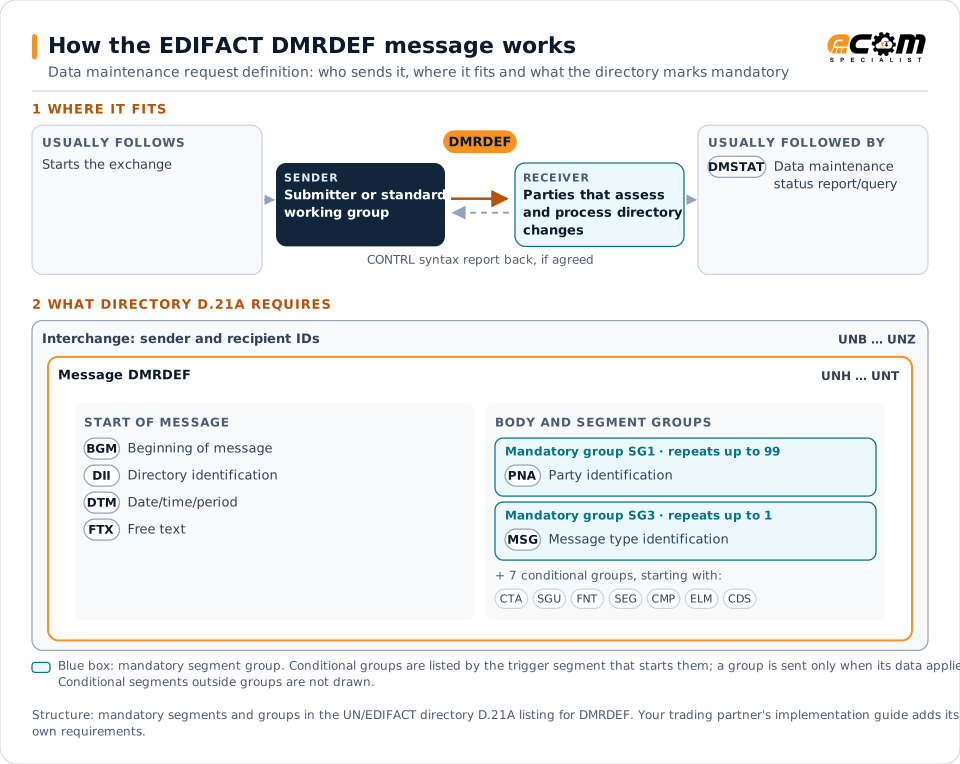
How to read this diagram: the top row shows who sends DMRDEF, to whom, and which messages usually come before and after it. The lower part shows what the directory D.21A itself requires: the envelopes around DMRDEF and the segments and segment groups it marks mandatory. Conditional groups are listed by their trigger segment rather than drawn in full. This is the directory's minimum, not a trading partner's requirement: a message implementation guide, such as an industry subset or a partner’s own guide, usually makes some conditional groups mandatory, restricts the codes and may use an older directory.
When it is used
- Submitting a request to change the directories
- Passing requests between working groups
- Recording resolved changes for directory production
Where it fits in the message flow
Structure
Mandatory segments in DMRDEF (directory D.21A)
In UN/EDIFACT directory D.21A, the DMRDEF message has 52 segment positions arranged in 13 segment groups. These are the segments and segment groups marked mandatory at message level, in order; a mandatory group is shown with the segment that starts it. Segments inside conditional groups are needed only when the group is used. This is the directory’s requirement, not your trading partner’s: each partner’s message implementation guide names the directory it uses, often an older one such as D.96A or D.01B where the structure can differ, makes some conditional segments mandatory and restricts the codes.
- UNH
- BGM
- DII
- DTM
- FTX
- SG1 (PNA)
- SG3 (MSG)
- UNT
Practical example
DMRDEF in practice
An industry group needs a new code value for a transport event. Its standards representative prepares a data maintenance request with the proposed code, its description and justification, and submits it as a DMRDEF. The request is assessed by the responsible group and, once approved, appears in the next directory.
Implementation
Implementation considerations for DMRDEF
- Follow UN/CEFACT procedures for data maintenance requests.
- Justify changes with a business requirement.
- Track the request through to the directory release.
- Coordinate with the industry bodies that use the affected messages.
How ECOM helps
Automate DMRDEF with ECOM
Solution
EDI Integration
Exchange X12 and EDIFACT documents with partners and integrate them directly with your ERP.
Service
Mapping and Translation
Map development and maintenance for X12, EDIFACT, XML, JSON, flat files and ERP formats.
Solution
B2B Integration
Connect every customer, supplier, carrier and bank across EDI, API, file and portal channels.
Compare X12 and EDIFACT, or see answers to general questions in the EDI FAQ.
Need help with DMRDEF?
ECOM maps, tests and monitors EDIFACT messages for your trading partners and integrates them with your ERP.