
EDIFACT message guide · Master data
DAPLOS Data Plot Sheet
The UN/EDIFACT message used to exchange data plot sheets, the crop production records of a field, between farmers and their partners.
- Sent by
- Farmer or farm management system
- Received by
- Supplier, buyer, cooperative or agricultural advisor
- Standard
- UN/EDIFACT · Batch message
- X12 equivalent
- No direct equivalent
What is the EDIFACT DAPLOS message?
DAPLOS is the UN/EDIFACT data plot sheet message. The directory describes it as a message describing the data plot sheet exchanged between farmers and suppliers. It contains the technical description of, and information about, crop production on a plot, to give the farmer's partners information for traceability.
A plot sheet records what happened on a field during a season: sowing, fertilizer and crop protection treatments, harvest and yields. Buyers and cooperatives use it to prove compliance with quality and sustainability requirements and to trace products back to the field.
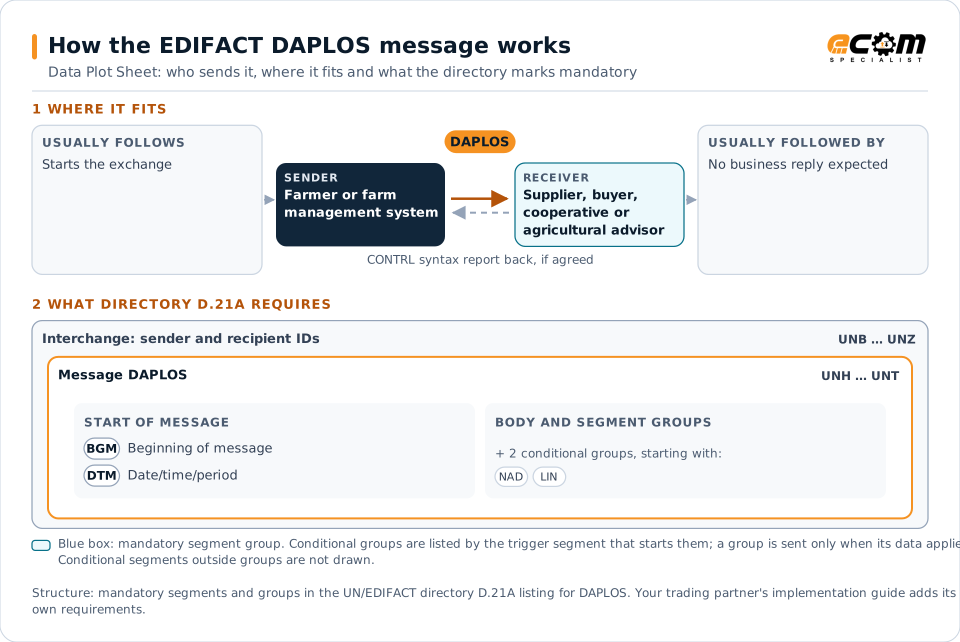
How to read this diagram: the top row shows who sends DAPLOS, to whom, and which messages usually come before and after it. The lower part shows what the directory D.21A itself requires: the envelopes around DAPLOS and the segments and segment groups it marks mandatory. Conditional groups are listed by their trigger segment rather than drawn in full. This is the directory's minimum, not a trading partner's requirement: a message implementation guide, such as an industry subset or a partner’s own guide, usually makes some conditional groups mandatory, restricts the codes and may use an older directory.
When it is used
- Sharing field operations with a cooperative or buyer
- Proving traceability for certified crops
- Exchanging records between farm software and advisors
Where it fits in the message flow
No other message routinely comes directly before or after DAPLOS; it is exchanged when the business event occurs. If the partners agree, the receiver confirms each interchange with a CONTRL syntax and service report.
Structure
Mandatory segments in DAPLOS (directory D.21A)
In UN/EDIFACT directory D.21A, the DAPLOS message has 60 segment positions arranged in 21 segment groups. These are the segments and segment groups marked mandatory at message level, in order; a mandatory group is shown with the segment that starts it. Segments inside conditional groups are needed only when the group is used. This is the directory’s requirement, not your trading partner’s: each partner’s message implementation guide names the directory it uses, often an older one such as D.96A or D.01B where the structure can differ, makes some conditional segments mandatory and restricts the codes.
- UNH
- BGM
- DTM
- UNT
Practical example
DAPLOS in practice
A cereal farmer supplies wheat to a milling cooperative under a quality scheme. At harvest, the farm management software sends the cooperative a DAPLOS for each field with the variety sown, fertilizer and crop protection applications with dates and doses, and the harvest date. The cooperative checks compliance and links the records to the grain lots received.
Implementation
Implementation considerations for DAPLOS
- Use agreed identifiers for plots, products and operations.
- Record dates and doses precisely for compliance checks.
- Respect farmers' control over the sharing of their data.
- Follow national agricultural data standards built on DAPLOS where they exist.
How ECOM helps
Automate DAPLOS with ECOM
Industry
Food and Beverage
Grocery and foodservice EDI for food and beverage manufacturers, with lot, date and inventory data.
Solution
Supply Chain Visibility
Track orders, shipments and invoices across partners and catch exceptions early.
Solution
B2B Integration
Connect every customer, supplier, carrier and bank across EDI, API, file and portal channels.
Compare X12 and EDIFACT, or see answers to general questions in the EDI FAQ.
Related messages
Related master data messages
Need help with DAPLOS?
ECOM maps, tests and monitors EDIFACT messages for your trading partners and integrates them with your ERP.