
EDIFACT message guide · Projects and construction
CONQVA Quantity valuation
The UN/EDIFACT message a contractor uses to submit progress, the quantities of work completed, to the client or its representative.
- Sent by
- Contractor or subcontractor
- Received by
- Client's representative or main contractor
- Standard
- UN/EDIFACT · Batch message
- X12 equivalent
- No direct equivalent
What is the EDIFACT CONQVA message?
CONQVA is the UN/EDIFACT quantity valuation message. The directory describes it as typically used by a contractor to submit progress details to a client or its representative. It is also used for parts of the project contracted out to other parties, where subcontractors report to the main contractor.
Progress is reported as quantities completed for each contract item. The client's representative checks the quantities, sometimes supported by measurements sent with CONWQD, and the agreed values lead to the payment valuation (CONPVA).
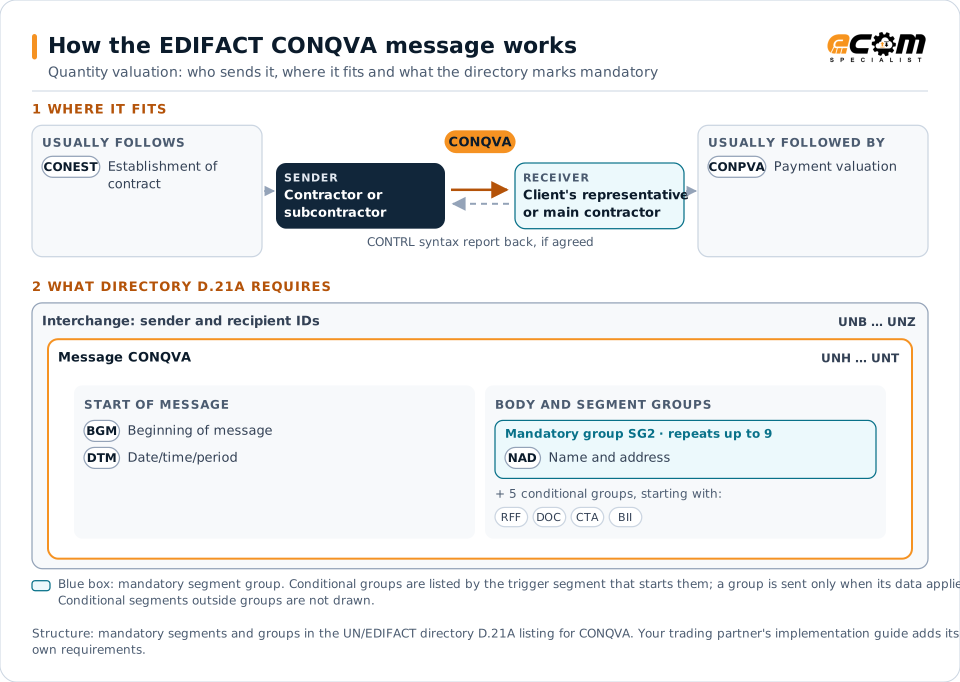
How to read this diagram: the top row shows who sends CONQVA, to whom, and which messages usually come before and after it. The lower part shows what the directory D.21A itself requires: the envelopes around CONQVA and the segments and segment groups it marks mandatory. Conditional groups are listed by their trigger segment rather than drawn in full. This is the directory's minimum, not a trading partner's requirement: a message implementation guide, such as an industry subset or a partner’s own guide, usually makes some conditional groups mandatory, restricts the codes and may use an older directory.
When it is used
- Reporting monthly progress on contract items
- Reporting subcontractor progress to the main contractor
- Supporting interim payment applications
Where it fits in the message flow
Structure
Mandatory segments in CONQVA (directory D.21A)
In UN/EDIFACT directory D.21A, the CONQVA message has 29 segment positions arranged in 9 segment groups. These are the segments and segment groups marked mandatory at message level, in order; a mandatory group is shown with the segment that starts it. Segments inside conditional groups are needed only when the group is used. This is the directory’s requirement, not your trading partner’s: each partner’s message implementation guide names the directory it uses, often an older one such as D.96A or D.01B where the structure can differ, makes some conditional segments mandatory and restricts the codes.
- UNH
- BGM
- DTM
- SG2 (NAD)
- UNT
Practical example
CONQVA in practice
At the end of each month, a contractor sends the client's quantity surveyor a CONQVA with the cumulative quantities completed for each contract item. The surveyor checks a sample against site measurements, agrees the quantities and prepares the payment valuation.
Implementation
Implementation considerations for CONQVA
- Report cumulative quantities against contract item references.
- Support disputed quantities with measurement details.
- Align reporting periods with the payment cycle.
- Separate variations from original contract items.
How ECOM helps
Automate CONQVA with ECOM
Industry
Industrial Manufacturing
Distributor, OEM customer and supplier integration for industrial manufacturers.
Solution
Financial Document Automation
Automate invoices, remittances, payment files and bank statements from capture to posting.
Solution
Supply Chain Visibility
Track orders, shipments and invoices across partners and catch exceptions early.
Compare X12 and EDIFACT, or see answers to general questions in the EDI FAQ.
Related messages
Related projects and construction messages
Need help with CONQVA?
ECOM maps, tests and monitors EDIFACT messages for your trading partners and integrates them with your ERP.