
EDIFACT message guide · Projects and construction
CONDPV Direct payment valuation
The UN/EDIFACT message a contractor uses to instruct the party responsible for payments to pay subcontractors for work completed.
- Sent by
- Main contractor
- Received by
- Party responsible for payments, such as the client
- Standard
- UN/EDIFACT · Batch message
- X12 equivalent
- No direct equivalent
What is the EDIFACT CONDPV message?
CONDPV is the UN/EDIFACT direct payment valuation message. The directory defines it as the instruction by the contractor to the party responsible for payments to pay the subcontractors for work completed.
Some contracts and public procurement rules let the client pay approved subcontractors directly rather than through the main contractor. The direct payment valuation tells the payer how much each subcontractor is owed for the period, so the payments can be made and deducted from the main contractor's valuation. The amounts are usually based on agreed progress.
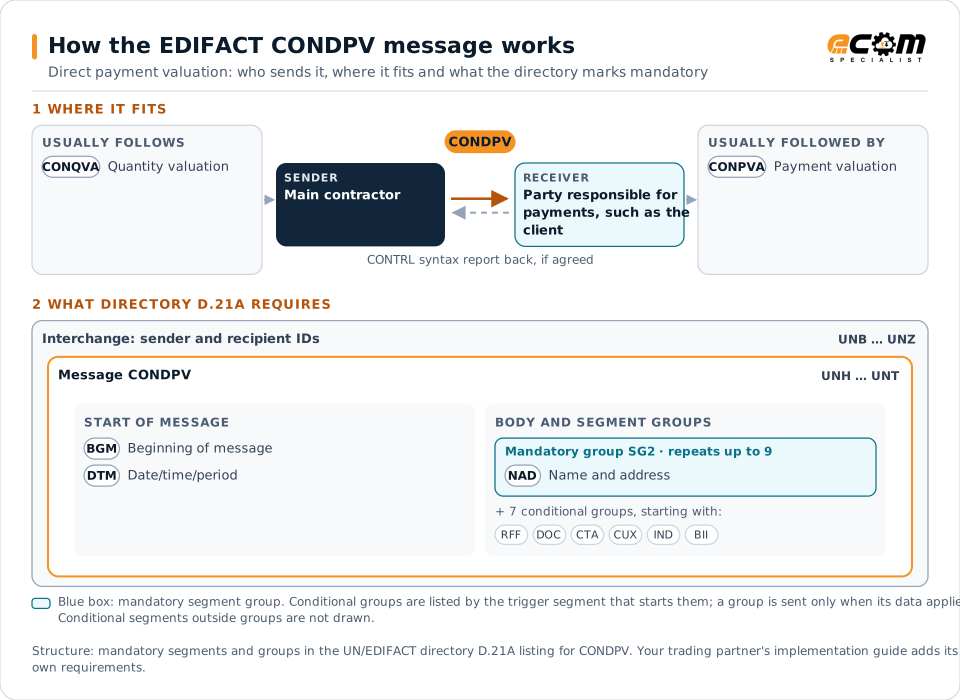
How to read this diagram: the top row shows who sends CONDPV, to whom, and which messages usually come before and after it. The lower part shows what the directory D.21A itself requires: the envelopes around CONDPV and the segments and segment groups it marks mandatory. Conditional groups are listed by their trigger segment rather than drawn in full. This is the directory's minimum, not a trading partner's requirement: a message implementation guide, such as an industry subset or a partner’s own guide, usually makes some conditional groups mandatory, restricts the codes and may use an older directory.
When it is used
- Instructing direct payment of subcontractors
- Splitting a period's valuation between contractors
- Supporting public works direct payment rules
Where it fits in the message flow
Structure
Mandatory segments in CONDPV (directory D.21A)
In UN/EDIFACT directory D.21A, the CONDPV message has 43 segment positions arranged in 15 segment groups. These are the segments and segment groups marked mandatory at message level, in order; a mandatory group is shown with the segment that starts it. Segments inside conditional groups are needed only when the group is used. This is the directory’s requirement, not your trading partner’s: each partner’s message implementation guide names the directory it uses, often an older one such as D.96A or D.01B where the structure can differ, makes some conditional segments mandatory and restricts the codes.
- UNH
- BGM
- DTM
- SG2 (NAD)
- UNT
Practical example
CONDPV in practice
On a public building project, the electrical subcontractor is paid directly by the authority. Each month the main contractor sends the authority a CONDPV stating the value of the subcontractor's completed work. The authority pays the subcontractor and deducts the amount from the main contractor's payment.
Implementation
Implementation considerations for CONDPV
- Confirm that the contract allows direct payment.
- Base amounts on agreed subcontractor progress.
- Keep main contractor and subcontractor valuations consistent.
- Record payments for both parties' accounts.
How ECOM helps
Automate CONDPV with ECOM
Industry
Industrial Manufacturing
Distributor, OEM customer and supplier integration for industrial manufacturers.
Solution
Financial Document Automation
Automate invoices, remittances, payment files and bank statements from capture to posting.
Solution
Procure-to-Pay Automation
Automate purchasing, receiving and supplier invoicing across EDI, portals and documents.
Compare X12 and EDIFACT, or see answers to general questions in the EDI FAQ.
Related messages
Related projects and construction messages
Need help with CONDPV?
ECOM maps, tests and monitors EDIFACT messages for your trading partners and integrates them with your ERP.