
X12 transaction guide · Acknowledgments
EDI 999 Implementation Acknowledgment
The X12 acknowledgment that reports whether received transactions passed syntax checks and the rules of the implementation guide they follow.
- Sent by
- Receiver of the original transactions
- Received by
- Sender of the original transactions
- Standard
- ANSI ASC X12
What is an EDI 999?
The EDI 999 Implementation Acknowledgment is the ANSI X12 transaction set used to report the results of the syntactical and relational analysis of received transactions, based on a full X12 transaction set or an implemented subset of it. In other words, it reports not only whether a document follows X12 syntax but also whether it follows the rules of the implementation guide in use.
The 999 is the standard acknowledgment for HIPAA healthcare transactions in version 5010, where it replaces the 997. It reports acceptance or rejection at the functional group and transaction set level, with the segments and elements in error.
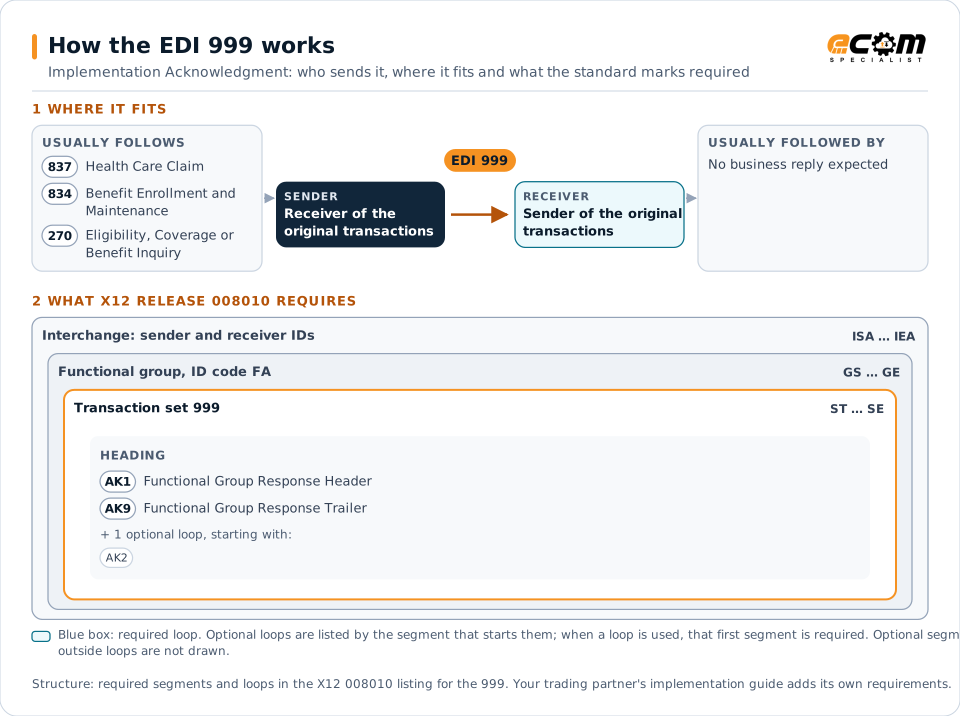
How to read this diagram: the top row shows who sends the 999, to whom, and which documents usually come before and after it. The lower part shows what X12 release 008010 itself requires: the envelopes around the 999 and the segments and loops the standard marks as required, area by area. Optional loops are listed by the segment that starts them rather than drawn in full. This is the standard's minimum, not a trading partner's requirement: each partner's implementation guide usually makes some optional loops mandatory, restricts the codes and may use a different release.
When it is used
- Acknowledging HIPAA claims, enrollments and other healthcare transactions
- Reporting implementation guide errors, not only syntax errors
- Confirming receipt of batches from clearinghouses
Where it fits in the document flow
Structure
Mandatory segments in the 999 (X12 release 008010)
The segments X12 release 008010 marks as mandatory at their level, in order. Segments inside optional loops are needed only when the loop is used. This is the standard's requirement, not your trading partner's: each partner's implementation guide names the release it uses, adds the optional segments it requires and restricts the values. The requirement status comes from one published X12 reference listing and has not been checked against a second source.
- ST
- AK1
- AK2
- IK3
- IK4
- IK5
- AK9
- SE
Practical example
The 999 in practice
A clearinghouse sends a payer a batch of 837 claims. The payer returns a 999 accepting the functional group but rejecting one claim whose diagnosis code element breaks an implementation guide rule. The clearinghouse alerts the provider, who corrects the code and resubmits that claim.
Implementation
Implementation considerations for the 999
- Reconcile every outbound batch with its 999 and alert on missing acknowledgments.
- Report rejected transactions to the team that can fix the data.
- Remember that a 999 confirms structure, not business acceptance or payment.
How ECOM helps
Automate the 999 with ECOM
Industry
Healthcare
Secure B2B integration and file transfer for providers, suppliers, distributors and healthcare partners.
Solution
EDI Integration
Exchange X12 and EDIFACT documents with partners and integrate them directly with your ERP.
Service
Fully Managed EDI
ECOM operates your defined EDI services end to end under a service agreement.
More general questions about EDI are answered in the EDI FAQ.
Related transactions
Related acknowledgments documents
Need help with the EDI 999?
ECOM maps, tests and monitors X12 documents for your trading partners and integrates them with your ERP.