
X12 transaction guide · Shipping and logistics
EDI 990 Response to a Load Tender
The X12 document a carrier sends to accept or decline a load tender received in an EDI 204.
- Sent by
- Motor carrier
- Received by
- Shipper, broker or 3PL
- Standard
- ANSI ASC X12
What is an EDI 990?
The EDI 990 Response to a Load Tender is the ANSI X12 transaction set a motor carrier sends to tell the tendering party whether it accepts or declines a load offered in a 204. It references the shipment identification number from the tender and the carrier's SCAC, and it can include a reason when a load is declined.
The 990 is short, but timing matters. Many tendering processes move the load to the next carrier if no response arrives within a set window, so carriers usually automate 990s from their transportation management system. A missing or late 990 is one of the most common causes of lost loads and tendering confusion.
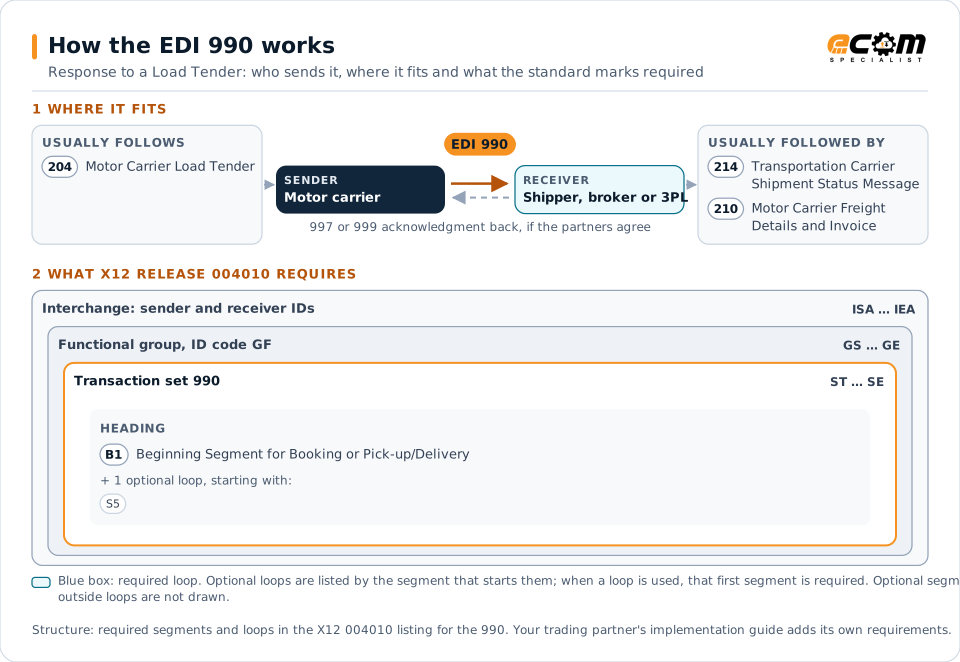
How to read this diagram: the top row shows who sends the 990, to whom, and which documents usually come before and after it. The lower part shows what X12 release 004010 itself requires: the envelopes around the 990 and the segments and loops the standard marks as required, area by area. Optional loops are listed by the segment that starts them rather than drawn in full. This is the standard's minimum, not a trading partner's requirement: each partner's implementation guide usually makes some optional loops mandatory, restricts the codes and may use a different release.
When it is used
- Accepting a load tender so the shipper can confirm the carrier
- Declining a tender so the shipper can offer the load to another carrier
- Confirming acceptance of updates to a previously accepted load
Where it fits in the document flow
Structure
Key segments in the 990
The segments most implementations use, described in plain language. The last column shows what X12 release 004010 itself requires: "Required" marks a segment the standard requires in every 990; "Optional, common" marks a segment the standard leaves optional, or that sits in an optional loop, but that implementations often use. This is the standard's requirement, not your trading partner's: each partner's implementation guide names the release it uses, makes some optional segments mandatory and restricts the values, and requirements can differ between releases. The requirement status comes from one published X12 reference listing and has not been checked against a second source.
| Segment | Name | What it carries | In X12 004010 |
|---|---|---|---|
| B1 | Beginning Segment for Booking or Pick-up/Delivery | Carrier SCAC, the shipment identification number from the 204, the date and the accept or decline code. | Required |
| N9 | Reference Identification | Additional references, such as the carrier's own load number. | Optional, common |
| V9 | Event Detail | Event details such as the date and time of the decision, where partners require it. | Optional, common |
| K1 | Remarks | Free-form remarks, such as a reason for declining. | Optional, common |
Example
Sample EDI 990
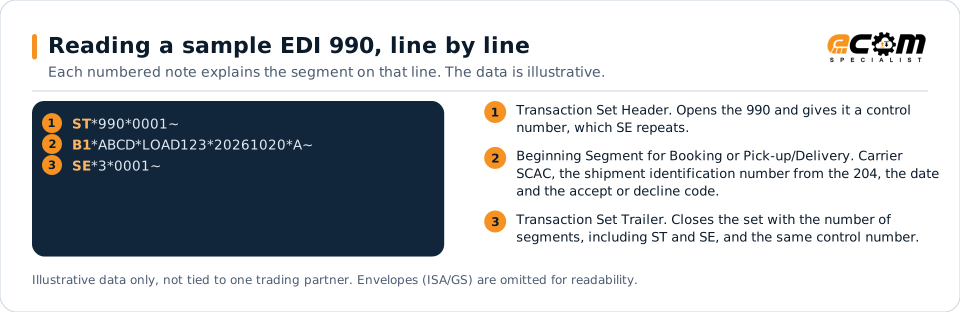
Carrier ABCD accepts (A) load LOAD123 on the tender date. A decline would use the decline code and may include a reason in a K1 remark.
Illustrative data only, not tied to one X12 release or trading partner. The interchange (ISA/IEA) and functional group (GS/GE) envelopes are omitted for readability.
ST*990*0001~
B1*ABCD*LOAD123*20261020*A~
SE*3*0001~The sample is the same one shown above, with a note beside each segment the first time it appears. Segment IDs are highlighted at the start of each line; the fields after them are separated by asterisks, and each segment ends with a tilde.
Avoid problems
Common 990 errors and how to prevent them
Responding too late
Tenders often expire if not answered promptly. Automate responses from the TMS rather than manual review.
Wrong shipment reference
The 990 must echo the shipment identification number from the 204 exactly, or the shipper cannot match it.
Accepting without capacity
Accepting loads that cannot be covered damages carrier scorecards. Responses should reflect real capacity.
Trading partners
Integration guides that include the 990







How ECOM helps
Automate the 990 with ECOM
Solution
Logistics Automation
Automate tenders, status updates, freight invoices and warehouse orders with logistics partners.
Industry
Trucking and Transportation
Load tenders, responses, status and freight invoices for carriers, brokers and shippers, integrated with the TMS.
Product
PRISM-SCV
Order lifecycle visibility, response monitoring, routed alerts and business-identifier search across your B2B transactions.
EDI 990 FAQs
What does an EDI 990 do?
It tells the shipper or broker whether the carrier accepts or declines a load tendered in a 204.
Is the 990 required?
Most shippers and brokers that tender by EDI expect a 990, and many re-tender loads that go unanswered.
What follows an accepted 990?
The carrier sends 214 shipment status messages as the freight moves and a 210 freight invoice after delivery.
More general questions about EDI are answered in the EDI FAQ.
Related transactions
Related shipping and logistics documents
Need help with the EDI 990?
ECOM maps, tests and monitors X12 documents for your trading partners and integrates them with your ERP.