
X12 transaction guide · Shipping and logistics
EDI 204 Motor Carrier Load Tender
The X12 document a shipper or broker sends to offer a shipment to a motor carrier, with stops, dates and freight details.
- Sent by
- Shipper, broker or 3PL
- Received by
- Motor carrier
- Standard
- ANSI ASC X12
- EDIFACT equivalent
- IFTMIN
What is an EDI 204?
The EDI 204 Motor Carrier Load Tender is the ANSI X12 transaction set a shipper, broker or third-party logistics provider uses to offer a shipment to a motor carrier. It describes the load, including pickup and delivery stops, dates and times, equipment, weights, commodities, references and payment terms, so the carrier can decide whether to accept it.
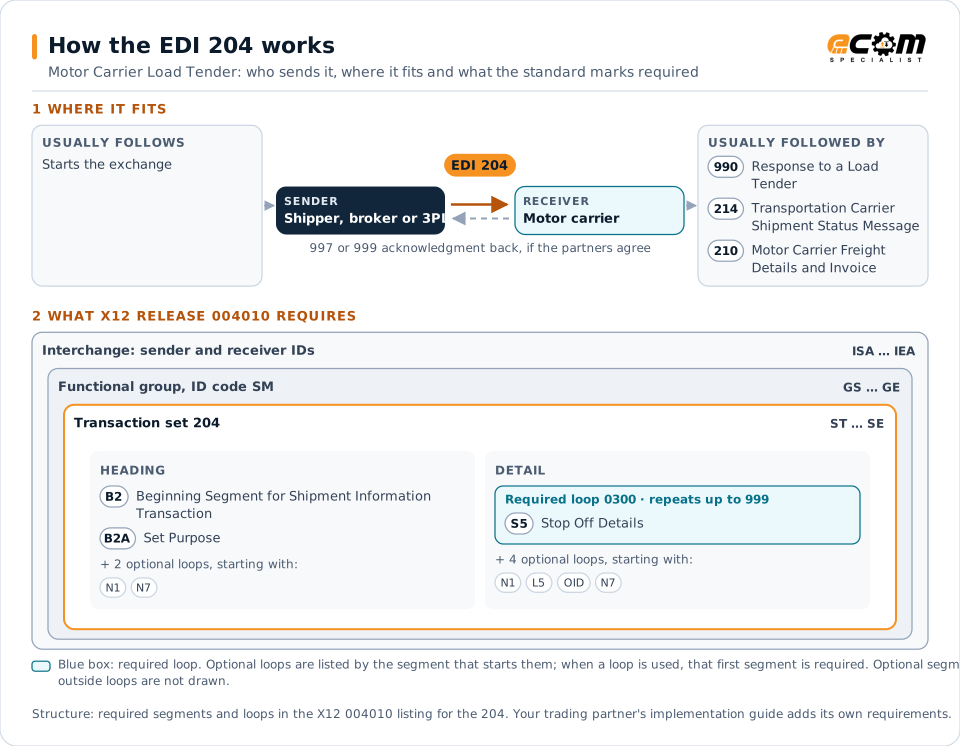
The 204 starts the transportation document cycle. The carrier responds with a 990 to accept or decline, sends 214 status messages as the freight moves, and bills with a 210 freight invoice. Tenders can also be updated or cancelled with a new 204 using a different purpose code.
How to read this diagram: the top row shows who sends the 204, to whom, and which documents usually come before and after it. The lower part shows what X12 release 004010 itself requires: the envelopes around the 204 and the segments and loops the standard marks as required, area by area. Optional loops are listed by the segment that starts them rather than drawn in full. This is the standard's minimum, not a trading partner's requirement: each partner's implementation guide usually makes some optional loops mandatory, restricts the codes and may use a different release.
When it is used
- Shippers tendering truckload or LTL shipments to contracted carriers
- Brokers and 3PLs offering loads to their carrier networks
- Updating or cancelling a previously tendered load
Where it fits in the document flow
Structure
Key segments in the 204
The segments most implementations use, described in plain language. The last column shows what X12 release 004010 itself requires: "Required" marks a segment the standard requires in every 204; "Optional, common" marks a segment the standard leaves optional, or that sits in an optional loop, but that implementations often use. This is the standard's requirement, not your trading partner's: each partner's implementation guide names the release it uses, makes some optional segments mandatory and restricts the values, and requirements can differ between releases. The requirement status comes from one published X12 reference listing and has not been checked against a second source.
| Segment | Name | What it carries | In X12 004010 |
|---|---|---|---|
| B2 | Beginning Segment for Shipment Information | Carrier SCAC, shipment identification number and payment method. | Required |
| B2A | Set Purpose | Whether the tender is original, an update or a cancellation. | Required |
| L11 | Business Instructions and Reference Number | References such as purchase order, bill of lading or customer reference numbers. | Optional, common |
| S5 loop | Stop Off Details | Each stop with its sequence, reason (load or unload), party, address and dates. | Required |
| L3 | Total Weight and Charges | Total weight and, where used, agreed charges. | Optional, common |
Example
Sample EDI 204
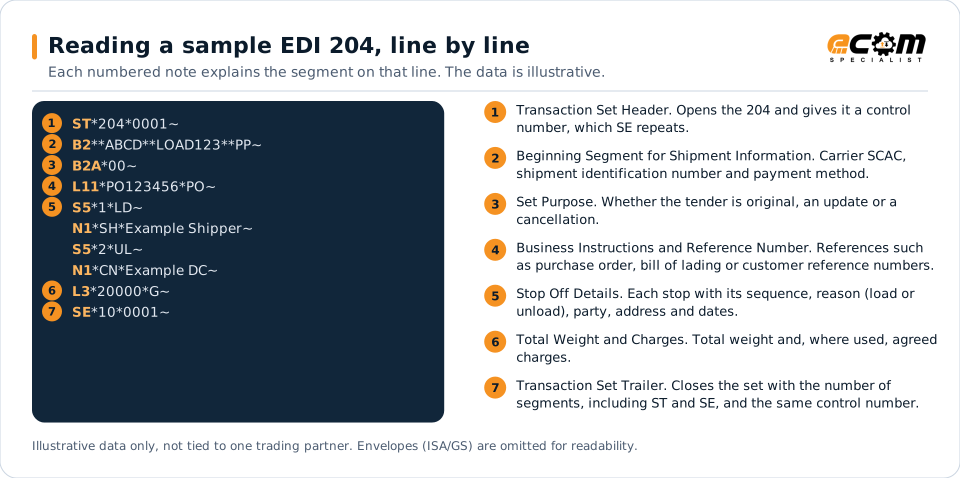
An original tender (B2A 00) of load LOAD123 to the carrier with SCAC ABCD, prepaid. The load has a pickup stop (LD) and a delivery stop (UL), and L3 gives a gross weight of 20,000.
Illustrative data only, not tied to one X12 release or trading partner. The interchange (ISA/IEA) and functional group (GS/GE) envelopes are omitted for readability.
ST*204*0001~
B2**ABCD**LOAD123**PP~
B2A*00~
L11*PO123456*PO~
S5*1*LD~
N1*SH*Example Shipper~
S5*2*UL~
N1*CN*Example DC~
L3*20000*G~
SE*10*0001~The sample is the same one shown above, with a note beside each segment the first time it appears. Segment IDs are highlighted at the start of each line; the fields after them are separated by asterisks, and each segment ends with a tilde.
Avoid problems
Common 204 errors and how to prevent them
Missing or wrong stop details
Incomplete addresses or appointment times lead carriers to decline tenders or arrive at the wrong time.
Updates sent as new tenders
Changes should use the update purpose code so carriers modify the existing load instead of creating a duplicate.
No follow-up on unanswered tenders
Tenders without a 990 response need monitoring and re-tendering to keep freight moving.
Trading partners
Integration guides that include the 204









How ECOM helps
Automate the 204 with ECOM
Solution
Logistics Automation
Automate tenders, status updates, freight invoices and warehouse orders with logistics partners.
Industry
Trucking and Transportation
Load tenders, responses, status and freight invoices for carriers, brokers and shippers, integrated with the TMS.
Product
PRISM-SCV
Order lifecycle visibility, response monitoring, routed alerts and business-identifier search across your B2B transactions.
EDI 204 FAQs
What is an EDI 204 used for?
A shipper, broker or 3PL uses the 204 to offer a shipment to a motor carrier with all the details needed to accept and plan the load.
How does a carrier respond to a 204?
With a 990 response to a load tender that accepts or declines the load, followed by 214 status messages and a 210 invoice if accepted.
Can a 204 cancel a load?
Yes. The purpose code in the B2A segment indicates whether the tender is original, an update or a cancellation.
More general questions about EDI are answered in the EDI FAQ.
Related transactions
Related shipping and logistics documents
Need help with the EDI 204?
ECOM maps, tests and monitors X12 documents for your trading partners and integrates them with your ERP.