
X12 transaction guide · Warehousing
EDI 945 Warehouse Shipping Advice
The X12 document a third-party warehouse sends to confirm what it shipped against a 940 shipping order.
- Sent by
- Third-party warehouse (3PL)
- Received by
- Depositor (brand, seller or manufacturer)
- Standard
- ANSI ASC X12
What is an EDI 945?
The EDI 945 Warehouse Shipping Advice is the ANSI X12 transaction set a third-party warehouse sends to the depositor to confirm that an order was shipped. It identifies the original shipping order, the shipment, the carrier and tracking or bill of lading references, and the quantities actually shipped for each line, including any shortages.
For the depositor, the 945 closes the fulfillment loop. It updates the order in the ERP, triggers customer invoicing and, for retail customers, often drives the advance ship notice the brand must send. An order is generally considered complete when an accurate 945 has been received for every 940 sent.
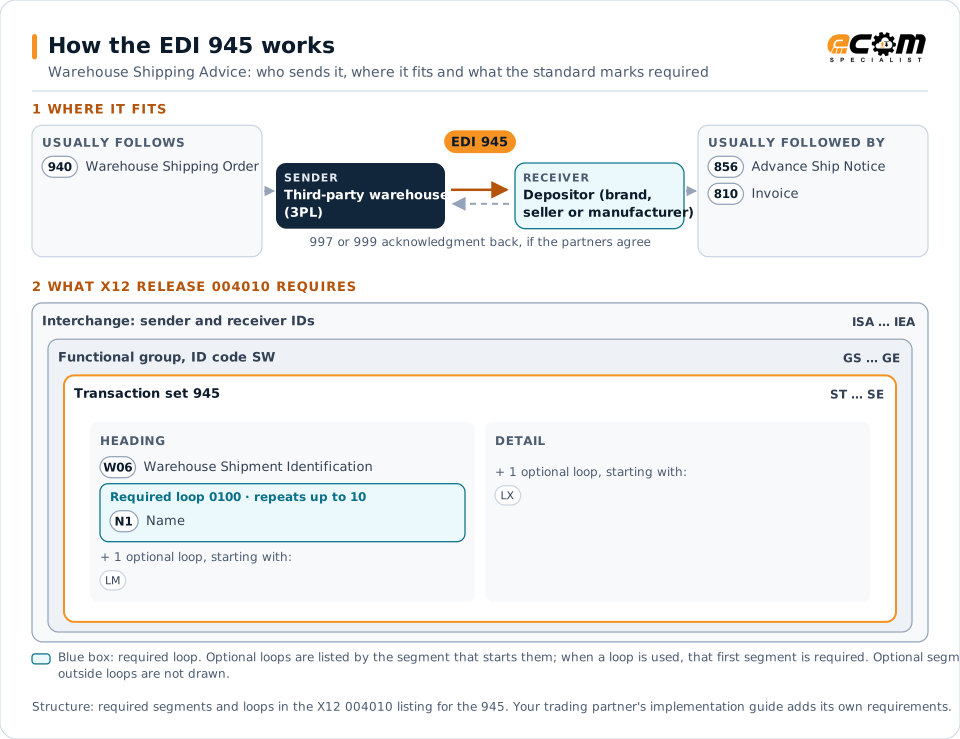
How to read this diagram: the top row shows who sends the 945, to whom, and which documents usually come before and after it. The lower part shows what X12 release 004010 itself requires: the envelopes around the 945 and the segments and loops the standard marks as required, area by area. Optional loops are listed by the segment that starts them rather than drawn in full. This is the standard's minimum, not a trading partner's requirement: each partner's implementation guide usually makes some optional loops mandatory, restricts the codes and may use a different release.
When it is used
- Confirming shipment of orders sent to a 3PL with a 940
- Reporting shortages or partial shipments
- Providing carrier and tracking information for customer notifications and ship notices
Where it fits in the document flow
Structure
Key segments in the 945
The segments most implementations use, described in plain language. The last column shows what X12 release 004010 itself requires: "Required" marks a segment the standard requires in every 945; "Optional, common" marks a segment the standard leaves optional, or that sits in an optional loop, but that implementations often use. This is the standard's requirement, not your trading partner's: each partner's implementation guide names the release it uses, makes some optional segments mandatory and restricts the values, and requirements can differ between releases. The requirement status comes from one published X12 reference listing and has not been checked against a second source.
| Segment | Name | What it carries | In X12 004010 |
|---|---|---|---|
| W06 | Warehouse Shipment Identification | Reporting code, depositor order number, ship date, shipment identification and purchase order number. | Required |
| N1 loop | Party Identification | Ship-to and other parties. | Required |
| W27 | Carrier Detail | Transportation method and carrier SCAC. | Optional, common |
| LX / W12 | Warehouse Item Detail | Shipment status, quantity ordered, quantity shipped, difference and product identifiers for each line. | Optional, common |
| W03 | Total Shipment Information | Total units shipped, weight and volume. | Optional, common |
Example
Sample EDI 945
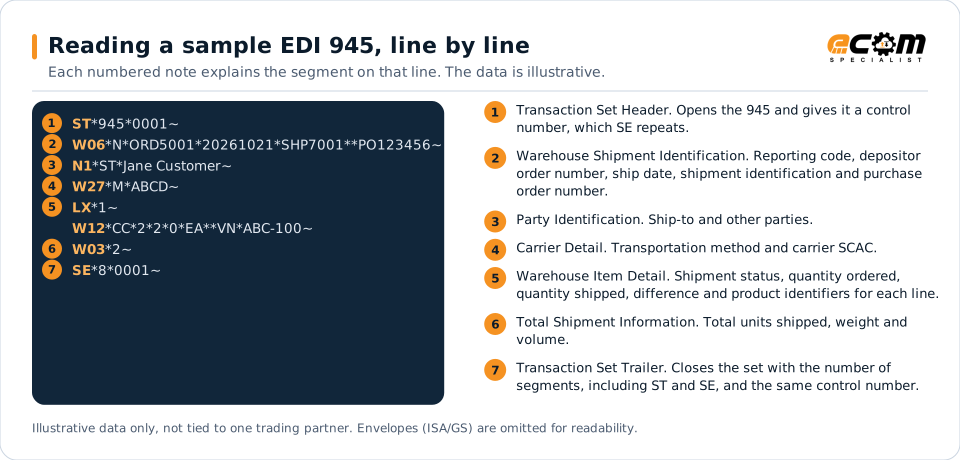
The 3PL confirms that order ORD5001 shipped complete (CC) on the ship date by carrier ABCD, with 2 of 2 units of item ABC-100 shipped and no shortage.
Illustrative data only, not tied to one X12 release or trading partner. The interchange (ISA/IEA) and functional group (GS/GE) envelopes are omitted for readability.
ST*945*0001~
W06*N*ORD5001*20261021*SHP7001**PO123456~
N1*ST*Jane Customer~
W27*M*ABCD~
LX*1~
W12*CC*2*2*0*EA**VN*ABC-100~
W03*2~
SE*8*0001~The sample is the same one shown above, with a note beside each segment the first time it appears. Segment IDs are highlighted at the start of each line; the fields after them are separated by asterisks, and each segment ends with a tilde.
Avoid problems
Common 945 errors and how to prevent them
Missing shortages
Shipped quantities must reflect what actually left the warehouse so the depositor invoices correctly.
No carrier references
Without tracking or bill of lading data, the depositor cannot build ship notices or notify customers.
Late confirmations
Delayed 945s delay invoicing and retailer ship notices. Send them at shipment confirmation.
Trading partners
Integration guides that include the 945

How ECOM helps
Automate the 945 with ECOM
Solution
Logistics Automation
Automate tenders, status updates, freight invoices and warehouse orders with logistics partners.
Industry
3PL and Warehousing
Warehouse orders, shipping advice, receipts and inventory reporting between brands, 3PLs, carriers and retailers.
Product
PRISM-SCV
Order lifecycle visibility, response monitoring, routed alerts and business-identifier search across your B2B transactions.
EDI 945 FAQs
What is the difference between a 945 and an 856?
A 945 is a warehouse's confirmation to the inventory owner. An 856 is a ship notice from the seller to its customer. Brands often generate the 856 from 945 data.
When should a 3PL send a 945?
When the shipment is confirmed in the warehouse system, so the depositor can invoice and notify customers promptly.
Can a 945 report partial shipments?
Yes. Line-level detail shows quantities ordered and shipped and the difference.
More general questions about EDI are answered in the EDI FAQ.
Related transactions
Related warehousing documents
Need help with the EDI 945?
ECOM maps, tests and monitors X12 documents for your trading partners and integrates them with your ERP.