
X12 transaction guide · Catalogs and pricing
EDI 877 Manufacturer Coupon Family Code Structure
The X12 document a manufacturer or agent uses to tell distributors which products belong to each coupon family code.
- Sent by
- Manufacturer or its agent
- Received by
- Distributor, retailer or coupon clearinghouse
- Standard
- ANSI ASC X12
What is an EDI 877?
The EDI 877 Manufacturer Coupon Family Code Structure is the ANSI X12 transaction set a manufacturer or third-party agent uses to notify a distributor or agent of coupon family code structures and the product codes associated with them. A family code groups the products a coupon can be redeemed against, so the point of sale can validate that the right product was bought.
Accurate family code data lets retailers accept valid coupons and reject misredemptions at the register, which reduces disputes when the retailer or its clearinghouse later claims reimbursement from the manufacturer.
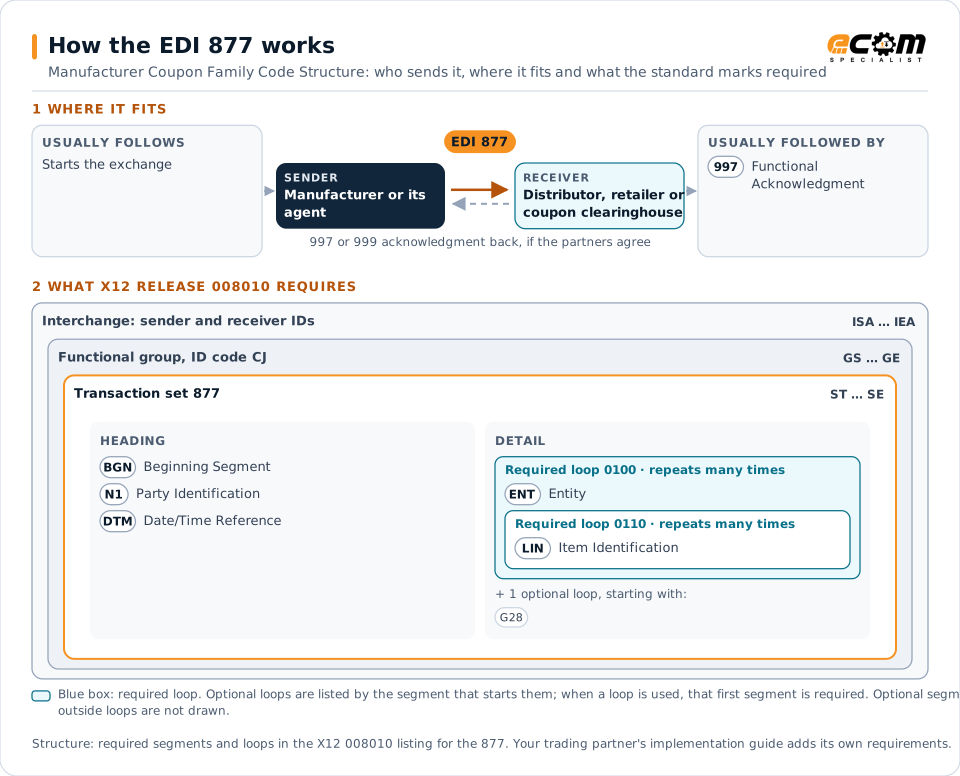
How to read this diagram: the top row shows who sends the 877, to whom, and which documents usually come before and after it. The lower part shows what X12 release 008010 itself requires: the envelopes around the 877 and the segments and loops the standard marks as required, area by area. Optional loops are listed by the segment that starts them rather than drawn in full. This is the standard's minimum, not a trading partner's requirement: each partner's implementation guide usually makes some optional loops mandatory, restricts the codes and may use a different release.
When it is used
- Publishing coupon family codes and their product lists
- Adding new products to an existing coupon family
- Removing discontinued products from a family
Where it fits in the document flow
Structure
Mandatory segments in the 877 (X12 release 008010)
The segments X12 release 008010 marks as mandatory at their level, in order. Segments inside optional loops are needed only when the loop is used. This is the standard's requirement, not your trading partner's: each partner's implementation guide names the release it uses, adds the optional segments it requires and restricts the values. The requirement status comes from one published X12 reference listing and has not been checked against a second source.
- ST
- BGN
- N1
- DTM
- ENT
- LIN
- G28
- SE
Practical example
The 877 in practice
A snack manufacturer launches two new flavors that should be covered by its existing coupon family. It sends retailers and its clearinghouse an 877 adding the new product codes to the family code with an effective date. The retailers' point-of-sale systems now accept the brand's coupons on the new flavors.
Implementation
Implementation considerations for the 877
- Send family changes before coupons on new products reach consumers.
- Keep product identifiers consistent with the item data sent in 888 item maintenance.
- Coordinate with the coupon notification (887) and redemption detail (881) processes.
- Check that partners still use family codes, as coupon formats have evolved.
How ECOM helps
Automate the 877 with ECOM
Industry
Consumer Goods
Retail, distributor, marketplace and direct-channel integration for consumer brands.
Industry
Retail
Retail and eCommerce EDI for suppliers and retailers, from purchase order to payment, with compliance built in.
Solution
B2B Integration
Connect every customer, supplier, carrier and bank across EDI, API, file and portal channels.
More general questions about EDI are answered in the EDI FAQ.
Related transactions
Related catalogs and pricing documents
Need help with the EDI 877?
ECOM maps, tests and monitors X12 documents for your trading partners and integrates them with your ERP.