
X12 transaction guide · Shipping and logistics
EDI 861 Receiving Advice/Acceptance Certificate
The X12 document a buyer sends to report the receipt of goods, or the formal acceptance of goods and services, including any differences from what was shipped.
- Sent by
- Buyer or receiving location
- Received by
- Supplier or vendor
- Standard
- ANSI ASC X12
- EDIFACT equivalent
- RECADV
What is an EDI 861?
The EDI 861 Receiving Advice/Acceptance Certificate is the ANSI X12 transaction set used to notify a trading partner that goods have been received, or that goods and services have been formally accepted. It reports what arrived against the purchase order or ship notice, including shortages, overages and damaged or rejected items.
Suppliers use 861 data to reconcile shipments with invoices and to resolve discrepancies before they become deductions. In some industries, acceptance recorded in an 861 is the trigger for payment.
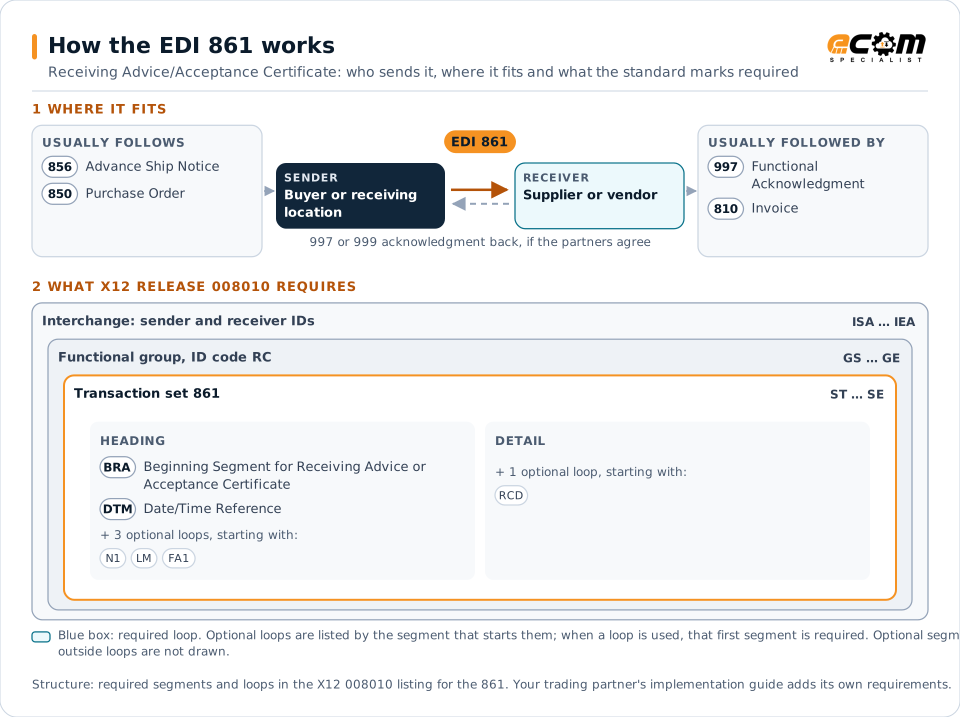
How to read this diagram: the top row shows who sends the 861, to whom, and which documents usually come before and after it. The lower part shows what X12 release 008010 itself requires: the envelopes around the 861 and the segments and loops the standard marks as required, area by area. Optional loops are listed by the segment that starts them rather than drawn in full. This is the standard's minimum, not a trading partner's requirement: each partner's implementation guide usually makes some optional loops mandatory, restricts the codes and may use a different release.
When it is used
- Confirming the quantities received against a ship notice
- Reporting shortages, overages or damage at receiving
- Recording formal acceptance of goods or services
Where it fits in the document flow
Structure
Mandatory segments in the 861 (X12 release 008010)
The segments X12 release 008010 marks as mandatory at their level, in order. Segments inside optional loops are needed only when the loop is used. This is the standard's requirement, not your trading partner's: each partner's implementation guide names the release it uses, adds the optional segments it requires and restricts the values. The requirement status comes from one published X12 reference listing and has not been checked against a second source.
- ST
- BRA
- DTM
- N1
- LM
- LQ
- FA1
- FA2
- RCD
- SLN
- SE
Practical example
The 861 in practice
A distribution center receives a shipment covered by an 856 listing 120 cartons. Two cartons are missing and one is damaged. The buyer's warehouse system sends an 861 reporting 117 cartons accepted, the shortage and the damage. The supplier adjusts its invoice to the accepted quantity, avoiding a deduction later.
Implementation
Implementation considerations for the 861
- Match receiving advices to the original order and ship notice by their reference numbers.
- Route shortages and damage to the team that issues credits or files freight claims.
- Agree whether the 861 or the invoice controls payment when quantities differ.
Trading partners
Integration guides that include the 861


How ECOM helps
Automate the 861 with ECOM
Industry
Retail
Retail and eCommerce EDI for suppliers and retailers, from purchase order to payment, with compliance built in.
Industry
3PL and Warehousing
Warehouse orders, shipping advice, receipts and inventory reporting between brands, 3PLs, carriers and retailers.
Solution
Order-to-Cash Automation
Automate the flow from purchase order to payment across every customer channel.
More general questions about EDI are answered in the EDI FAQ.
Related transactions
Related shipping and logistics documents
Need help with the EDI 861?
ECOM maps, tests and monitors X12 documents for your trading partners and integrates them with your ERP.