
X12 transaction guide · Finance
EDI 844 Product Transfer Account Adjustment
The X12 document a distributor uses to request a credit or adjustment, such as a chargeback, for products sold under a pre-authorized price agreement.
- Sent by
- Distributor or wholesaler
- Received by
- Manufacturer or vendor
- Standard
- ANSI ASC X12
What is an EDI 844?
The EDI 844 Product Transfer Account Adjustment is the ANSI X12 transaction set used to send a debit, credit or request for credit relating to pre-authorized product transfers. Its most common use is the chargeback: a distributor sells a product to a contracted end customer at a price lower than its own cost and claims the difference from the manufacturer.
Each 844 references the contract or price authorization, the end customer, the products, quantities and the amount claimed per line. The manufacturer validates the claim against its contracts and answers with an 849 response, accepting or rejecting each line. The 844 is used heavily in pharmaceutical, medical, electrical and industrial distribution.
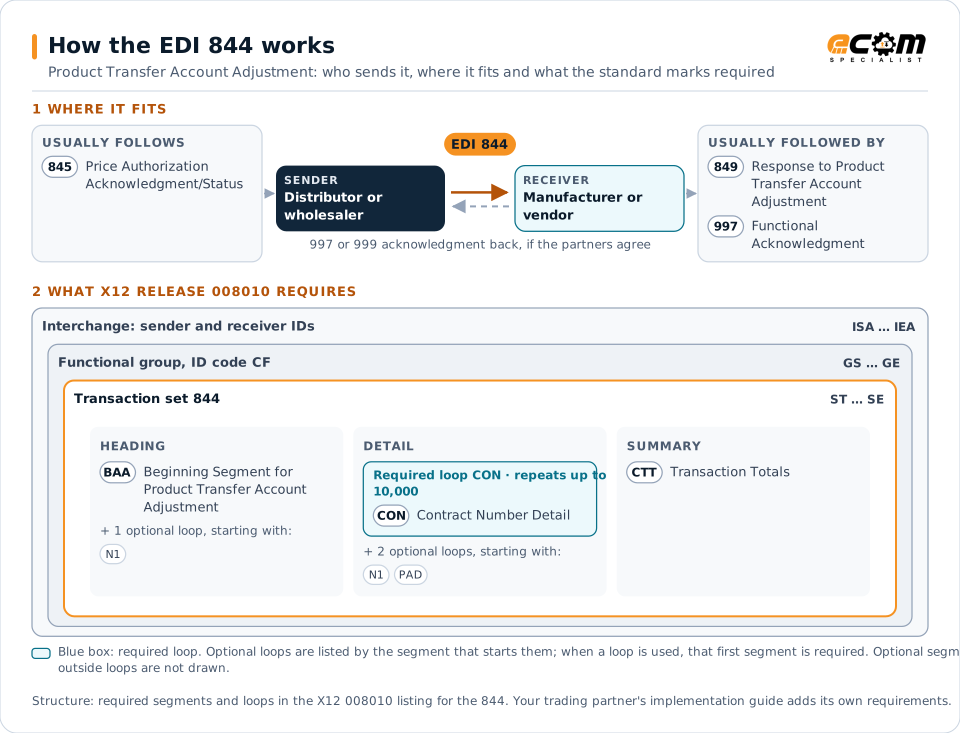
How to read this diagram: the top row shows who sends the 844, to whom, and which documents usually come before and after it. The lower part shows what X12 release 008010 itself requires: the envelopes around the 844 and the segments and loops the standard marks as required, area by area. Optional loops are listed by the segment that starts them rather than drawn in full. This is the standard's minimum, not a trading partner's requirement: each partner's implementation guide usually makes some optional loops mandatory, restricts the codes and may use a different release.
When it is used
- Claiming chargebacks for contract sales to end customers
- Requesting credit under a manufacturer's price authorization
- Resubmitting corrected chargeback lines after a rejection
Where it fits in the document flow
Structure
Mandatory segments in the 844 (X12 release 008010)
The segments X12 release 008010 marks as mandatory at their level, in order. Segments inside optional loops are needed only when the loop is used. This is the standard's requirement, not your trading partner's: each partner's implementation guide names the release it uses, adds the optional segments it requires and restricts the values. The requirement status comes from one published X12 reference listing and has not been checked against a second source.
- ST
- BAA
- N1
- CON
- SII
- PAD
- CTT
- SE
Practical example
The 844 in practice
A medical supplies distributor sells gloves to a hospital group at the manufacturer's contract price, which is below the distributor's acquisition cost. At the end of each day the distributor's system sends the manufacturer an 844 listing each contract sale, the contract number, the hospital's identifier, quantities and the credit claimed per unit. The manufacturer validates the lines and returns an 849 with the approved and rejected amounts.
Implementation
Implementation considerations for the 844
- Keep contract numbers and eligible customer lists synchronized with the manufacturer, since mismatches are the main rejection cause.
- Use the product and customer identifiers the manufacturer's contract system expects.
- Track each claim line through to the 849 response and the resulting credit.
- Build a process to correct and resubmit rejected lines within the manufacturer's deadline.
How ECOM helps
Automate the 844 with ECOM
Industry
Wholesale Distribution
Customer orders, supplier purchasing, catalogs and drop-ship for distributors.
Industry
Pharmaceuticals
Orders, ship notices, chargebacks and sales data exchange for pharma manufacturers and distributors.
Solution
Financial Document Automation
Automate invoices, remittances, payment files and bank statements from capture to posting.
More general questions about EDI are answered in the EDI FAQ.
Related transactions
Related finance documents
Need help with the EDI 844?
ECOM maps, tests and monitors X12 documents for your trading partners and integrates them with your ERP.