
X12 transaction guide · Healthcare and insurance
EDI 500 Medical Event Reporting
The X12 document used to make voluntary, mandatory and periodic reports on adverse effects and product problems with medications and medical devices.
- Sent by
- Manufacturer, healthcare facility or reporter
- Received by
- Regulatory agency or manufacturer
- Standard
- ANSI ASC X12
What is an EDI 500?
The EDI 500 Medical Event Reporting is the ANSI X12 transaction set that can be used to make voluntary, mandatory, baseline, annual and semi-annual reports on adverse effects and product problems involving medications and medical devices.
Manufacturers and healthcare facilities must report certain adverse events to regulators, who use the reports to detect safety problems. Many regulators now prescribe specific electronic reporting formats, so implementers should confirm which format each authority accepts. Reports can be initial reports or follow-up reports with the results of investigations, and they help regulators identify safety signals across many sources.
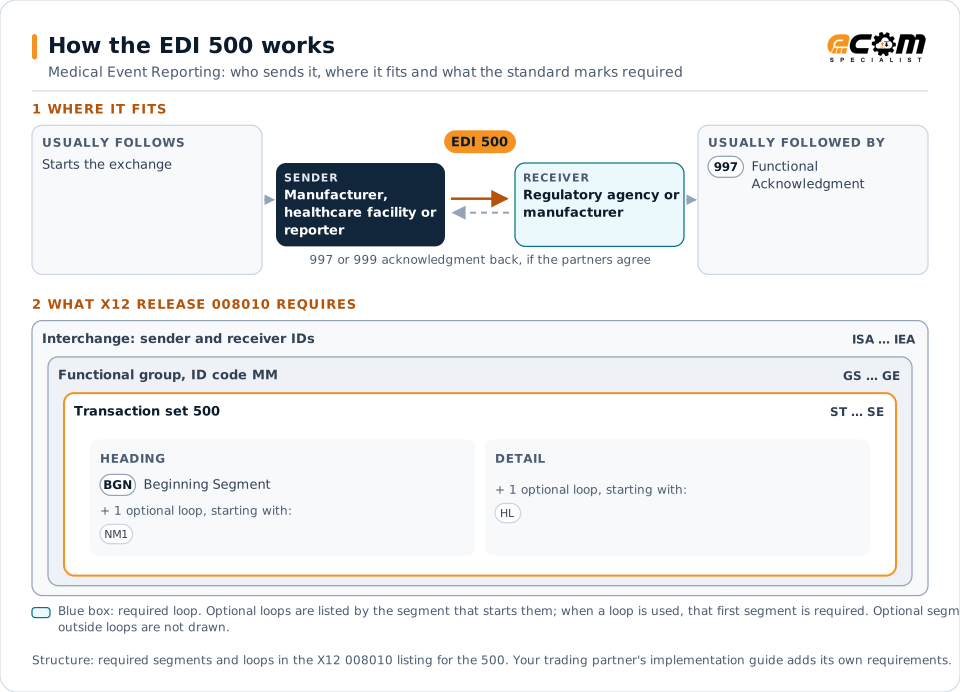
How to read this diagram: the top row shows who sends the 500, to whom, and which documents usually come before and after it. The lower part shows what X12 release 008010 itself requires: the envelopes around the 500 and the segments and loops the standard marks as required, area by area. Optional loops are listed by the segment that starts them rather than drawn in full. This is the standard's minimum, not a trading partner's requirement: each partner's implementation guide usually makes some optional loops mandatory, restricts the codes and may use a different release.
When it is used
- Reporting adverse drug reactions
- Reporting medical device malfunctions
- Submitting periodic safety reports
Where it fits in the document flow
Structure
Mandatory segments in the 500 (X12 release 008010)
The segments X12 release 008010 marks as mandatory at their level, in order. Segments inside optional loops are needed only when the loop is used. This is the standard's requirement, not your trading partner's: each partner's implementation guide names the release it uses, adds the optional segments it requires and restricts the values. The requirement status comes from one published X12 reference listing and has not been checked against a second source.
- ST
- BGN
- NM1
- LM
- LQ
- HL
- LIN
- QTY
- PID
- MTX
- SE
Practical example
The 500 in practice
A hospital's biomedical team finds that an infusion pump delivered an incorrect dose. The device manufacturer is informed and files a report with the regulator describing the device, the event, the patient outcome and its investigation. The regulator adds the report to its safety database.
Implementation
Implementation considerations for the 500
- Confirm the reporting format each regulator requires.
- Meet the mandatory reporting deadlines for each event.
- Protect patients' personal data under applicable law.
- Follow up initial reports with investigation results.
How ECOM helps
Automate the 500 with ECOM
Industry
Healthcare
Secure B2B integration and file transfer for providers, suppliers, distributors and healthcare partners.
Industry
Pharmaceuticals
Orders, ship notices, chargebacks and sales data exchange for pharma manufacturers and distributors.
Solution
EDI Integration
Exchange X12 and EDIFACT documents with partners and integrate them directly with your ERP.
More general questions about EDI are answered in the EDI FAQ.
Related transactions
Related healthcare and insurance documents
- 186Insurance Underwriting Requirements Reporting
- 111Individual Insurance Policy and Client Information
- 148Report of Injury, Illness or Incident
- 255Underwriting Information Services
- 269Health Care Benefit Coordination Verification
- 270Eligibility, Coverage or Benefit Inquiry
- 271Eligibility, Coverage or Benefit Information
- 274Healthcare Provider Information
- 275Patient Information
- 276Health Care Claim Status Request
- 277Health Care Information Status Notification
- 278Health Care Services Review Information
Need help with the EDI 500?
ECOM maps, tests and monitors X12 documents for your trading partners and integrates them with your ERP.