
X12 transaction guide · Healthcare and insurance
EDI 275 Patient Information
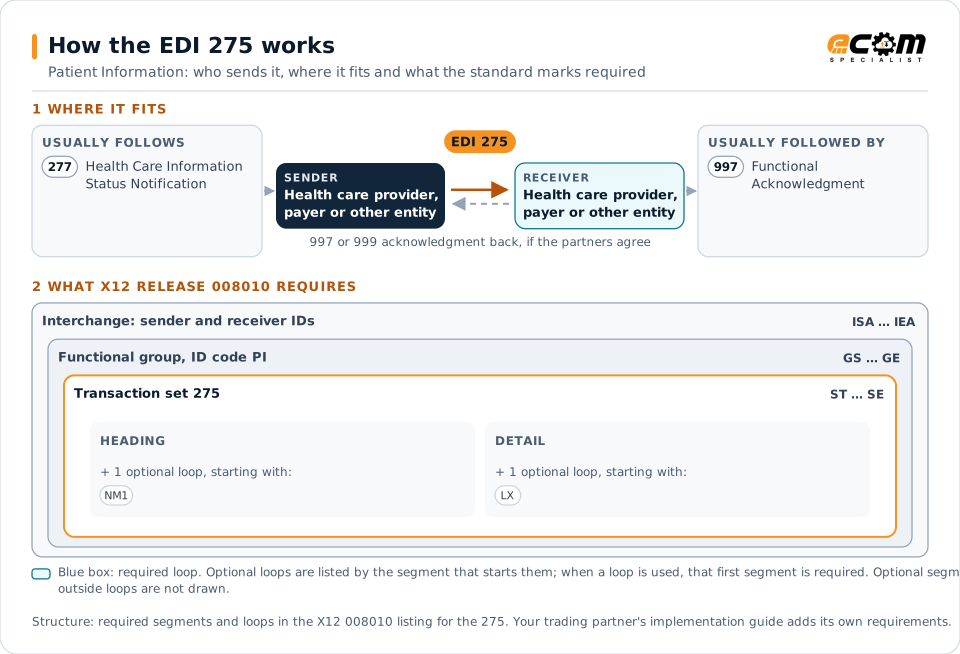
The X12 document used to request and send individual patient information between health care entities, solicited or unsolicited.
- Sent by
- Health care provider, payer or other entity
- Received by
- Health care provider, payer or other entity
- Standard
- ANSI ASC X12
What is an EDI 275?
The EDI 275 Patient Information is the ANSI X12 transaction set used to communicate requests for individual patient information, and the patient information itself, whether solicited or unsolicited, between separate health care entities in a variety of settings.
A common use is sending supporting documentation with or after a claim, such as clinical notes or reports that a payer needs to process it. The 275 can carry such attachments in electronic form, replacing faxed or mailed records. Its use for claim attachments depends on the rules in force in each market.
How to read this diagram: the top row shows who sends the 275, to whom, and which documents usually come before and after it. The lower part shows what X12 release 008010 itself requires: the envelopes around the 275 and the segments and loops the standard marks as required, area by area. Optional loops are listed by the segment that starts them rather than drawn in full. This is the standard's minimum, not a trading partner's requirement: each partner's implementation guide usually makes some optional loops mandatory, restricts the codes and may use a different release.
When it is used
- Sending claim attachments to payers
- Responding to requests for additional documentation
- Exchanging patient information between providers
Where it fits in the document flow
Structure
Mandatory segments in the 275 (X12 release 008010)
The segments X12 release 008010 marks as mandatory at their level, in order. Segments inside optional loops are needed only when the loop is used. This is the standard's requirement, not your trading partner's: each partner's implementation guide names the release it uses, adds the optional segments it requires and restricts the values. The requirement status comes from one published X12 reference listing and has not been checked against a second source.
- ST
- NM1
- NX1
- LX
- DTP
- OOI
- BDS
- SE
Practical example
The 275 in practice
A payer needs operative notes to process a surgical claim and requests them from the hospital. The hospital sends a 275 with the notes attached and the claim reference. The payer's claims system links the attachment to the claim and completes adjudication.
Implementation
Implementation considerations for the 275
- Protect patients' health information under applicable law.
- Link attachments to the right claim and patient.
- Check the attachment rules in force in your market.
- Send only the information requested or necessary.
How ECOM helps
Automate the 275 with ECOM
Industry
Healthcare
Secure B2B integration and file transfer for providers, suppliers, distributors and healthcare partners.
Solution
Intelligent Document Processing
Automate data capture from PDFs, emails and spreadsheets with validation and human review.
Solution
EDI Integration
Exchange X12 and EDIFACT documents with partners and integrate them directly with your ERP.
More general questions about EDI are answered in the EDI FAQ.
Related transactions
Related healthcare and insurance documents
- 277Health Care Information Status Notification
- 111Individual Insurance Policy and Client Information
- 148Report of Injury, Illness or Incident
- 186Insurance Underwriting Requirements Reporting
- 255Underwriting Information Services
- 269Health Care Benefit Coordination Verification
- 270Eligibility, Coverage or Benefit Inquiry
- 271Eligibility, Coverage or Benefit Information
- 274Healthcare Provider Information
- 276Health Care Claim Status Request
- 278Health Care Services Review Information
- 429Railroad Retirement Activity
Need help with the EDI 275?
ECOM maps, tests and monitors X12 documents for your trading partners and integrates them with your ERP.