
The short answer
Retail EDI chargebacks are deductions retailers apply when suppliers miss requirements, most often for late or inaccurate ship notices, label errors, missing acknowledgments and invoice discrepancies. Prevent them by generating documents and labels from real warehouse and ERP data, sending them on time automatically, monitoring every order against each retailer's rules, and reviewing deductions to fix root causes.
The first three steps prevent deductions; the last recovers the invalid ones. Evidence such as transmission logs, acknowledgments, MDNs and proof of delivery supports disputes.
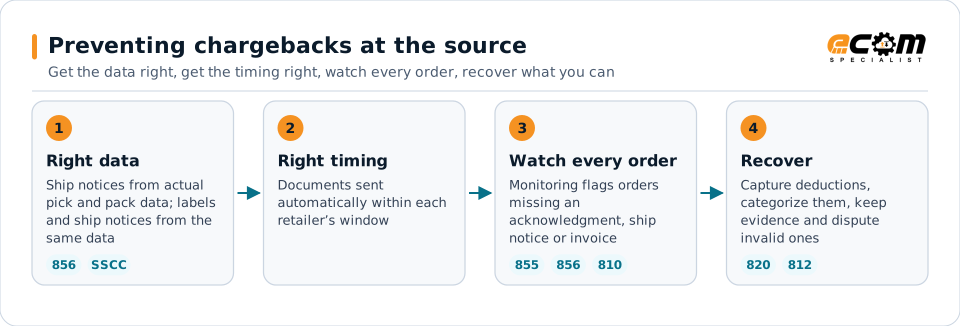
Why retailers issue chargebacks
Large retailers run tightly scheduled distribution networks. When a ship notice is late or wrong, receiving slows down, inventory records go out of sync and labor costs rise. Compliance programs and chargebacks push suppliers to get documents right. Each retailer sets its own rules, fees and dispute processes, published in its vendor or routing guides.
The most common causes
| Cause | What usually goes wrong |
|---|---|
| Late ship notice | The 856 is sent after the shipment arrives or outside the required window |
| Inaccurate ship notice | Quantities, items or carton contents do not match what arrived |
| Label errors | Missing, unreadable or mismatched GS1-128 carton labels |
| Missing acknowledgments | No 855 or 997 within the expected time |
| Invoice discrepancies | Prices, quantities or references that do not match the order or receipt |
| Routing violations | Shipments that ignore the retailer’s routing or appointment rules |
Prevention: get the data right at the source
- Build ship notices from actual pick and pack data, not from the order. What was shipped, not what was ordered, is what the retailer receives.
- Print labels and create ship notices from the same data, so the SSCC on each carton always matches the ship notice.
- Invoice shipped quantities at agreed prices, generated from ERP billing.
- Keep item, location and pricing data current for each retailer.
Prevention: get the timing right
- Trigger acknowledgments automatically when orders are accepted.
- Send ship notices at shipment confirmation, not in an end-of-day batch.
- Alert when a document is approaching its deadline, not after it is late.
- Cover weekends and holidays with monitoring.
Prevention: watch every order
Monitoring each order across its lifecycle, from purchase order to acknowledgment, ship notice and invoice, catches gaps while there is still time to act. Useful alerts include:
- Orders without an acknowledgment within the expected time
- Shipments without a ship notice
- Ship notices rejected or reported in an 824
- Invoices without a matching receipt
Recover what you can
Even with good prevention, some chargebacks will occur, and some will be invalid. To recover them:
- Capture deduction data electronically from remittances and adjustment documents.
- Categorize deductions by reason code and retailer.
- Keep evidence: transmission logs, acknowledgments, MDNs and proof of delivery.
- Dispute invalid deductions within each retailer’s window.
- Fix root causes for valid ones so they do not recur.
A quick self-assessment
- Ship notices are generated from warehouse data, not orders
- Labels and ship notices come from the same source
- Outbound documents are triggered by business events
- Every order is tracked through acknowledgment, shipment and invoice
- Deductions are captured, categorized and reviewed monthly
- Evidence is retained long enough for retailer dispute windows