
EDIFACT message guide · Healthcare and social
MEDREQ Medical service request
The UN/EDIFACT message a requester sends a service provider to order investigations, or to change or cancel an order.
- Sent by
- Requesting clinician, practice or hospital
- Received by
- Laboratory or other service provider
- Standard
- UN/EDIFACT · Batch message
- X12 equivalent
- No direct equivalent
What is the EDIFACT MEDREQ message?
MEDREQ is the UN/EDIFACT medical service request. The directory defines it as a message sent from a service requester to a service provider to order investigations, to modify a previous order or ordered investigation, or to cancel a previous order.
Laboratory tests and other investigations are ordered electronically so the provider receives the patient identification, the tests requested and clinical information without transcription. Results come back in MEDRPT. Many health systems now use HL7 standards for the same purpose. Orders can be changed or cancelled.
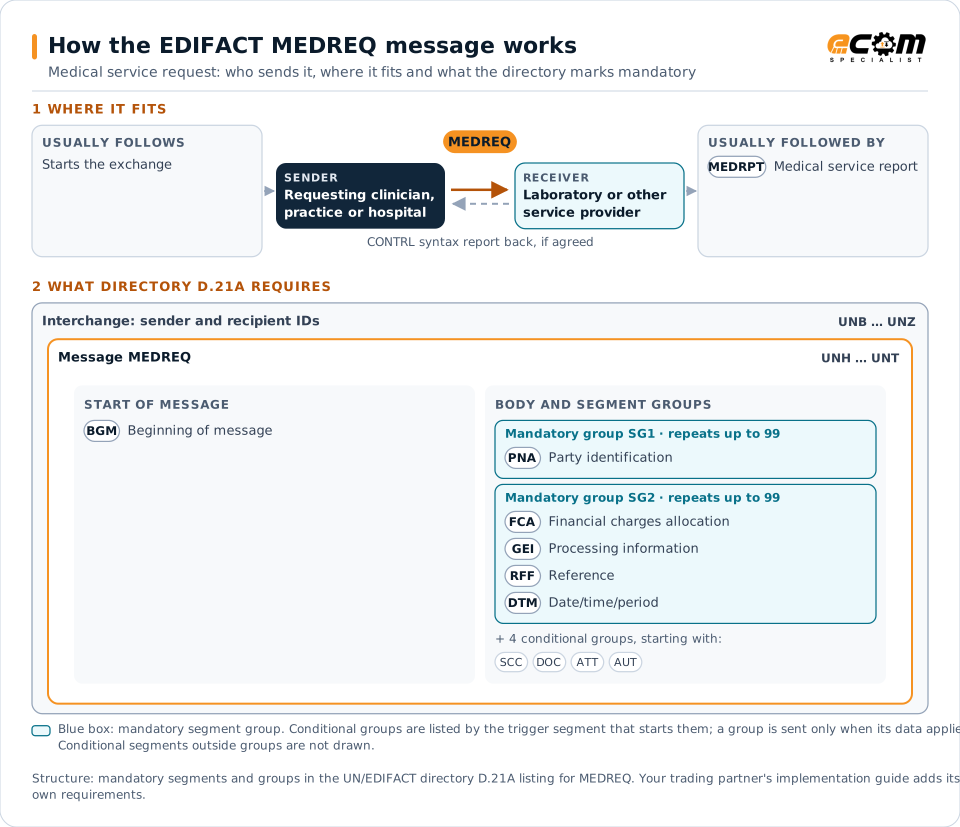
How to read this diagram: the top row shows who sends MEDREQ, to whom, and which messages usually come before and after it. The lower part shows what the directory D.21A itself requires: the envelopes around MEDREQ and the segments and segment groups it marks mandatory. Conditional groups are listed by their trigger segment rather than drawn in full. This is the directory's minimum, not a trading partner's requirement: a message implementation guide, such as an industry subset or a partner’s own guide, usually makes some conditional groups mandatory, restricts the codes and may use an older directory.
When it is used
- Ordering laboratory tests
- Modifying or cancelling ordered investigations
- Requesting other diagnostic services
Where it fits in the message flow
Structure
Mandatory segments in MEDREQ (directory D.21A)
In UN/EDIFACT directory D.21A, the MEDREQ message has 114 segment positions arranged in 17 segment groups. These are the segments and segment groups marked mandatory at message level, in order; a mandatory group is shown with the segment that starts it. Segments inside conditional groups are needed only when the group is used. This is the directory’s requirement, not your trading partner’s: each partner’s message implementation guide names the directory it uses, often an older one such as D.96A or D.01B where the structure can differ, makes some conditional segments mandatory and restricts the codes.
- UNH
- BGM
- SG1 (PNA)
- SG2 (FCA)
- UNT
Practical example
MEDREQ in practice
A general practitioner orders blood tests for a patient. The practice system sends the laboratory a MEDREQ with the patient's identification, the tests requested and relevant clinical details. The laboratory registers the order when the sample arrives and later returns the results with MEDRPT.
Implementation
Implementation considerations for MEDREQ
- Comply with health data protection laws.
- Use test codes the laboratory recognizes.
- Identify patients reliably to avoid mismatched results.
- Check whether partners use HL7 or another national standard instead.
How ECOM helps
Automate MEDREQ with ECOM
Industry
Healthcare
Secure B2B integration and file transfer for providers, suppliers, distributors and healthcare partners.
Solution
B2B Integration
Connect every customer, supplier, carrier and bank across EDI, API, file and portal channels.
Solution
EDI Integration
Exchange X12 and EDIFACT documents with partners and integrate them directly with your ERP.
Compare X12 and EDIFACT, or see answers to general questions in the EDI FAQ.
Related messages
Related healthcare and social messages
- MEDRPTMedical service report
- MEDPREMedical prescription
- MEDRUCMedical resource usage and cost
- COPAYMContributions for payment
- IHCEBIInteractive health insurance eligibility and benefits inquiry and response
- IHCLMEHealth care claim or encounter request and response
- MEDPIDPerson identification
- SOCADESocial administration
- SSIMODModification of identity details
- SSRECHWorker's insurance history
- SSREGWNotification of registration of a worker
Need help with MEDREQ?
ECOM maps, tests and monitors EDIFACT messages for your trading partners and integrates them with your ERP.