
EDIFACT message guide · Statistics and reporting
GESMES Generic statistical
The UN/EDIFACT message used to exchange statistical data and related metadata between statistical organizations.
- Sent by
- Statistical office, central bank or international organization
- Received by
- Another statistical organization or data user
- Standard
- UN/EDIFACT · Batch message
- X12 equivalent
- No direct equivalent
What is the EDIFACT GESMES message?
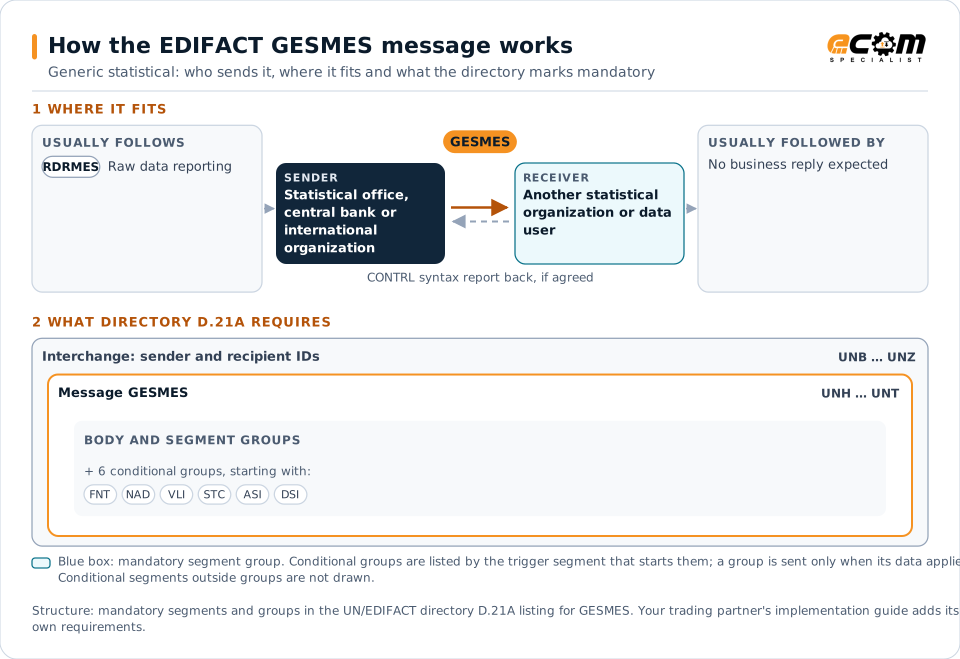
GESMES is the UN/EDIFACT generic statistical message. The directory places it in the chain of statistics compilation, from raw data collection through harmonization and aggregation to aggregated statistical data. GESMES is designed for exchanging statistical data and the metadata that describes it, such as code lists and data structure definitions, between organizations.
Central banks and statistical agencies used GESMES, notably the GESMES/TS profile for time series, to exchange economic statistics. Many have since moved to the SDMX standard, which grew out of this work.
How to read this diagram: the top row shows who sends GESMES, to whom, and which messages usually come before and after it. The lower part shows what the directory D.21A itself requires: the envelopes around GESMES and the segments and segment groups it marks mandatory. Conditional groups are listed by their trigger segment rather than drawn in full. This is the directory's minimum, not a trading partner's requirement: a message implementation guide, such as an industry subset or a partner’s own guide, usually makes some conditional groups mandatory, restricts the codes and may use an older directory.
When it is used
- Exchanging time series between statistical agencies
- Sending code lists and data structure definitions
- Reporting aggregated statistics to international organizations
Where it fits in the message flow
Structure
Mandatory segments in GESMES (directory D.21A)
In UN/EDIFACT directory D.21A, the GESMES message has 63 segment positions arranged in 25 segment groups. These are the segments and segment groups marked mandatory at message level, in order; a mandatory group is shown with the segment that starts it. Segments inside conditional groups are needed only when the group is used. This is the directory’s requirement, not your trading partner’s: each partner’s message implementation guide names the directory it uses, often an older one such as D.96A or D.01B where the structure can differ, makes some conditional segments mandatory and restricts the codes.
- UNH
- UNT
Practical example
GESMES in practice
A national central bank reports monthly monetary statistics to a regional central bank. It sends the time series with their identifying dimensions and observation values in a GESMES message using the agreed data structure. The receiving bank loads the series into its statistical database for aggregation.
Implementation
Implementation considerations for GESMES
- Agree the data structure definitions and code lists in advance.
- Check whether partners now require SDMX instead of GESMES.
- Version changes to metadata and code lists carefully.
- Validate observation values against expected ranges.
How ECOM helps
Automate GESMES with ECOM
Industry
Financial Services
Secure file transfer and B2B integration for banks and financial institutions.
Solution
EDI Integration
Exchange X12 and EDIFACT documents with partners and integrate them directly with your ERP.
Solution
Enterprise Integration
Any-to-any integration across partners, systems, protocols, security requirements, formats and ERPs, in batch or real time.
Compare X12 and EDIFACT, or see answers to general questions in the EDI FAQ.
Related messages
Related statistics and reporting messages
Need help with GESMES?
ECOM maps, tests and monitors EDIFACT messages for your trading partners and integrates them with your ERP.