
EDIFACT message guide · Master data
CLASET Classification information set
The UN/EDIFACT message used to exchange classifications, meaning tree structures or code lists and the links between them.
- Sent by
- Classification owner or data provider
- Received by
- Trading partner or data user
- Standard
- UN/EDIFACT · Batch message
- X12 equivalent
- No direct equivalent
What is the EDIFACT CLASET message?
CLASET is the UN/EDIFACT classification information set message. The directory describes it as designed to exchange tree structures or code lists and the links between them, referred to as classifications. It covers general information about a classification and all or part of its content or structure.
Product classifications, such as category trees used in catalogues, need to be shared so that both partners place items in the same categories. CLASET lets a classification owner distribute a new version, or changes, in a form systems can load.
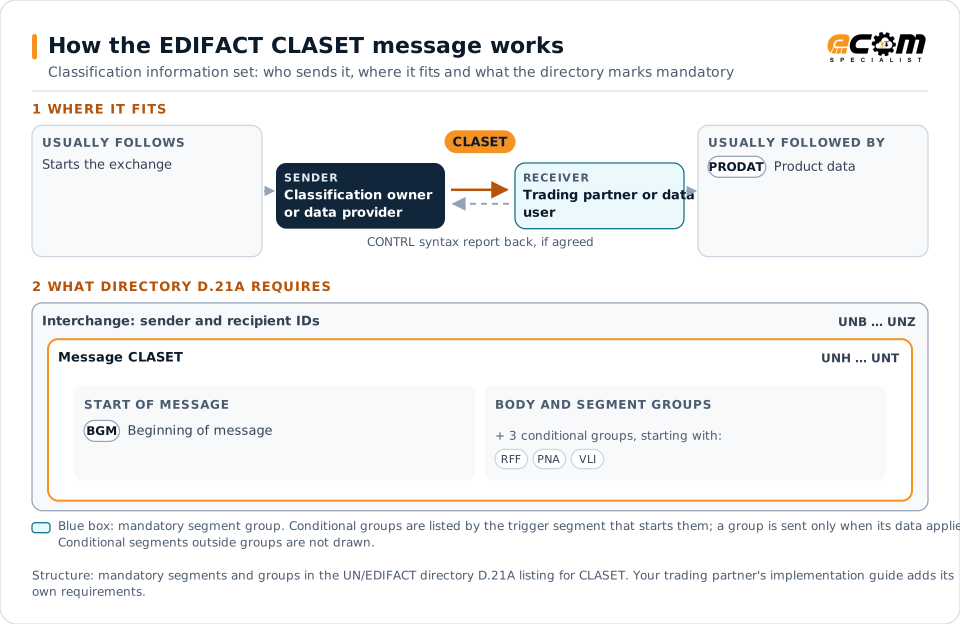
How to read this diagram: the top row shows who sends CLASET, to whom, and which messages usually come before and after it. The lower part shows what the directory D.21A itself requires: the envelopes around CLASET and the segments and segment groups it marks mandatory. Conditional groups are listed by their trigger segment rather than drawn in full. This is the directory's minimum, not a trading partner's requirement: a message implementation guide, such as an industry subset or a partner’s own guide, usually makes some conditional groups mandatory, restricts the codes and may use an older directory.
When it is used
- Distributing a product category tree
- Sending updates to a code list
- Mapping between two classification schemes
Where it fits in the message flow
Structure
Mandatory segments in CLASET (directory D.21A)
In UN/EDIFACT directory D.21A, the CLASET message has 51 segment positions arranged in 20 segment groups. These are the segments and segment groups marked mandatory at message level, in order; a mandatory group is shown with the segment that starts it. Segments inside conditional groups are needed only when the group is used. This is the directory’s requirement, not your trading partner’s: each partner’s message implementation guide names the directory it uses, often an older one such as D.96A or D.01B where the structure can differ, makes some conditional segments mandatory and restricts the codes.
- UNH
- BGM
- UNT
Practical example
CLASET in practice
A wholesaler reorganizes its online catalogue categories. It sends its suppliers a CLASET with the new category tree and the codes of each node. Suppliers update their systems so the product data they send with PRODAT is classified in the wholesaler's new categories.
Implementation
Implementation considerations for CLASET
- Version classifications and state their validity dates.
- Send changes as well as full sets, as agreed.
- Keep mappings between old and new codes during transitions.
- Agree who owns and maintains the classification.
How ECOM helps
Automate CLASET with ECOM
Industry
Wholesale Distribution
Customer orders, supplier purchasing, catalogs and drop-ship for distributors.
Solution
B2B Integration
Connect every customer, supplier, carrier and bank across EDI, API, file and portal channels.
Industry
Retail
Retail and eCommerce EDI for suppliers and retailers, from purchase order to payment, with compliance built in.
Compare X12 and EDIFACT, or see answers to general questions in the EDI FAQ.
Related messages
Related master data messages
Need help with CLASET?
ECOM maps, tests and monitors EDIFACT messages for your trading partners and integrates them with your ERP.