
X12 transaction guide · Catalogs and pricing
EDI 492 Miscellaneous Rates
The X12 document used to transmit rail rates for demurrage, detention and storage.
- Sent by
- Railroad or rate publisher
- Received by
- Shippers and other rate users
- Standard
- ANSI ASC X12
What is an EDI 492?
The EDI 492 Miscellaneous Rates is the ANSI X12 transaction set used to transmit rail rates for demurrage, detention and storage.
These charges apply when cars or freight are held beyond the free time allowed, for example when a customer does not unload a car promptly. Knowing the rates helps shippers and receivers manage car dwell time and audit the related bills. Demurrage applies to cars held by customers beyond the free time allowed, while storage applies to freight held at railroad facilities. Both encourage the prompt release of equipment.
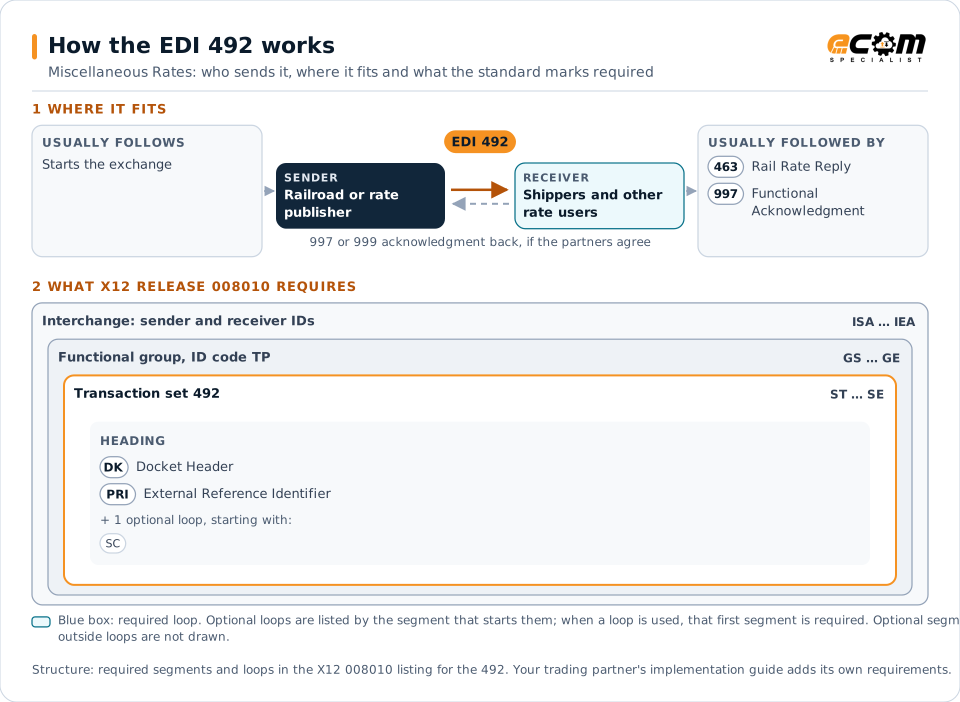
How to read this diagram: the top row shows who sends the 492, to whom, and which documents usually come before and after it. The lower part shows what X12 release 008010 itself requires: the envelopes around the 492 and the segments and loops the standard marks as required, area by area. Optional loops are listed by the segment that starts them rather than drawn in full. This is the standard's minimum, not a trading partner's requirement: each partner's implementation guide usually makes some optional loops mandatory, restricts the codes and may use a different release.
When it is used
- Publishing demurrage rates
- Publishing storage and detention charges
- Updating accessorial rates
Where it fits in the document flow
Structure
Mandatory segments in the 492 (X12 release 008010)
The segments X12 release 008010 marks as mandatory at their level, in order. Segments inside optional loops are needed only when the loop is used. This is the standard's requirement, not your trading partner's: each partner's implementation guide names the release it uses, adds the optional segments it requires and restricts the values. The requirement status comes from one published X12 reference listing and has not been checked against a second source.
- ST
- DK
- PRI
- SC
- SE
Practical example
The 492 in practice
A railroad updates its demurrage charges per car per day. It sends customers a 492 with the new rates, free time rules and effective date. Customers update their systems so demurrage bills are audited correctly and car unloading is prioritized.
Implementation
Implementation considerations for the 492
- Load miscellaneous rates together with their effective dates.
- Understand free time rules as well as charges.
- Audit demurrage bills against published rates.
- Monitor car dwell time to reduce charges.
How ECOM helps
Automate the 492 with ECOM
Industry
Trucking and Transportation
Load tenders, responses, status and freight invoices for carriers, brokers and shippers, integrated with the TMS.
Solution
Financial Document Automation
Automate invoices, remittances, payment files and bank statements from capture to posting.
Solution
Supply Chain Visibility
Track orders, shipments and invoices across partners and catch exceptions early.
More general questions about EDI are answered in the EDI FAQ.
Related transactions
Related catalogs and pricing documents
Need help with the EDI 492?
ECOM maps, tests and monitors X12 documents for your trading partners and integrates them with your ERP.