
X12 transaction guide · Transportation
EDI 358 Customs Consist Information
The X12 document carriers use to list the bills of lading on a specific conveyance and trip for which a manifest was already filed.
- Sent by
- Carrier, terminal operator, port authority or service center
- Received by
- Customs authority
- Standard
- ANSI ASC X12
What is an EDI 358?
The EDI 358 Customs Consist Information is the ANSI X12 transaction set transportation carriers, terminal operators, port authorities and service centers use to provide a list of bills of lading to be carried on a specific conveyance and trip number for which an electronic manifest was previously filed.
A consist ties manifested cargo to the actual train or truck carrying it. Rail carriers in particular send consists so customs knows which bills of lading are on each train arriving at the border, which supports advance targeting and faster crossing.
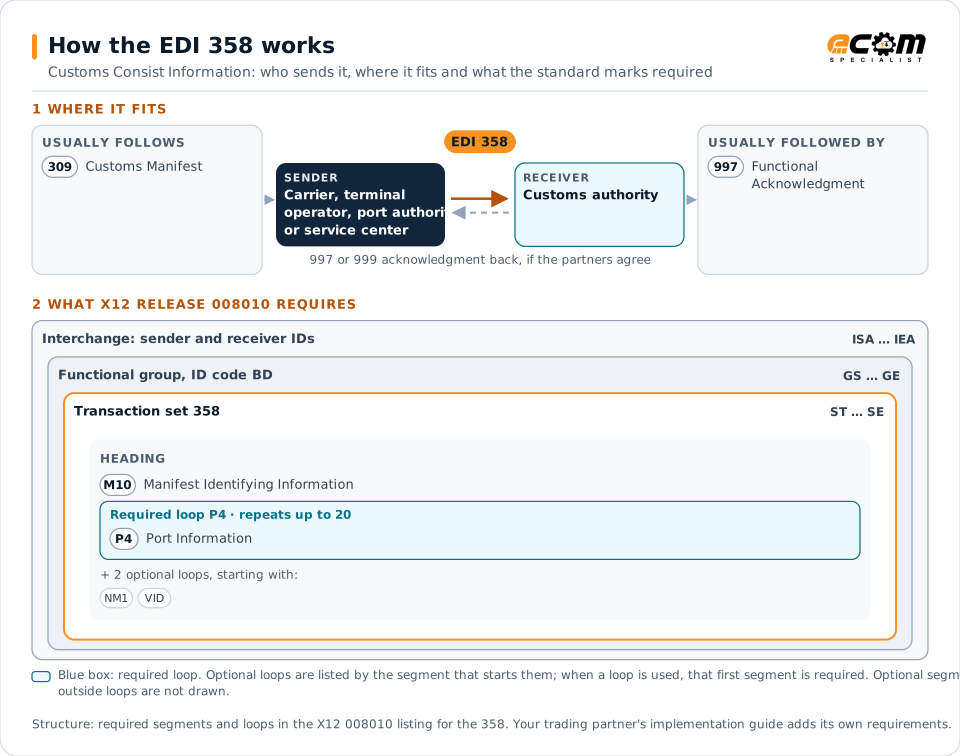
How to read this diagram: the top row shows who sends the 358, to whom, and which documents usually come before and after it. The lower part shows what X12 release 008010 itself requires: the envelopes around the 358 and the segments and loops the standard marks as required, area by area. Optional loops are listed by the segment that starts them rather than drawn in full. This is the standard's minimum, not a trading partner's requirement: each partner's implementation guide usually makes some optional loops mandatory, restricts the codes and may use a different release.
When it is used
- Listing the bills of lading on a train arriving at the border
- Linking previously filed manifests to a specific trip
- Updating a consist after cars are added or removed
Where it fits in the document flow
Structure
Mandatory segments in the 358 (X12 release 008010)
The segments X12 release 008010 marks as mandatory at their level, in order. Segments inside optional loops are needed only when the loop is used. This is the standard's requirement, not your trading partner's: each partner's implementation guide names the release it uses, adds the optional segments it requires and restricts the values. The requirement status comes from one published X12 reference listing and has not been checked against a second source.
- ST
- M10
- NM1
- P4
- VID
- MBL
- SE
Practical example
The 358 in practice
A rail carrier has filed manifests for cargo moving from Canada into the United States. Before the train reaches the border, it sends customs a 358 listing the train and trip number and the bills of lading on each car. Customs matches the consist to the filed manifests and completes its review before the train arrives.
Implementation
Implementation considerations for the 358
- Send the consist after the manifests it refers to are on file.
- Update the consist when equipment is added or dropped.
- Use trip and conveyance identifiers exactly as customs expects.
- Follow the customs authority's implementation guide.
How ECOM helps
Automate the 358 with ECOM
Industry
Trucking and Transportation
Load tenders, responses, status and freight invoices for carriers, brokers and shippers, integrated with the TMS.
Solution
Logistics Automation
Automate tenders, status updates, freight invoices and warehouse orders with logistics partners.
Solution
EDI Integration
Exchange X12 and EDIFACT documents with partners and integrate them directly with your ERP.
More general questions about EDI are answered in the EDI FAQ.
Related transactions
Related transportation documents
- 309Customs Manifest
- 350Customs Status Information
- 352Customs Carrier General Order Status
- 353Customs Events Advisory Details
- 354Customs Automated Manifest Archive Status
- 355Customs Acceptance/Rejection
- 356Customs Permit to Transfer Request
- 357Customs In-Bond Information
- 601Customs Export Shipment Information
- 311Canada Customs Information
- 359Customs Customer Profile Management
- 418Rail Advance Interchange Consist
Need help with the EDI 358?
ECOM maps, tests and monitors X12 documents for your trading partners and integrates them with your ERP.