
EDIFACT message guide · Finance
STATAC Statement of account
The UN/EDIFACT message a seller or its agent sends a buyer with the status of an account at a point in time, as a reconciliation aid.
- Sent by
- Seller or its agent
- Received by
- Buyer or its agent
- Standard
- UN/EDIFACT · Batch message
- X12 equivalent
- No direct equivalent
What is the EDIFACT STATAC message?
STATAC is the UN/EDIFACT statement of account. The directory defines it as a communication from a seller, or its agent, to a buyer, or its agent, giving information about the status of an account at a specific point in time. It is used as an aid to reconciliation and can also serve as a reminder of payments due.
A statement lists open invoices, credit notes and payments received, with balances and due dates. Buyers compare it with their own payables ledger to find invoices they never received, payments the seller has not applied and differences that need resolving.
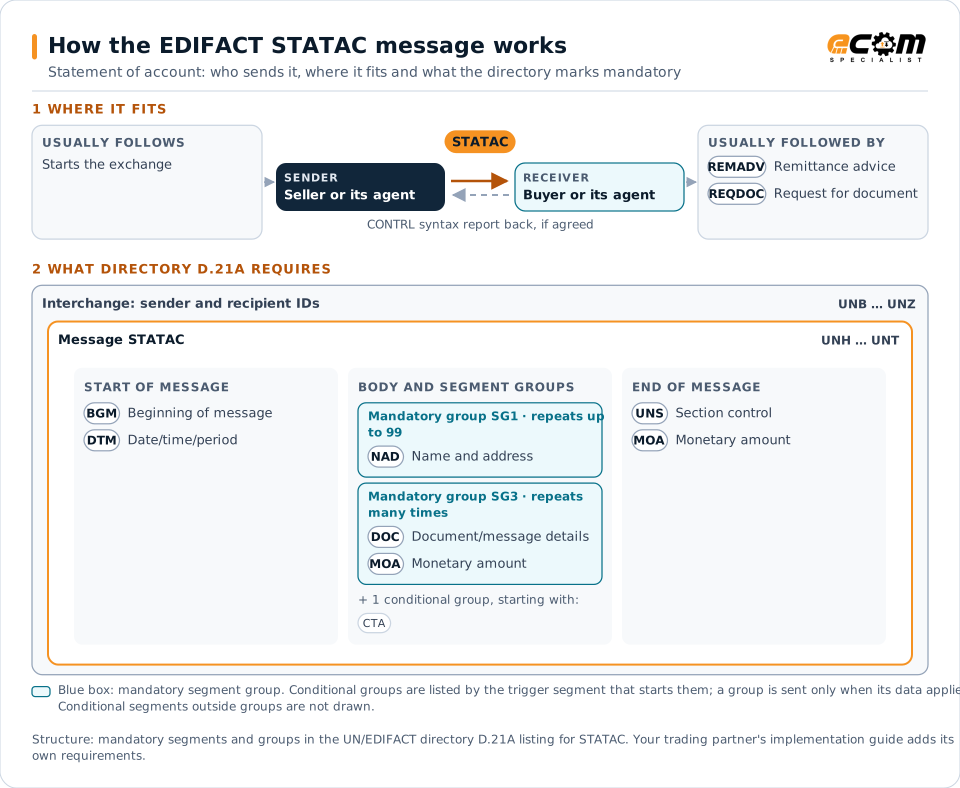
How to read this diagram: the top row shows who sends STATAC, to whom, and which messages usually come before and after it. The lower part shows what the directory D.21A itself requires: the envelopes around STATAC and the segments and segment groups it marks mandatory. Conditional groups are listed by their trigger segment rather than drawn in full. This is the directory's minimum, not a trading partner's requirement: a message implementation guide, such as an industry subset or a partner’s own guide, usually makes some conditional groups mandatory, restricts the codes and may use an older directory.
When it is used
- Sending periodic account statements to customers
- Reconciling receivables and payables
- Reminding customers of overdue items
Where it fits in the message flow
Structure
Mandatory segments in STATAC (directory D.21A)
In UN/EDIFACT directory D.21A, the STATAC message has 16 segment positions arranged in 3 segment groups. These are the segments and segment groups marked mandatory at message level, in order; a mandatory group is shown with the segment that starts it. Segments inside conditional groups are needed only when the group is used. This is the directory’s requirement, not your trading partner’s: each partner’s message implementation guide names the directory it uses, often an older one such as D.96A or D.01B where the structure can differ, makes some conditional segments mandatory and restricts the codes.
- UNH
- BGM
- DTM
- SG1 (NAD)
- SG3 (DOC)
- UNS
- MOA
- UNT
Practical example
STATAC in practice
A packaging supplier sends a retailer a STATAC at each month end listing open invoices, credit notes and unapplied payments. The retailer's payables system matches it with its ledger and finds two invoices it never received. It requests copies with REQDOC and schedules payment of the overdue items.
Implementation
Implementation considerations for STATAC
- Reference documents exactly as originally issued.
- Agree the statement frequency and cut-off date.
- Reconcile differences promptly in both directions.
- Distinguish reminders from routine statements.
How ECOM helps
Automate STATAC with ECOM
Solution
Financial Document Automation
Automate invoices, remittances, payment files and bank statements from capture to posting.
Solution
Order-to-Cash Automation
Automate the flow from purchase order to payment across every customer channel.
Industry
Wholesale Distribution
Customer orders, supplier purchasing, catalogs and drop-ship for distributors.
Compare X12 and EDIFACT, or see answers to general questions in the EDI FAQ.
Related messages
Related finance messages
Need help with STATAC?
ECOM maps, tests and monitors EDIFACT messages for your trading partners and integrates them with your ERP.