
EDIFACT message guide · Communications
GENRAL General purpose
The UN/EDIFACT message used to transmit textual information between trading partners.
- Sent by
- Any trading partner
- Received by
- Any trading partner
- Standard
- UN/EDIFACT · Batch message
- X12 equivalent
- 864 Text Message
What is the EDIFACT GENRAL message?
GENRAL is the UN/EDIFACT general purpose message. The directory defines it as a message for transmitting textual information.
It carries free-form text, such as announcements, instructions or explanations, over the same EDI connection used for business messages, with parties, references and dates to give it context. Because the text is not structured, receiving systems cannot act on it automatically; it should be routed to a person and not used where a structured message exists for the purpose. It is the EDIFACT counterpart of the X12 864 text message.
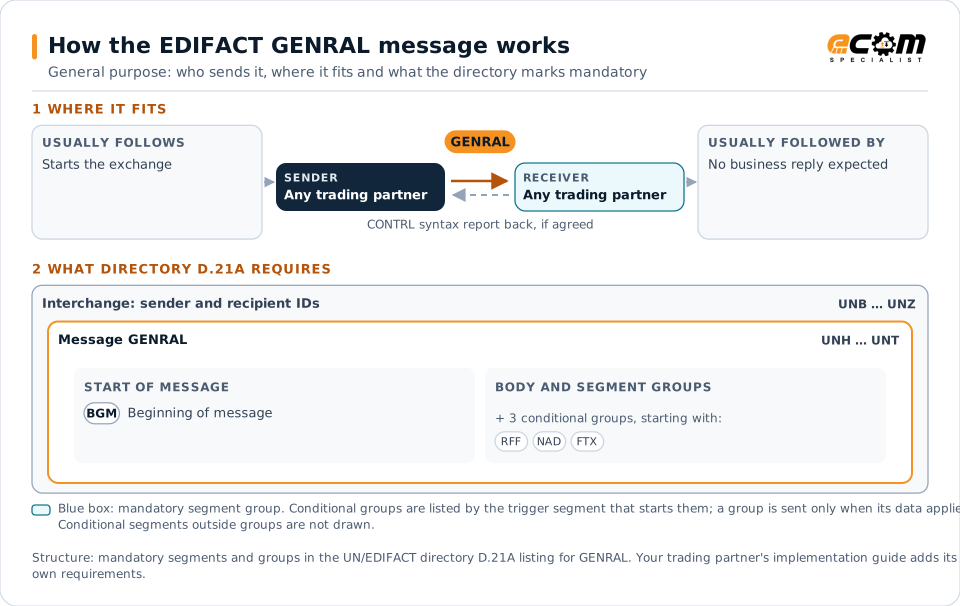
How to read this diagram: the top row shows who sends GENRAL, to whom, and which messages usually come before and after it. The lower part shows what the directory D.21A itself requires: the envelopes around GENRAL and the segments and segment groups it marks mandatory. Conditional groups are listed by their trigger segment rather than drawn in full. This is the directory's minimum, not a trading partner's requirement: a message implementation guide, such as an industry subset or a partner’s own guide, usually makes some conditional groups mandatory, restricts the codes and may use an older directory.
When it is used
- Sending announcements to trading partners
- Explaining exceptions that structured messages cannot express
- Distributing procedures or policy changes
Where it fits in the message flow
No other message routinely comes directly before or after GENRAL; it is exchanged when the business event occurs. If the partners agree, the receiver confirms each interchange with a CONTRL syntax and service report.
Structure
Mandatory segments in GENRAL (directory D.21A)
In UN/EDIFACT directory D.21A, the GENRAL message has 19 segment positions arranged in 8 segment groups. These are the segments and segment groups marked mandatory at message level, in order; a mandatory group is shown with the segment that starts it. Segments inside conditional groups are needed only when the group is used. This is the directory’s requirement, not your trading partner’s: each partner’s message implementation guide names the directory it uses, often an older one such as D.96A or D.01B where the structure can differ, makes some conditional segments mandatory and restricts the codes.
- UNH
- BGM
- UNT
Practical example
GENRAL in practice
A car maker changes its plant holiday schedule. It sends all suppliers a GENRAL message explaining the closure dates, the adjusted delivery windows and a contact for questions. Supplier EDI systems route the message to logistics coordinators, who adjust their shipping plans.
Implementation
Implementation considerations for GENRAL
- Route GENRAL messages to people, since text is not processed automatically.
- Prefer structured messages where one exists for the information.
- Include references so readers know what the text relates to.
- Agree the language and any length limits for the text.
How ECOM helps
Automate GENRAL with ECOM
Solution
EDI Integration
Exchange X12 and EDIFACT documents with partners and integrate them directly with your ERP.
Solution
B2B Integration
Connect every customer, supplier, carrier and bank across EDI, API, file and portal channels.
Industry
Automotive
Schedules, ship notices, labels, self-billing and multi-plant routing for automotive suppliers.
Compare X12 and EDIFACT, or see answers to general questions in the EDI FAQ.
Related messages
Related communications messages
Need help with GENRAL?
ECOM maps, tests and monitors EDIFACT messages for your trading partners and integrates them with your ERP.