
EDIFACT message guide · Finance
DEBADV Debit advice
The UN/EDIFACT message a bank sends to tell an account owner that its account has been, or will be, debited for a specified amount.
- Sent by
- Account-servicing bank
- Received by
- Account owner
- Standard
- UN/EDIFACT · Batch message
- X12 equivalent
- No direct equivalent
What is the EDIFACT DEBADV message?
DEBADV is the UN/EDIFACT debit advice message. The directory defines it as a message sent by the account-servicing financial institution to the account owner, informing it that its account has been or will be debited for a specified amount on the date indicated, in settlement of the referenced business transactions.
Debit advices confirm that payments the company ordered, or direct debits collected from it, have been charged to its account. Treasury teams use them to confirm execution and to update cash positions before the end-of-day statement arrives.
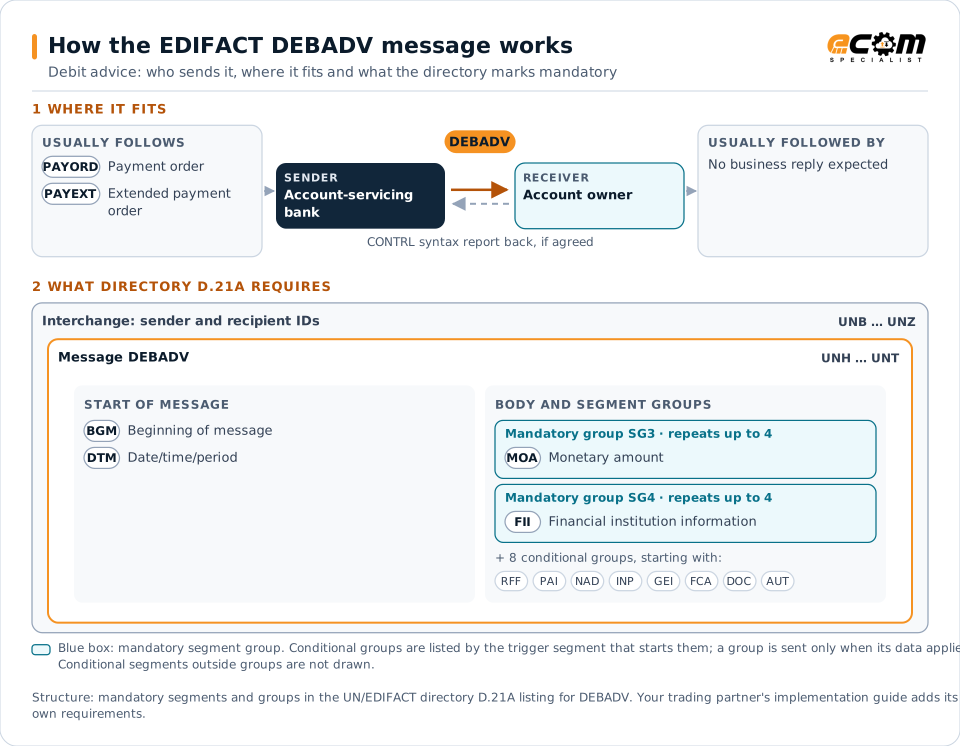
How to read this diagram: the top row shows who sends DEBADV, to whom, and which messages usually come before and after it. The lower part shows what the directory D.21A itself requires: the envelopes around DEBADV and the segments and segment groups it marks mandatory. Conditional groups are listed by their trigger segment rather than drawn in full. This is the directory's minimum, not a trading partner's requirement: a message implementation guide, such as an industry subset or a partner’s own guide, usually makes some conditional groups mandatory, restricts the codes and may use an older directory.
When it is used
- Confirming execution of an outgoing payment
- Advising direct debits charged to an account
- Advising bank fees and charges
Where it fits in the message flow
Structure
Mandatory segments in DEBADV (directory D.21A)
In UN/EDIFACT directory D.21A, the DEBADV message has 44 segment positions arranged in 12 segment groups. These are the segments and segment groups marked mandatory at message level, in order; a mandatory group is shown with the segment that starts it. Segments inside conditional groups are needed only when the group is used. This is the directory’s requirement, not your trading partner’s: each partner’s message implementation guide names the directory it uses, often an older one such as D.96A or D.01B where the structure can differ, makes some conditional segments mandatory and restricts the codes.
- UNH
- BGM
- DTM
- SG3 (MOA)
- SG4 (FII)
- UNT
Practical example
DEBADV in practice
A company orders an urgent supplier payment with a PAYORD in the morning. When the bank executes it, it sends a DEBADV with the amount debited, the value date and the payment reference. The company's treasury system marks the payment as executed and updates the day's cash position.
Implementation
Implementation considerations for DEBADV
- Match advices to payment orders by reference.
- Reconcile debit advices with the account statement.
- Distinguish payments, direct debits and fees by transaction code.
- Choose between single and multiple debit advices with the bank.
How ECOM helps
Automate DEBADV with ECOM
Solution
Financial Document Automation
Automate invoices, remittances, payment files and bank statements from capture to posting.
Industry
Financial Services
Secure file transfer and B2B integration for banks and financial institutions.
Solution
Procure-to-Pay Automation
Automate purchasing, receiving and supplier invoicing across EDI, portals and documents.
Compare X12 and EDIFACT, or see answers to general questions in the EDI FAQ.
Related messages
Related finance messages
- PAYEXTExtended payment order
- PAYORDPayment order
- DEBMULMultiple debit advice
- CREADVCredit advice
- CREEXTExtended credit advice
- CREMULMultiple credit advice
- DIRDEBDirect debit
- DOCADVDocumentary credit advice
- DOCAMAAdvice of an amendment of a documentary credit
- AUTHORAuthorization
- BALANCBalance
- BANSTABanking status
Need help with DEBADV?
ECOM maps, tests and monitors EDIFACT messages for your trading partners and integrates them with your ERP.