
X12 transaction guide · Communications
EDI 998 Set Cancellation
The X12 document used to request deletion of a previously transmitted transaction set, with the reason, such as a diversion or cancelled bill.
- Sent by
- Sender of the original transaction set
- Received by
- Receiver of the original transaction set
- Standard
- ANSI ASC X12
What is an EDI 998?
The EDI 998 Set Cancellation is the ANSI X12 transaction set used to request the deletion of a previously transmitted transaction set, indicating the reason, such as a diversion or a cancelled bill.
It is used mainly in transportation, for example to cancel a bill of lading or waybill that was sent but will not be used. The receiver identifies the original transaction from the references in the 998 and removes it from processing, so the cancelled document does not lead to movements or charges.
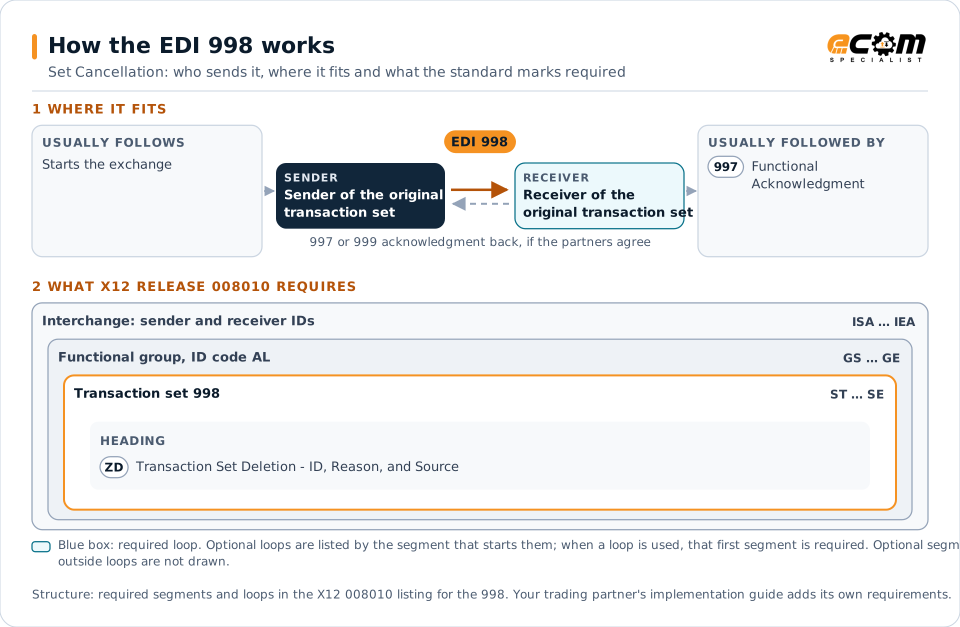
How to read this diagram: the top row shows who sends the 998, to whom, and which documents usually come before and after it. The lower part shows what X12 release 008010 itself requires: the envelopes around the 998 and the segments and loops the standard marks as required, area by area. Optional loops are listed by the segment that starts them rather than drawn in full. This is the standard's minimum, not a trading partner's requirement: each partner's implementation guide usually makes some optional loops mandatory, restricts the codes and may use a different release.
When it is used
- Cancelling a bill of lading sent in error
- Deleting a waybill after a diversion
- Withdrawing a transaction before it is processed
Where it fits in the document flow
Structure
Mandatory segments in the 998 (X12 release 008010)
The segments X12 release 008010 marks as mandatory at their level, in order. Segments inside optional loops are needed only when the loop is used. This is the standard's requirement, not your trading partner's: each partner's implementation guide names the release it uses, adds the optional segments it requires and restricts the values. The requirement status comes from one published X12 reference listing and has not been checked against a second source.
- ST
- ZD
- SE
Practical example
The 998 in practice
A shipper sends a railroad a 404 bill of lading for a car, but the customer cancels the order before the car is pulled. The shipper sends the railroad a 998 identifying the bill of lading and the reason. The railroad deletes the waybill, so the car is not moved or billed.
Implementation
Implementation considerations for the 998
- Reference the original transaction precisely.
- State the cancellation reason with agreed codes.
- Confirm the receiver supports set cancellation.
- Send cancellations before the original is acted on.
How ECOM helps
Automate the 998 with ECOM
Industry
Trucking and Transportation
Load tenders, responses, status and freight invoices for carriers, brokers and shippers, integrated with the TMS.
Solution
EDI Integration
Exchange X12 and EDIFACT documents with partners and integrate them directly with your ERP.
Solution
Logistics Automation
Automate tenders, status updates, freight invoices and warehouse orders with logistics partners.
More general questions about EDI are answered in the EDI FAQ.
Need help with the EDI 998?
ECOM maps, tests and monitors X12 documents for your trading partners and integrates them with your ERP.