
X12 transaction guide · Communications
EDI 815 Cryptographic Service Message
The X12 document that provides the data format for cryptographic key management, including the automated distribution and exchange of keys.
- Sent by
- Trading partner or key management center
- Received by
- Trading partner or key management center
- Standard
- ANSI ASC X12
What is an EDI 815?
The EDI 815 Cryptographic Service Message is the ANSI X12 transaction set that provides the data format for cryptographic key management, including the automated distribution and exchange of keys. The mechanism uses X12 structures and data formats and is based on existing financial institution key management standards.
Partners that secure X12 data at the message level, for example by authenticating or encrypting transaction sets, need to exchange and update keys reliably. The 815 lets them do so over the same EDI channel. Today many partners secure data at the transport level instead, for example with AS2, so the 815 is mainly found in specialized secure EDI arrangements.
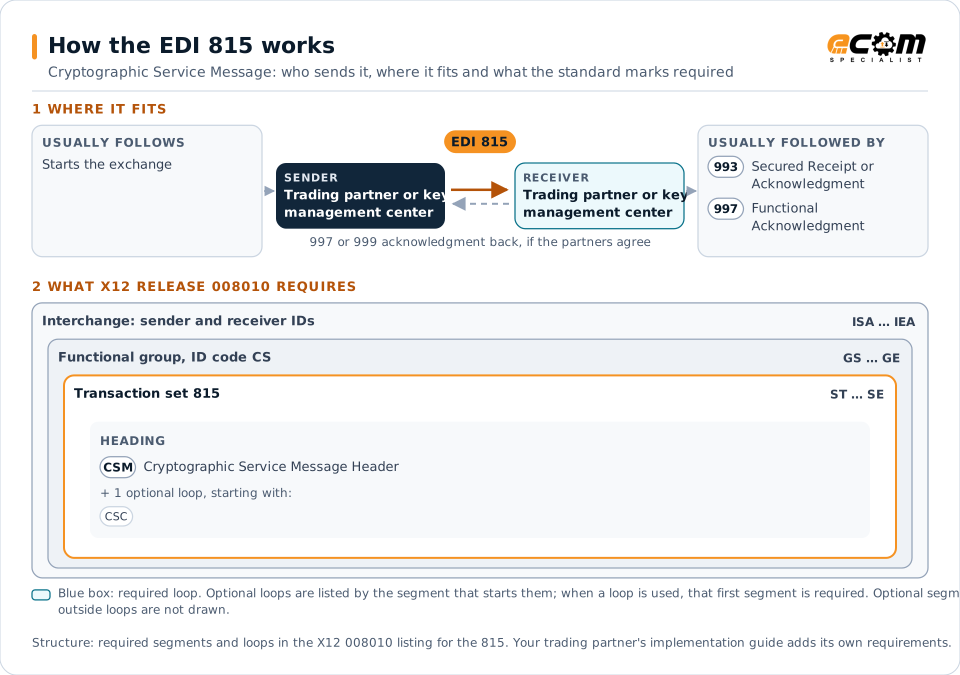
How to read this diagram: the top row shows who sends the 815, to whom, and which documents usually come before and after it. The lower part shows what X12 release 008010 itself requires: the envelopes around the 815 and the segments and loops the standard marks as required, area by area. Optional loops are listed by the segment that starts them rather than drawn in full. This is the standard's minimum, not a trading partner's requirement: each partner's implementation guide usually makes some optional loops mandatory, restricts the codes and may use a different release.
When it is used
- Distributing cryptographic keys between partners
- Requesting or updating keys
- Managing keys for authenticated X12 data
Where it fits in the document flow
Structure
Mandatory segments in the 815 (X12 release 008010)
The segments X12 release 008010 marks as mandatory at their level, in order. Segments inside optional loops are needed only when the loop is used. This is the standard's requirement, not your trading partner's: each partner's implementation guide names the release it uses, adds the optional segments it requires and restricts the values. The requirement status comes from one published X12 reference listing and has not been checked against a second source.
- ST
- CSM
- CSC
- SE
Practical example
The 815 in practice
Two banks exchange authenticated payment data in X12. Before the current authentication keys expire, one bank sends the other an 815 delivering the new key in protected form, with its effective date. The receiving bank installs the key and confirms, and authenticated transaction sets use the new key from that date.
Implementation
Implementation considerations for the 815
- Agree algorithms and key management procedures in advance.
- Decide whether transport-level security already meets the requirement.
- Protect key material in transit and in storage.
- Track key expiry dates and rotate keys in good time.
How ECOM helps
Automate the 815 with ECOM
Solution
Managed File Transfer
Design, migrate and operate secure, auditable file exchange across partners and systems.
Industry
Financial Services
Secure file transfer and B2B integration for banks and financial institutions.
Solution
B2B Integration
Connect every customer, supplier, carrier and bank across EDI, API, file and portal channels.
More general questions about EDI are answered in the EDI FAQ.
Related transactions
Related communications documents
Need help with the EDI 815?
ECOM maps, tests and monitors X12 documents for your trading partners and integrates them with your ERP.