
X12 transaction guide · Government and regulatory
EDI 288 Wage Determination
The bi-directional X12 document used to request and respond to requests for wage information, such as prevailing wage rates.
- Sent by
- Contracting agency, contractor or labor authority
- Received by
- Labor authority or requester
- Standard
- ANSI ASC X12
What is an EDI 288?
The EDI 288 Wage Determination is the bi-directional ANSI X12 transaction set used to request, and respond to requests for, wage information such as prevailing wage rates. The information can be determined by occupational category and geographic area.
Government-funded construction and service contracts often require contractors to pay at least the prevailing wages set for each occupation and locality. Contracting agencies obtain the applicable wage determinations and include them in solicitations, so bidders price labor correctly. Determinations are updated periodically.
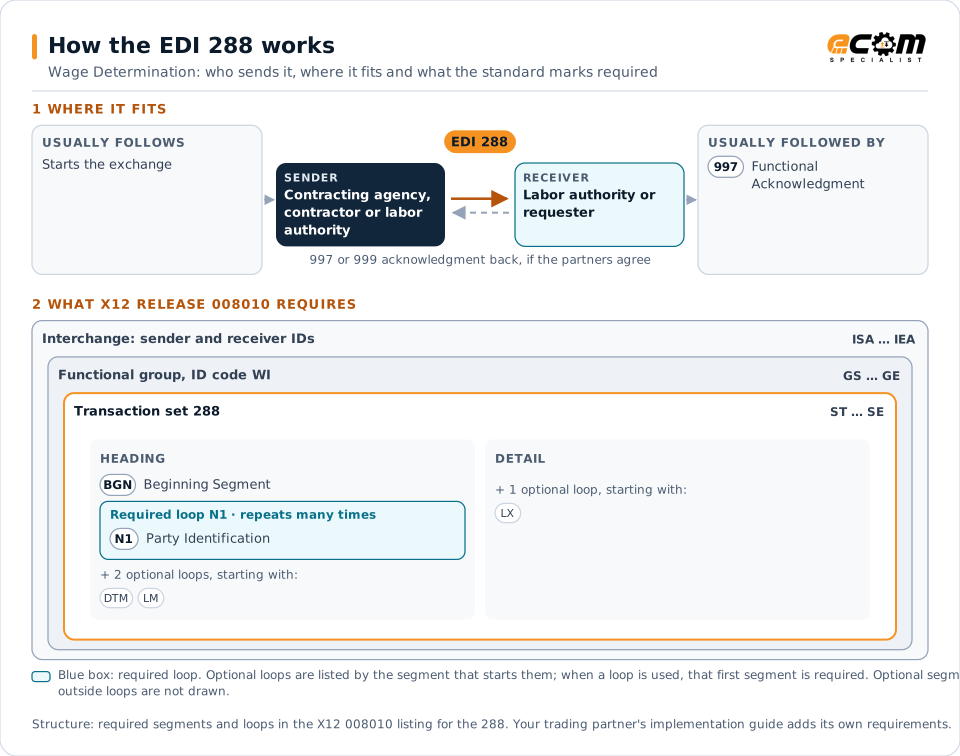
How to read this diagram: the top row shows who sends the 288, to whom, and which documents usually come before and after it. The lower part shows what X12 release 008010 itself requires: the envelopes around the 288 and the segments and loops the standard marks as required, area by area. Optional loops are listed by the segment that starts them rather than drawn in full. This is the standard's minimum, not a trading partner's requirement: each partner's implementation guide usually makes some optional loops mandatory, restricts the codes and may use a different release.
When it is used
- Requesting prevailing wage determinations
- Providing wage rates for contract solicitations
- Updating wage determinations
Where it fits in the document flow
Structure
Mandatory segments in the 288 (X12 release 008010)
The segments X12 release 008010 marks as mandatory at their level, in order. Segments inside optional loops are needed only when the loop is used. This is the standard's requirement, not your trading partner's: each partner's implementation guide names the release it uses, adds the optional segments it requires and restricts the values. The requirement status comes from one published X12 reference listing and has not been checked against a second source.
- ST
- BGN
- N1
- DTM
- LM
- LX
- LQ
- SE
Practical example
The 288 in practice
A federal agency prepares to solicit a building maintenance contract. It requests the applicable wage determination for the occupations and county involved, and the labor authority responds with the prevailing wage rates and fringe benefits. The agency includes them in the solicitation.
Implementation
Implementation considerations for the 288
- Use the wage determination in force for the contract.
- Identify occupations and locations precisely.
- Track updates that affect existing contracts.
- Follow the labor authority's current systems.
How ECOM helps
Automate the 288 with ECOM
Solution
Enterprise Integration
Any-to-any integration across partners, systems, protocols, security requirements, formats and ERPs, in batch or real time.
Solution
Procure-to-Pay Automation
Automate purchasing, receiving and supplier invoicing across EDI, portals and documents.
Solution
EDI Integration
Exchange X12 and EDIFACT documents with partners and integrate them directly with your ERP.
More general questions about EDI are answered in the EDI FAQ.
Need help with the EDI 288?
ECOM maps, tests and monitors X12 documents for your trading partners and integrates them with your ERP.