
X12 transaction guide · Government and regulatory
EDI 286 Commercial Vehicle Credentials
The bi-directional X12 document owners, lessees and drivers of commercial vehicles use to apply for the credentials needed to operate legally.
- Sent by
- Vehicle owner, lessee or driver
- Received by
- Credentialing agency
- Standard
- ANSI ASC X12
What is an EDI 286?
The EDI 286 Commercial Vehicle Credentials is the bi-directional ANSI X12 transaction set owners, lessees and drivers of commercial motor vehicles can use to apply electronically for the credentials needed to operate those vehicles legally, and agencies can use to respond.
Trucks operating across states need registrations, fuel tax licenses, oversize and overweight permits and other credentials. Applying electronically lets fleets obtain them faster and keep them current across many vehicles and jurisdictions. Agencies respond with issued credentials or reasons for refusal.
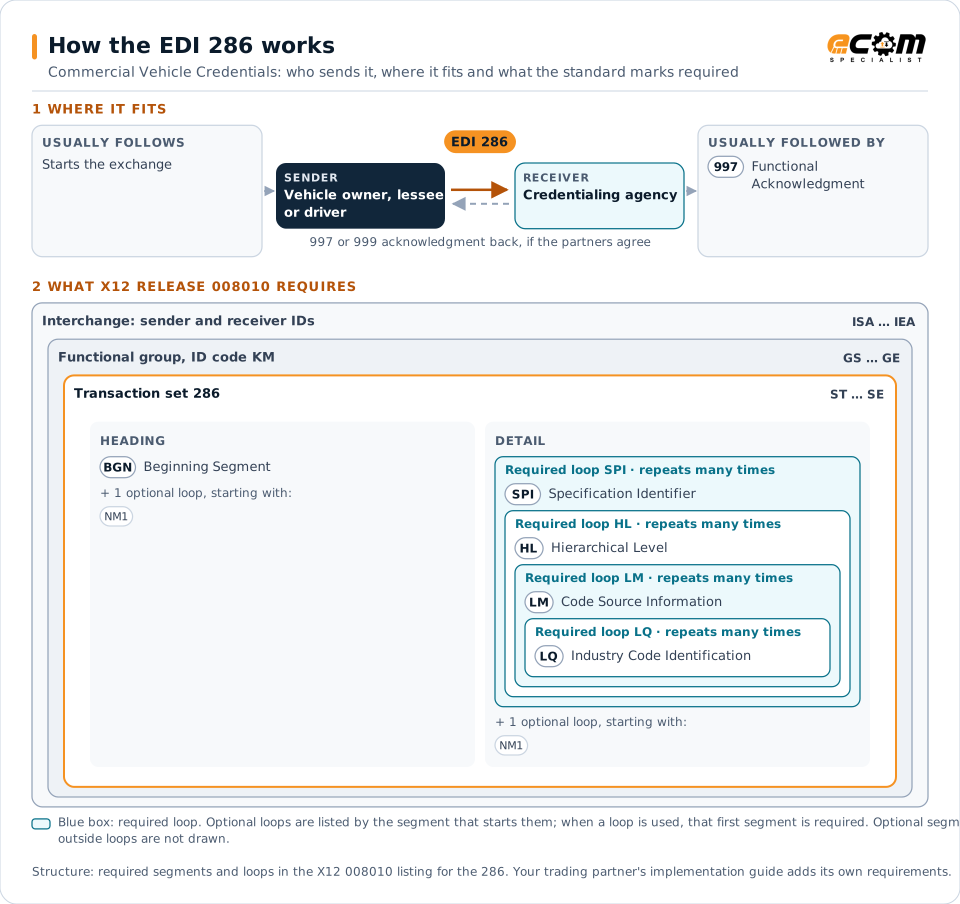
How to read this diagram: the top row shows who sends the 286, to whom, and which documents usually come before and after it. The lower part shows what X12 release 008010 itself requires: the envelopes around the 286 and the segments and loops the standard marks as required, area by area. Optional loops are listed by the segment that starts them rather than drawn in full. This is the standard's minimum, not a trading partner's requirement: each partner's implementation guide usually makes some optional loops mandatory, restricts the codes and may use a different release.
When it is used
- Applying for vehicle registrations and apportioned plates
- Applying for oversize or overweight permits
- Renewing credentials
Where it fits in the document flow
Structure
Mandatory segments in the 286 (X12 release 008010)
The segments X12 release 008010 marks as mandatory at their level, in order. Segments inside optional loops are needed only when the loop is used. This is the standard's requirement, not your trading partner's: each partner's implementation guide names the release it uses, adds the optional segments it requires and restricts the values. The requirement status comes from one published X12 reference listing and has not been checked against a second source.
- ST
- BGN
- NM1
- SPI
- HL
- LM
- LQ
- SE
Practical example
The 286 in practice
A fleet adds 20 tractors that will run in several states. Its compliance team applies for apportioned registrations for the new tractors, with the vehicle details and the distances expected in each state. The agency issues the credentials and the fleet records them.
Implementation
Implementation considerations for the 286
- Keep credentials current and track renewal dates.
- Report accurate distance and weight data.
- Use official vehicle identifiers, such as VINs.
- Check each agency's current electronic systems.
How ECOM helps
Automate the 286 with ECOM
Industry
Trucking and Transportation
Load tenders, responses, status and freight invoices for carriers, brokers and shippers, integrated with the TMS.
Solution
EDI Integration
Exchange X12 and EDIFACT documents with partners and integrate them directly with your ERP.
Solution
Enterprise Integration
Any-to-any integration across partners, systems, protocols, security requirements, formats and ERPs, in batch or real time.
More general questions about EDI are answered in the EDI FAQ.
Related transactions
Related government and regulatory documents
Need help with the EDI 286?
ECOM maps, tests and monitors X12 documents for your trading partners and integrates them with your ERP.