
Comparisons

Web EDI vs integrated EDI: which is right for your business?

How browser-based web EDI compares with EDI integrated into your ERP, and when it is time to move from one to the other.

2 min read · Updated October 29, 2026

The short answer

Web EDI lets you exchange EDI documents in a browser, typing or reviewing data in web forms, with no EDI software to run. Integrated EDI connects trading partners directly to your ERP, so orders, ship notices and invoices flow automatically. Web EDI suits low volumes and few partners; integrated EDI pays off as volumes, partners and accuracy requirements grow.

Web EDI vs integrated EDI

CriteriaWeb EDIIntegrated EDI
How documents are handledViewed and created in web formsCreated and posted automatically in your ERP
Manual effortOrders still re-keyed into internal systemsMinimal; people handle exceptions
Startup time and costFast and lowHigher, depending on ERP and partners
Accuracy at volumeDeclines as volumes growHigh, with validation against ERP data
Best fitFew partners and low order volumesGrowing volumes or many partners
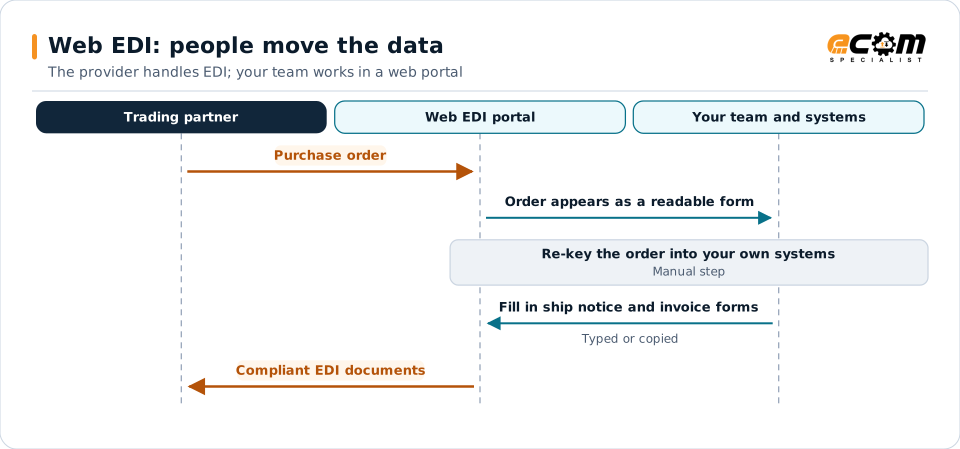
Web EDI: people move the dataSequence diagram of web EDI: a purchase order from the trading partner appears in a web portal as a form, your team re-keys it into its own systems, fills in ship notice and invoice forms in the portal, and the provider sends them as compliant EDI.Web EDI: people move the dataThe provider handles EDI; your team works in a web portalTrading partnerWeb EDI portalYour team and systemsPurchase orderOrder appears as a readable formRe-key the order into your own systemsManual stepFill in ship notice and invoice formsTyped or copiedCompliant EDI documents
Web EDI: people move the dataSequence diagram of web EDI: a purchase order from the trading partner appears in a web portal as a form, your team re-keys it into its own systems, fills in ship notice and invoice forms in the portal, and the provider sends them as compliant EDI.Web EDI: people move the dataThe provider handles EDI; your team works in aweb portalTradingpartnerWeb EDIportalYour teamand systemsPurchase orderOrder appears as areadable formRe-key the order intoyour own systemsManual stepFill in ship notice andinvoice formsTyped or copiedCompliant EDI documents

Web EDI is fast and low-cost to start, but every order and response passes through people, so errors grow with volume.
Expand diagram Download SVG

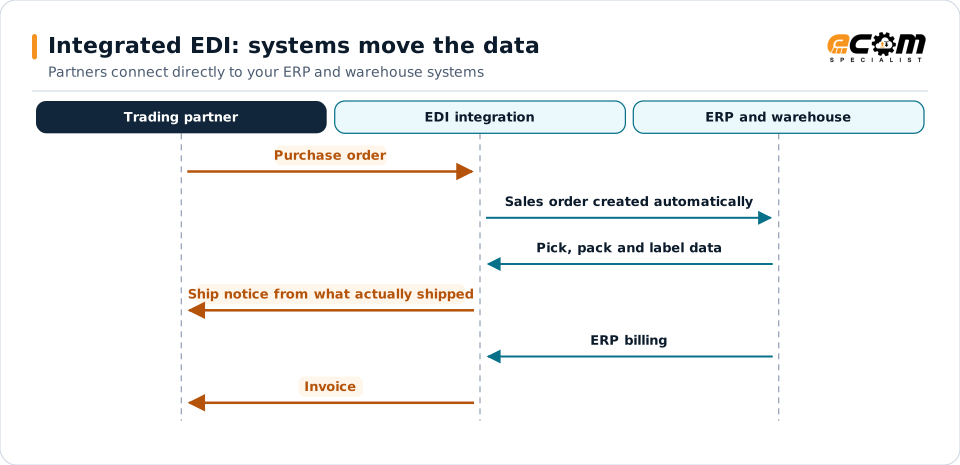
Integrated EDI: systems move the dataSequence diagram of integrated EDI: a purchase order becomes a sales order automatically, ship notices are built from actual pick, pack and label data, and invoices come from ERP billing, with people involved only when validation flags an exception.Integrated EDI: systems move the dataPartners connect directly to your ERP and warehouse systemsTrading partnerEDI integrationERP and warehousePurchase orderSales order created automaticallyPick, pack and label dataShip notice from what actually shippedERP billingInvoice
Integrated EDI: systems move the dataSequence diagram of integrated EDI: a purchase order becomes a sales order automatically, ship notices are built from actual pick, pack and label data, and invoices come from ERP billing, with people involved only when validation flags an exception.Integrated EDI: systems movethe dataPartners connect directly to your ERP andwarehouse systemsTradingpartnerEDIintegrationERP andwarehousePurchase orderSales order createdautomaticallyPick, pack and label dataShip notice from whatactually shippedERP billingInvoice

People step in only when validation flags an exception. The trade-off is a larger initial project that depends on your ERP and your partners’ requirements.
Expand diagram Download SVG

Two ways to meet the same requirement

When a customer requires EDI, both approaches get you compliant. They differ in how much of the work stays manual.

How web EDI works

A provider hosts the EDI translation and partner connection. You log in to a web portal where incoming purchase orders appear as readable forms. You create acknowledgments, ship notices and invoices by filling in forms, often by turning the original order into a response so data carries forward. The provider converts your forms into compliant EDI and sends them.

Why companies choose it: fast to start, low cost, no software or EDI staff required.

The trade-off: orders still have to be entered into your own order, warehouse and accounting systems, and ship notices and invoices are typed or copied, which introduces errors as volumes grow.

How integrated EDI works

Integrated EDI connects your trading partners directly to your ERP and warehouse systems. Purchase orders become sales orders automatically; ship notices are built from actual pick, pack and label data; invoices come from ERP billing. People only step in when validation flags an exception.

Why companies choose it: accuracy, speed and scalability, plus fewer compliance penalties.

The trade-off: a larger initial project that depends on your ERP and partners’ requirements.

Signs it is time to integrate

  • Staff spend hours a week re-keying orders or invoices.
  • Chargebacks or deductions for ship notice or invoice errors are increasing.
  • You are adding partners or programs, such as drop-ship.
  • Peak seasons overwhelm manual processes.

A practical path

Start with web EDI to meet a first customer’s deadline, then integrate the highest-volume partners first. When both run on the same platform, moving a partner from web forms to integration can keep the same provider and partner connection. Expect the partner to test the documents your systems now generate, because their content and timing change.

Frequently asked questions

Is web EDI real EDI?

Yes. Your partner receives standard EDI documents. The difference is that you work with them in a browser instead of having them flow into your systems automatically.

When should we move to integrated EDI?

Common signals are rising order volumes, more trading partners, frequent keying errors or chargebacks, and staff time spent re-entering orders.

Can we keep some partners on web EDI?

Yes. Many companies integrate high-volume partners and keep low-volume partners on web EDI.

Have an EDI question we did not answer?

ECOM's integration specialists can review your partners, documents and systems and recommend next steps.