
The short answer
In-house EDI gives you full control but requires software, infrastructure and scarce specialist skills. Managed EDI shifts operations to a provider under a service agreement, reducing staffing risk and effort. Hybrid models such as EDI Team as a Service sit in between: you keep control and visibility while specialists do the hands-on work.
In-house, hybrid and managed EDI
| Criteria | In-house EDI | EDI Team as a Service | Fully managed EDI |
|---|---|---|---|
| Who runs daily operations | Your staff | Provider specialists, directed by you | The provider |
| Platform | Yours | Yours or the provider's | Usually the provider's |
| Staffing risk | High: depends on a few specialists | Low: shared team coverage | Low: provider staffs the service |
| Control over priorities | Full | High | Defined by service scope |
| Cost structure | Licenses, infrastructure and salaries | Subscription for team capacity | Service fees by scope and volume |
Moving from left to right shifts the hands-on work and the staffing risk to a provider, and moves control from you to the service agreement. The table in this article compares the three models in detail.
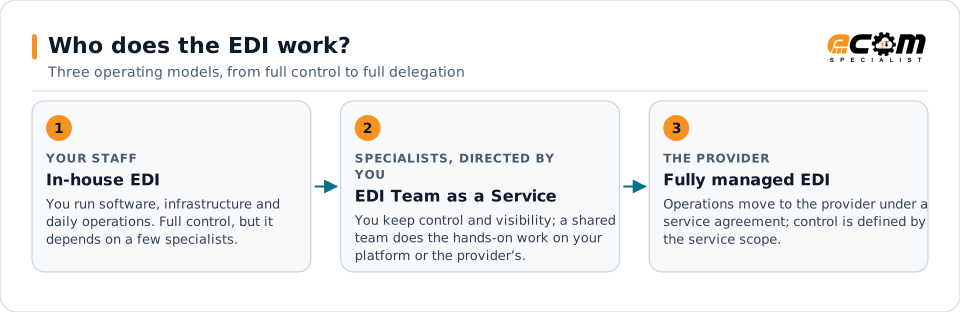
The real question: who does the EDI work?
Every EDI program needs the same work done: maintaining the platform, building and updating maps, onboarding partners, monitoring transactions and fixing errors. The choice between in-house and managed EDI is about who does that work, on whose platform, and who sets priorities.
Running EDI in-house
With in-house EDI, your organization licenses or builds the platform, hosts it and employs the people who run it.
Strengths: full control over priorities, data and change timing; deep knowledge of your business inside the team.
Challenges:
- Scarce skills. Experienced EDI developers and administrators are hard to hire and retain.
- Key-person risk. Many programs depend on one or two people who understand everything.
- Coverage. Monitoring outside business hours, vacations and peak seasons is hard to staff.
- Platform upkeep. Upgrades, security patches and certificate renewals compete with business projects.
Fully managed EDI
A provider operates the EDI program within an agreed scope, usually on its own platform, and commits to service levels.
Strengths: predictable operations, no platform to run, specialists on call.
Considerations: you depend on the provider’s processes, and changes follow the service agreement. Choose a provider that gives you real visibility into transactions.
The hybrid option: EDI Team as a Service
Between the two sits a team-based model. Specialists from the provider work as an extension of your team, on your platform or theirs, while you keep control of priorities. It suits organizations that want to keep EDI close to the business but cannot staff every skill or shift. See EDI Team as a Service.
How to decide
Ask these questions:
- Do you have, and can you keep, experienced EDI staff? If not, consider hybrid or managed.
- How important is direct control over priorities and change timing? If very, keep it in-house or hybrid.
- What does round-the-clock coverage cost you today? Include overtime and the cost of incidents.
- What is your platform roadmap? An upcoming upgrade or migration is a natural point to change models.
Many organizations end up with a mix: core operations managed or team-based, with internal staff focused on business requirements and partner relationships.