
The short answer
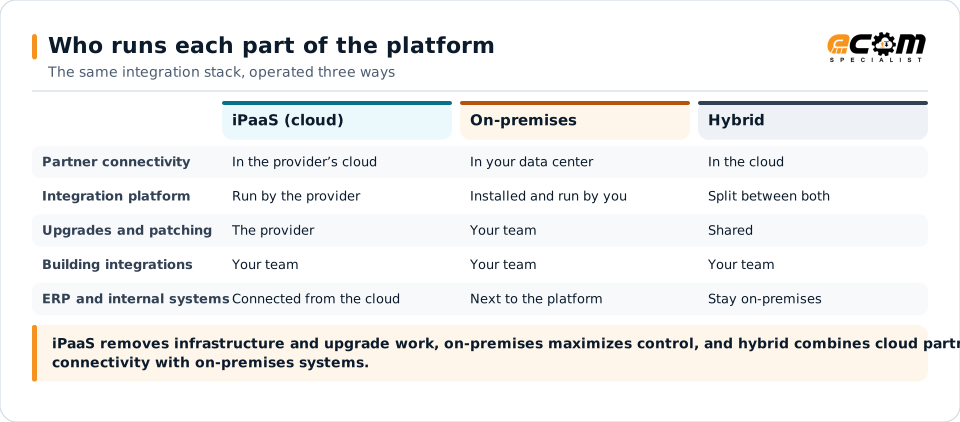
With iPaaS, the provider runs the integration platform in the cloud while your team builds and manages integrations. With on-premises EDI software, you install and operate the platform in your own data center. iPaaS removes infrastructure and upgrade work; on-premises maximizes control. Hybrid deployments combine cloud partner connectivity with on-premises systems.
iPaaS, on-premises and hybrid
| Criteria | iPaaS (cloud) | On-premises | Hybrid |
|---|---|---|---|
| Infrastructure | Run by the provider | Run by you | Split between both |
| Upgrades and patching | Handled by the provider | Your responsibility | Shared |
| Control over environment | Standardized | Full | High where it matters |
| Cost structure | Subscription | Licenses, hardware and staff | Mix of both |
| Best fit | Teams that want to focus on integrations | Strict data or network requirements | Cloud connectivity with on-premises ERP |
Read down a column to see one deployment model. In every model your team still designs and manages the integrations; what changes is who runs the infrastructure and upgrades.
A deployment decision, not just a software decision
The EDI capabilities you need, such as translation, partner connectivity, monitoring and ERP integration, are similar however you deploy them. The difference is who runs the infrastructure and how much control and responsibility you keep.
iPaaS
An integration platform as a service runs in the provider’s cloud. The provider handles servers, scaling, security patches and upgrades. Your team builds maps, onboards partners and monitors transactions through the platform’s tools.
Strengths: no infrastructure to manage, faster start, always on current versions, predictable subscription costs.
Considerations: standardized environment and change schedules; review data location and security controls.
On-premises EDI software
You install the EDI platform on your own servers, in your data center or your own cloud account, and operate it yourself.
Strengths: full control over configuration, network, data location and change timing; fits existing investments.
Considerations: you own upgrades, patching, capacity, backups and high availability, and you need the skills to do so.
Hybrid
Many organizations combine both: cloud services handle partner connectivity and translation, while secure agents or connections integrate with on-premises ERP and databases. A private cloud deployment, a dedicated environment for one customer, is another middle ground when isolation is required.
How to choose
- Choose iPaaS if you want your team focused on integrations rather than infrastructure.
- Choose on-premises if strict policies, latency or existing investments require it and you have the operational skills.
- Choose hybrid when partner connectivity benefits from the cloud but core systems must stay on premises.
The decision is not permanent. Keeping business logic and maps portable makes it possible to change deployment models later without rebuilding partner integrations.